
CEO Corner: The Next AI Battleground Isn’t Models - It’s Engineering Intelligence by Mark Hewitt
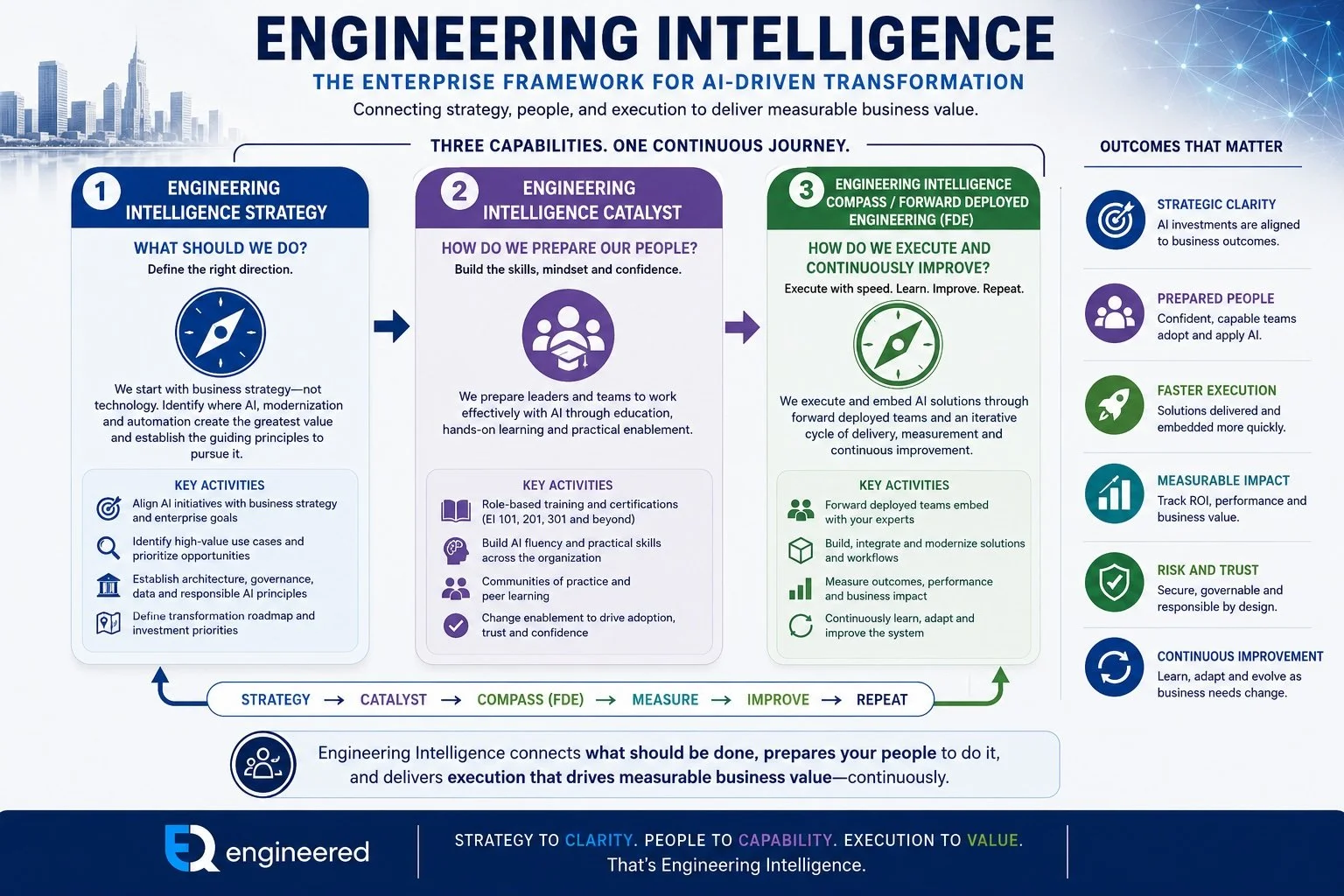
Engineering Intelligence: Moving Enterprise AI From Experimentation to Execution
The enterprise AI market is entering a new phase. For the past several years, much of the conversation has centered on models including which model is most capable, which platform enterprises should adopt, and how quickly organizations can experiment with generative AI. That conversation is changing.
The recent acquisition of Casper Studios by Ode, the enterprise AI company backed by Anthropic, Blackstone and Hellman & Friedman, provides another signal of where the market is heading. AI leaders increasingly recognize that access to powerful models is not enough. Enterprises need experienced practitioners who can translate those capabilities into production systems, operational workflows and measurable business outcomes. Those outcomes depend on adoption, and adoption depends on whether the people doing the work can understand, trust and act on what the system produces.
At EQengineered, we believe this represents an even larger shift: AI is moving from a technology initiative to an enterprise engineering capability. We call that Engineering Intelligence.
Beyond AI Implementation
Forward Deployed Engineering is rapidly emerging as an important model for enterprise AI adoption. Senior engineers work directly alongside business and technology teams to identify opportunities, integrate AI into existing systems and rapidly build solutions. This is an important evolution, and one that we have adopted at EQengineered. However, implementation alone does not solve the broader enterprise challenge.
Organizations still need to determine where AI should be applied, which processes should change, how applications and data architectures must evolve, what governance is required, how people will actually work alongside these systems, how engineering teams should work differently, and how results will be measured. Engineering Intelligence addresses this broader challenge.
EQengineered's Engineering Intelligence Framework connects three critical capabilities:
1. EI Strategy: What Should We Do?
We begin with business strategy rather than technology. Leaders identify where AI, modernization and automation can create meaningful enterprise value and establish the organizational, architectural, data and governance principles necessary to pursue it. Value is identified not only in financial models but in observed work. Some of the most valuable AI opportunities are visible in the friction, repetitive processes and workarounds people have already created for themselves.
EI Strategy establishes the direction, identifies and prioritizes high-value opportunities, and creates the transformation roadmap that connects AI investment to enterprise objectives.
2. EI Catalyst: How Do We Prepare Our People?
Strategy only creates value when an organization has the capability and confidence to execute it. EI Catalyst prepares leaders, engineers and business teams to work effectively with AI through education, hands-on learning, role-based enablement and practical application.
Technical readiness and human readiness are different questions. An AI system can be architecturally sound and still fail if the people it serves do not understand how to use it, cannot interpret its output or do not trust when and how to intervene. EI Catalyst builds the AI fluency, skills, operating practices and organizational readiness required to turn technology adoption into sustainable enterprise capability.
3. EI Compass l Forward Deployed Engineering: How Do We Execute and Continuously Improve?
EI Compass turns strategy and organizational readiness into execution. We assess applications, architecture, data, engineering workflows, AI readiness and user workflows to determine how prioritized opportunities should be engineered and integrated into the enterprise.
Through Forward Deployed Engineering, senior engineers, architects, designers, data practitioners and strategists work directly with enterprise teams to build solutions, modernize systems and embed AI into real workflows. Embedding matters because real workflows are rarely documented perfectly. Seeing the work as it is actually performed helps create systems that fit the enterprise rather than systems the enterprise must work around.
Execution is also iterative. Outcomes are measured, lessons are incorporated and solutions continuously improve as technology, business requirements and user needs evolve.
EI Strategy → EI Catalyst → EI Compass l Forward Deployed Engineering
What should we do? → How do we prepare our people? → How do we execute and continuously improve?
The result is a continuous cycle: Strategy → Assessment → Roadmap → Engineering → Adoption → Measurement → Improvement.
AI Should Improve the Engineering System
Engineering Intelligence also changes how software itself is created. AI can accelerate requirements development, architecture, software development, testing, documentation and deployment. Yet, isolated adoption of AI coding tools does not create an AI-enabled enterprise.
Organizations need repeatable engineering standards, human review, requirements traceability, secure development controls, testing discipline and measurable outcomes. They also need systems designed around the people expected to use them, with clear opportunities for human judgment, intervention and accountability.
The objective is not simply to make individual developers faster. It is to make the entire engineering system more intelligent. Intelligence at the system level means technology, process and people improving together, rather than automation being introduced in isolation.
From Experimentation to Enterprise Capability
The emerging AI services market validates an important idea, namely that enterprises will need sophisticated engineering partners even as AI models become dramatically more capable. The leaders will not simply provide more AI engineers; they will combine strategic consulting, enterprise architecture, software and data modernization, human-centered design, AI-enabled engineering practices, organizational adoption and Forward Deployed Engineering into a repeatable system for transformation.
This is the opportunity that EQengineered’s Engineering Intelligence is designed to address. The next generation of digital consulting will not be defined by how many people a firm can deploy or even which AI model it prefers. Success will be defined by how effectively an organization can connect enterprise strategy to engineering execution, engineering execution to adoption, and adoption to measurable business value.
That is Engineering Intelligence.