
Forward Deployed Engineering Isn’t Enough: The Enterprise Needs an AI Operating Model by Mark Hewitt
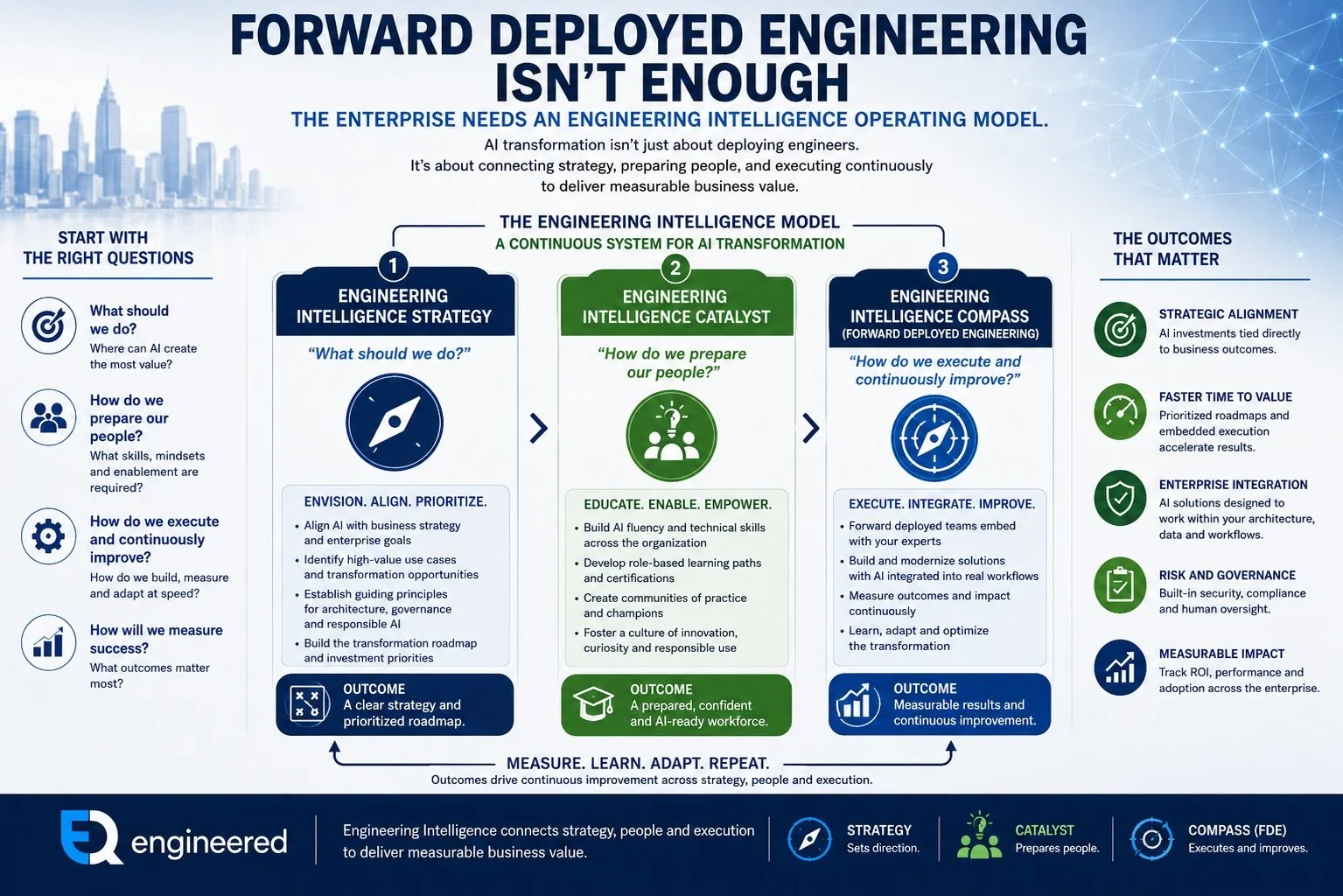
Forward Deployed Engineering is having a moment. Across the enterprise AI market, technology companies, consultancies and investors are embracing a model pioneered by firms such as Palantir that puts highly capable engineers directly alongside customers, giving them access to powerful AI technologies, and empowering them to rapidly solve real business problems.
The appeal is understandable. Enterprises have spent several years experimenting with generative AI, launching proofs-of-concept and providing employees with increasingly sophisticated tools. Now executives want results. They want AI embedded into workflows, applications and business processes. Forward Deployed Engineers can help close that gap, but there is one problem: Forward Deployed Engineering is an execution model. It is not an enterprise AI strategy.
The Last Mile Is Not the Entire Journey
The emerging enthusiasm around Forward Deployed Engineering reflects an important realization, namely that AI models are becoming increasingly accessible. The competitive advantage is shifting toward an organization's ability to apply those models to real business problems which makes engineering critically important. However, putting talented engineers inside an enterprise does not automatically answer the questions that determine whether AI transformation succeeds.
Strategic enterprise questions that need to be addressed include:
Which business problems should receive investment first?
Which applications should be modernized rather than augmented?
Is the underlying data architecture capable of supporting the desired AI use cases?
How should AI systems interact with existing enterprise applications?
What governance standards should apply?
How will security, privacy and human oversight be managed?
How should software development itself change?
What outcomes will determine whether the investment is succeeding?
These are not simply engineering questions. They have enterprise impact. Without a broader operating model, Forward Deployed Engineering risks creating a new generation of highly sophisticated AI point solutions. Individual projects may succeed while the enterprise itself remains fragmented.
From AI Strategy to Engineering Intelligence
At EQengineered, we believe organizations need a connective layer between enterprise AI strategy and Forward Deployed Engineering. We call that layer Engineering Intelligence. Engineering Intelligence establishes a repeatable system for determining where AI creates value, how the enterprise must evolve to support it, and how strategy becomes engineered execution.
The model begins with EI Strategy, where business strategy, modernization priorities and AI opportunities are considered together. The objective is not to create another collection of AI use cases. It is to determine where technology can materially change enterprise performance and establish the architectural, organizational and governance principles required to make that change sustainable.
From there, EI Catalyst turns strategic intent into an actionable engineering roadmap and focuses on training the enterprise. Applications, architecture, data, engineering workflows, AI readiness and organizational capabilities are assessed together. Opportunities can then be prioritized based on business value, feasibility, risk and enterprise impact.
Only then does EI Compass - Forward Deployed Engineering - become the execution engine. Senior engineers, architects, data practitioners and strategists work directly with enterprise teams to build solutions, modernize systems, integrate AI into workflows and create production-ready capabilities. The distinction matters as Engineering Intelligence Strategy determines where to go, Engineering Intelligence Catalyst determines how the enterprise gets there, and Enterprise Intelligence - Forward Deployed Engineering - accelerates execution.
AI Must Change the Engineering System
There is another reason enterprises need a broader operating model.. AI is increasingly changing how engineering itself is performed, and not simply something engineering teams build. Requirements can be developed with AI assistance, architecture can be modeled and evaluated differently, developers can work alongside coding agents, testing can become increasingly automated and intelligent, and documentation, code review, security analysis and deployment can all be augmented.
Organizations therefore need to think beyond AI applications and examine the entire software delivery lifecycle. The goal should not simply be faster developers. It should be a more intelligent engineering system. This new AI-enabled software development life cycle requires standards, governance, traceability, human review, architectural discipline and measurement. The automated SDLC also requires organizational adoption. An enterprise cannot achieve Engineering Intelligence through technology alone.
The Next Competitive Advantage
The rapid growth of Forward Deployed Engineering (FDE) is a positive development for enterprise AI as it signals that the market is moving beyond experimentation toward implementation and measurable outcomes. The next question is whether enterprises will treat FDE as another technology delivery mechanism or incorporate it into a broader transformation model.
We believe the organizations that create sustainable advantage will connect three capabilities:
Engineering Intelligence Strategy → Engineering Intelligence Catalyst → Engineering Intelligence Compass/Forward Deployed Engineering
1. EI Strategy answers "What should we do?"
2. EI Catalyst answers "How do we prepare our people?"
3. EI Compass (FDE) answers "How do we execute and continuously improve?"
Continuously improving and measuring results are critical to the enterprise operating model and success. The success of enterprise AI will be evidenced by the organizations that can systematically connect enterprise strategy to engineering execution, and engineering execution to measurable business value.
Forward Deployed Engineering is an important part of that future, but in and of itself, it just isn't enough.