
CEO Corner: The Modernization Shortcut That Isn’t: Why Black-Box AI Falls Short by Mark Hewitt
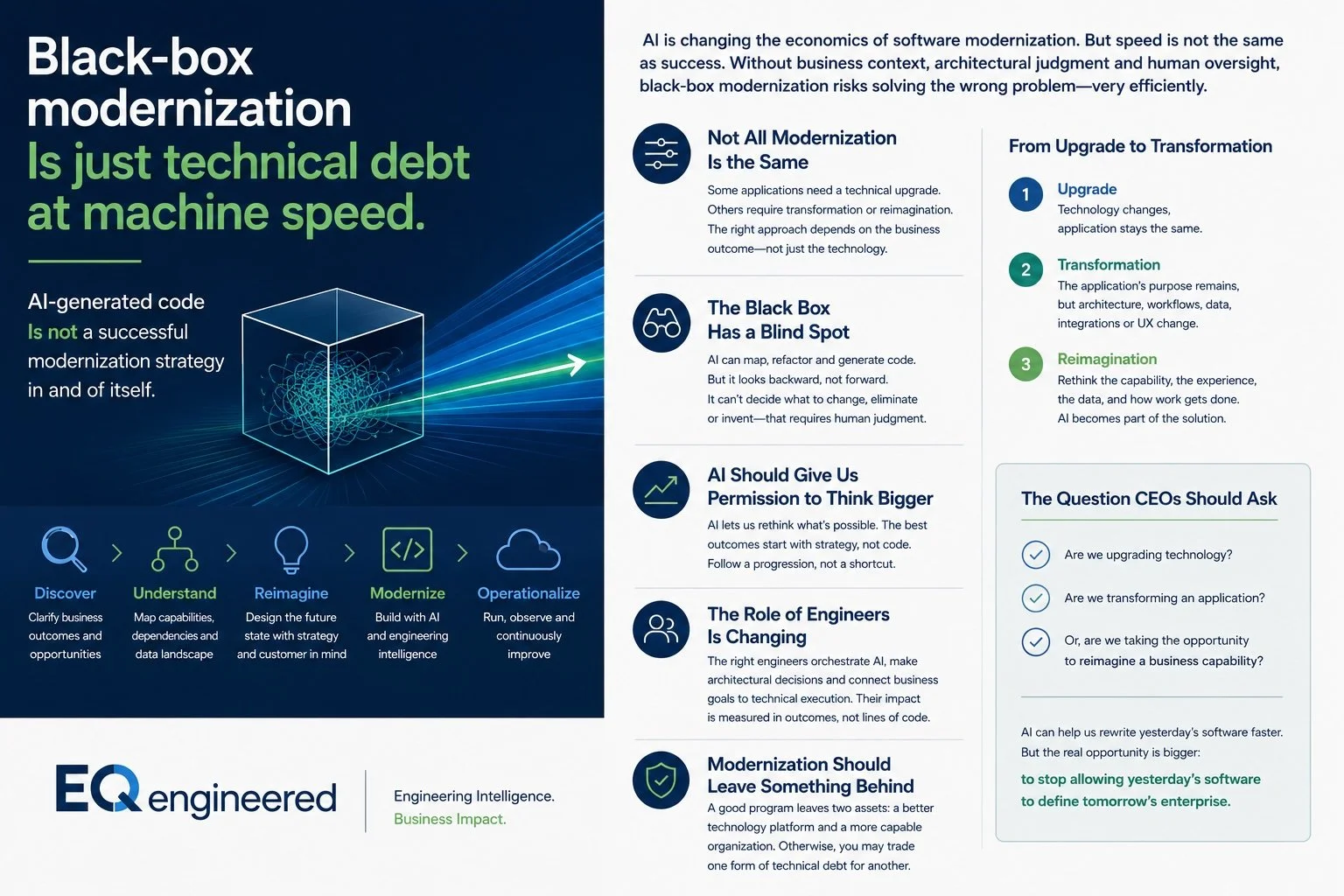
Black-box modernization Is just technical debt at machine speed.AI-generated code Is not a successful modernization strategy in and of itself.
It is certainly a fact that AI is changing the economics of software modernization faster than most enterprises expected. Work that once required large engineering teams and multi-year programs can increasingly be accelerated by AI agents capable of analyzing codebases, documenting dependencies, generating code, executing tests and resolving defects. That is real progress and CEOs should be paying attention.
But as AI makes modernization faster, it is also creating a potentially dangerous shortcut in how we think about the problem. A new generation of platforms effectively promises to put legacy applications into an AI-powered factory and produce modern applications on the other side is not a sound strategy.
For some applications, that may be exactly the right answer. For others, it risks solving the wrong problem very efficiently. The distinction comes down to a simple question: Are you trying to modernize the technology, or are you trying to modernize the enterprise?
Not All Modernization Is the Same
Consider an application running on an older version of Java or .NET. The business processes are sound, users are satisfied, and the architecture is appropriate. The organization simply needs to eliminate technical debt and move onto a supported technology stack. That is fundamentally a technical modernization.
AI should be very good at driving efficiency in this case. The existing application provides a blueprint, automated tests establish expected behavior, and agents can perform much of the repetitive engineering work. I expect these projects to become faster and less expensive as the technology matures.
However, many enterprise modernization programs aren't that clean. A system built ten or fifteen+ years ago reflects decisions made for the right reasons at the time. It reflects the customer expectations, business processes, organizational structure, integration patterns, data environment and technical limitations of that period. The question isn't always how to recreate that system using modern technology, but rather, If we were building this capability today, would we build it this way at all? That changes the conversation.
From Upgrade to Transformation
Enterprises need to distinguish among three kinds of modernization.
The first is an upgrade. The technology changes, but the application essentially remains the same.
The second is a transformation. The application still serves the right business purpose, but architecture, integrations, workflows, data or user experience need meaningful change.
The third is a reimagination. The existing system may provide useful context, but it should not define the future state. The organization has an opportunity to rethink how customers interact with it, how employees work, how data moves across the enterprise and how AI itself becomes part of the application.
AI can play an important role in all three scenarios, and the amount of human judgment required increases dramatically as you move from upgrade to reimagination. This is where the emerging "black box" approach to modernization needs to be challenged.
The Black Box Has a Blind Spot
An AI system can become remarkably good at understanding what exists. It can map a codebase, document dependencies, understand interfaces, identify patterns and generate enormous quantities of new code. It can compare the resulting application's behavior against thousands of tests. These types of capabilities are valuable, but they are primarily looking backward. The codebase tells us what the enterprise built, the tests tell us how it is supposed to behave, and the interfaces tell us how systems currently communicate. None of this necessarily tells us what the enterprise should become.
A successful modernization may require us to change the customer experience rather than reproduce it. It may eliminate a business process rather than automate it. It may also consolidate an architecture rather than translate its components. It may even expose data that previously lived inside organizational silos. And, a successful modernization may fundamentally change how employees work.
If technical equivalence becomes the primary measure of success, we can easily end up with something that passes every test while missing the larger opportunity resulting in modernizing the code without modernizing much of anything else.
AI Should Give Us Permission to Think Bigger
AI's capabilities are not limited to completing the in-place modernizations enterprises have postponed for years. They give us an opportunity to rethink applications and enterprise architectures without being as constrained by the cost of changing them. Instead of asking, "How quickly can we replace this legacy application?" leadership can ask, "What should this capability look like if we invented it today?" This approach brings business strategy, architecture, product thinking, design, organizational change and engineering into the conversation before agents start generating code. The process becomes less like a factory and more like a progression:
Discover. Understand. Reimagine. Modernize. Operationalize.
AI can accelerate every stage. It should not eliminate them.
The Role of Engineers Is Changing Too
There is another misconception embedded in the black-box narrative: that increasingly capable agents reduce the importance of engineers. I think they increase the importance of the right engineers. The emerging Forward Deployed Engineer is a good example. These are senior technical people working directly with the enterprise who can understand business context, make architectural decisions, orchestrate AI agents and translate between executive objectives and technical execution. Their value isn't measured by how much code they personally produce, but rather by the quality of the decisions they help the organization make and how effectively they direct AI toward those outcomes.
The same applies to agent orchestration. I am less interested in whether a platform can deploy hundreds or thousands of agents than whether it can deploy the right intelligence against the right problem at the right cost, with appropriate human oversight. Agent count is not a business outcome.
Modernization Should Leave Something Behind
The final issue CEOs should consider when evaluating AI modernization approaches is, "when the project is finished, what has changed inside your organization? If you receive modernized software but your engineering organization has learned nothing about AI-assisted development, agent orchestration, governance, observability or new delivery practices, you may simply have exchanged one form of technical debt for another form of dependency. A good modernization program should leave behind two assets: a better technology platform and a more capable organization. That is increasingly important because this will not be the last modernization cycle. The pace of technology change makes that almost certain.
The Question CEOs Should Ask
There will absolutely be a market for highly automated, AI-driven modernization. For well-understood technical upgrades with clearly defined outcomes, the economics may become compelling. However, CEOs should classify the problem before selecting the solution. Key questions to contemplate are:
Are we upgrading technology?
Are we transforming an application?
Or, are we taking the opportunity to reimagine a business capability?
If the answer is the first, putting much of the work into an AI modernization engine may make perfect sense. If it is the second or third, I would be considerably more cautious because the greatest opportunity presented by AI isn't simply the ability to rewrite yesterday's software faster. The opportunity is to stop allowing yesterday's software to define tomorrow's enterprise.