
The Energy Cost of AI: Balancing Compute Power and Sustainability by Mark Hewitt
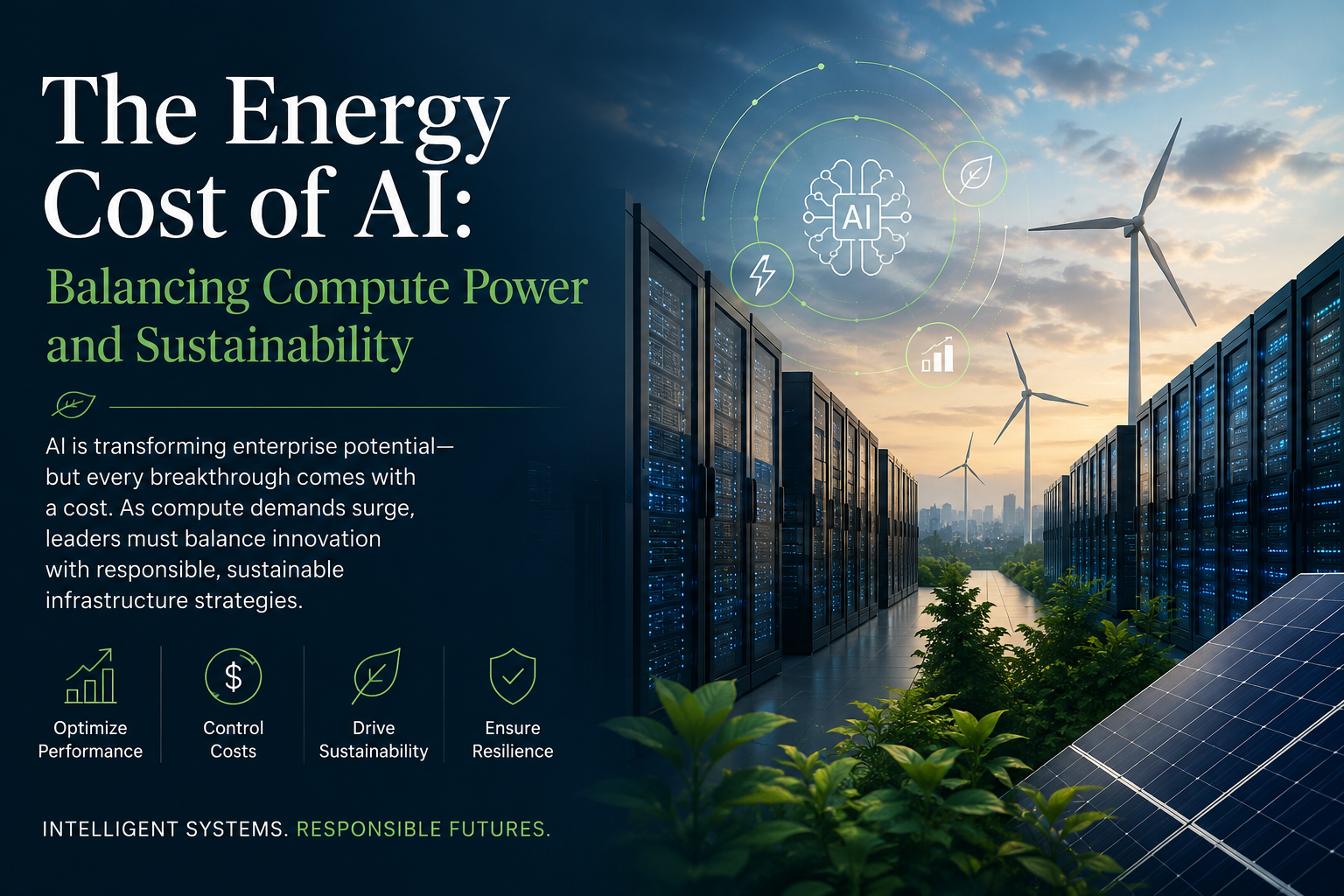
Artificial intelligence is rapidly becoming one of the most transformative technologies in modern enterprise history. Yet beneath the excitement surrounding generative AI, autonomous systems, and intelligent automation lies a growing operational challenge that many organizations are only beginning to recognize: the energy cost of compute.
Training and operating large-scale AI systems requires extraordinary computational power. Data centers supporting AI workloads consume significant electricity, demand advanced cooling systems, and increasingly place pressure on energy infrastructure. As enterprises accelerate AI adoption, executives must begin viewing compute not simply as a technical resource, but as a strategic operational and financial consideration.
For many organizations, the first wave of AI adoption focused primarily on experimentation and capability development. The next wave will center on efficiency, governance, and sustainability. Enterprises that fail to account for the infrastructure implications of AI may face rising operational costs, capacity constraints, and increasing scrutiny from regulators, investors, and customers focused on environmental responsibility.
This challenge becomes even more complex as organizations deploy larger foundation models, increase inference workloads, and expand AI usage across departments. The assumption that more compute automatically produces more business value is beginning to face legitimate economic and operational questions. At scale, inefficient AI architectures can create significant financial drag while delivering diminishing returns.
As a result, forward-looking enterprises are beginning to rethink how AI systems are designed and deployed. Smaller domain-specific models, hybrid cloud architectures, localized inference, and edge computing strategies are emerging as practical approaches to reducing both latency and energy consumption. Organizations are increasingly evaluating whether every AI task truly requires hyperscale compute resources.
This shift mirrors broader patterns seen throughout technology evolution. Early adoption phases often prioritize speed and capability. Mature operating models prioritize optimization, resilience, and sustainability. AI will likely follow the same trajectory.
Leadership teams should also recognize that sustainability is not separate from performance. Efficient systems often become more resilient, more cost predictable, and easier to operationalize. The enterprises that successfully balance innovation with operational discipline may ultimately outperform organizations pursuing AI expansion without strategic infrastructure planning.
The future of enterprise AI will not be defined solely by model size or computational scale. It will be defined by how intelligently organizations align compute investments with business outcomes, governance requirements, operational resilience, and long-term sustainability goals.
The conversation around AI is evolving. It is no longer only about what AI can do. Increasingly, it is about what it costs to operate responsibly at scale.