
EQengineered's Engineering Intelligence Framework Part II by Mark Hewitt
The EQengineered Engineering Intelligence Framework helps enterprises capture, structure, validate, and reuse engineering knowledge across modernization programs. It transforms fragmented legacy code, system artifacts, documentation, and institutional knowledge into persistent engineering intelligence that can be used throughout the software lifecycle.
The framework is designed to preserve institutional knowledge, clarify legacy system behavior, reduce modernization ambiguity, and improve confidence in AI-enabled software engineering. It helps teams uncover the business logic, dependencies, workflows, and system relationships that drive critical enterprise operations.
Unlike transactional AI coding tools, the EQengineered framework focuses on persistent contextual understanding, validated experimentation, and operational repeatability. It separates functional intent from historical technical implementation, giving business and technology stakeholders a clearer view of what a system does, why it matters, and where modernization opportunities exist.
The framework produces validated current-state specifications, including process flows, technical summaries, dependency mappings, and architectural views. These outputs establish a shared understanding of the existing environment before modernization begins.
By creating a persistent, human-validated engineering knowledge layer, EQengineered enables enterprises to reduce delivery uncertainty, accelerate transformation planning, and build repeatable modernization patterns that improve delivery confidence and long-term engineering continuity.
The core blocks of the framework are shown and described below:
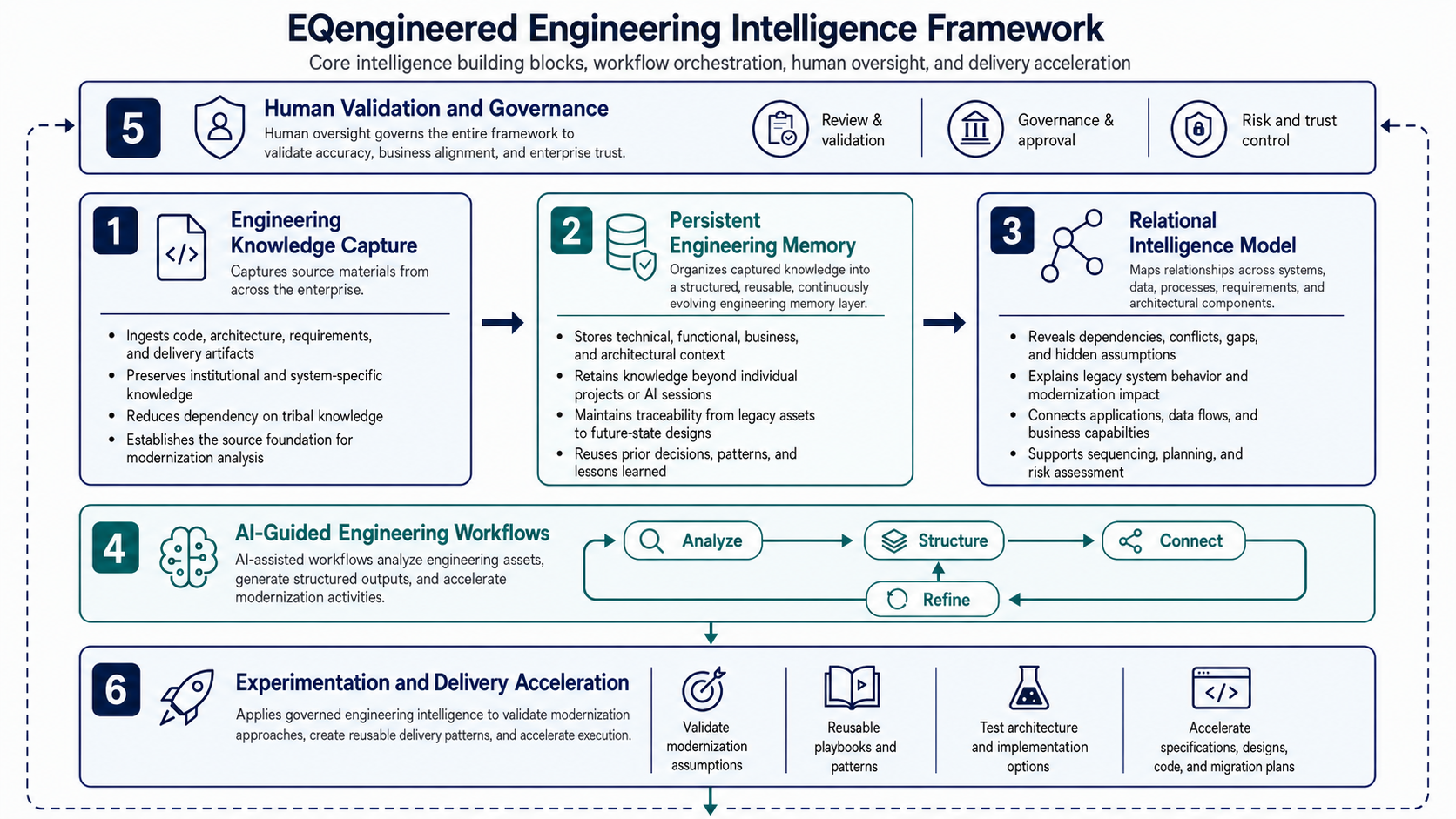
1. Engineering Knowledge Capture
Captures source materials from across the enterprise, including code, architecture documents, requirements, business rules, interviews, runbooks, and delivery artifacts.
Core functions
Ingest code, architecture, requirements, documentation, and delivery artifacts
Preserve institutional and system-specific knowledge
Reduce dependency on tribal knowledge
Establish the source foundation for modernization analysis
2. Persistent Engineering Memory
Organizes captured knowledge into a structured, reusable, and continuously evolving engineering memory layer.
Core functions
Store technical, functional, business, and architectural context
Retain knowledge beyond individual projects or AI sessions
Maintain traceability from legacy assets to future-state designs
Reuse prior decisions, patterns, and lessons learned
3. Relational Intelligence Model
Maps relationships across applications, data, processes, requirements, dependencies, and architectural components.
Core functions
Reveal dependencies, conflicts, gaps, and hidden assumptions
Explain legacy system behavior and modernization impact
Connect applications, data flows, and business capabilities
Support sequencing, planning, and risk assessment
4. AI-Guided Engineering Workflows
Operates across the first three building blocks to analyze, structure, connect, and refine engineering knowledge.
Core functions
Analyze engineering assets
Structure raw knowledge into usable outputs
Connect related systems, requirements, data, and architecture
Refine outputs through iterative learning and validation
5. Human Validation and Governance
Ensures AI-generated insights and outputs are reviewed, refined, and approved by qualified enterprise stakeholders.
Core functions
Keeps humans in control of critical engineering decisions
Validates accuracy, completeness, and business alignment
Reduces enterprise risk and executive resistance
Provides governance over AI-assisted modernization outputs
6. Experimentation and Delivery Acceleration
Applies validated modernization playbooks, engineering patterns, and outcome-oriented experiments to improve delivery speed and confidence.
Core functions
Validate modernization assumptions through controlled experiments
Convert insights into reusable delivery playbooks and engineering patterns
Test architecture and implementation options before full-scale execution
Reduce delivery risk through evidence-based modernization decisions
Accelerate production of specifications, designs, code, and migration plans
Key Differentiators
1. Persistent Intelligence
Most AI tools operate within a single session or task. The EQengineered Engineering Intelligence Framework retains engineering context over time, creating a persistent memory of systems, decisions, dependencies, requirements, and modernization patterns.
This allows enterprises to build on prior knowledge instead of repeatedly rediscovering the same legacy context.
2. Human-Governed AI Engineering
The framework is AI-assisted, human-validated, and enterprise-governed. It keeps qualified experts in control of critical engineering decisions while using AI to accelerate analysis, structuring, and delivery preparation.
This improves trust, reduces executive resistance, and supports adoption in complex enterprise environments.
3. Reusable Modernization Memory
The framework creates reusable modernization intelligence that can be applied across programs, teams, and future initiatives which enables:
Institutional engineering continuity
Reusable modernization knowledge
Repeatable transformation playbooks
Traceability from legacy assets to future-state designs
4. Experimentation and Delivery Acceleration
Using reusable playbooks and outcome-oriented engineering patterns, the framework helps enterprises test assumptions, reduce modernization risk, and accelerate delivery of specifications, designs, code, and migration plans.
Category Positioning
EQengineered’s Engineering Intelligence Framework transforms fragmented legacy knowledge into reusable engineering intelligence that accelerates modernization, improves delivery certainty, and enables scalable human-governed AI engineering.
The market does not need another “AI coding accelerator.” Enterprises need durable engineering context, legacy understanding, governance, repeatability, and confidence in modernization execution.
Part I of the EQengineered Engineering Intelligence Framework Series is located here.