EQengineered's Engineering Intelligence Framework Part I by Mark Hewitt
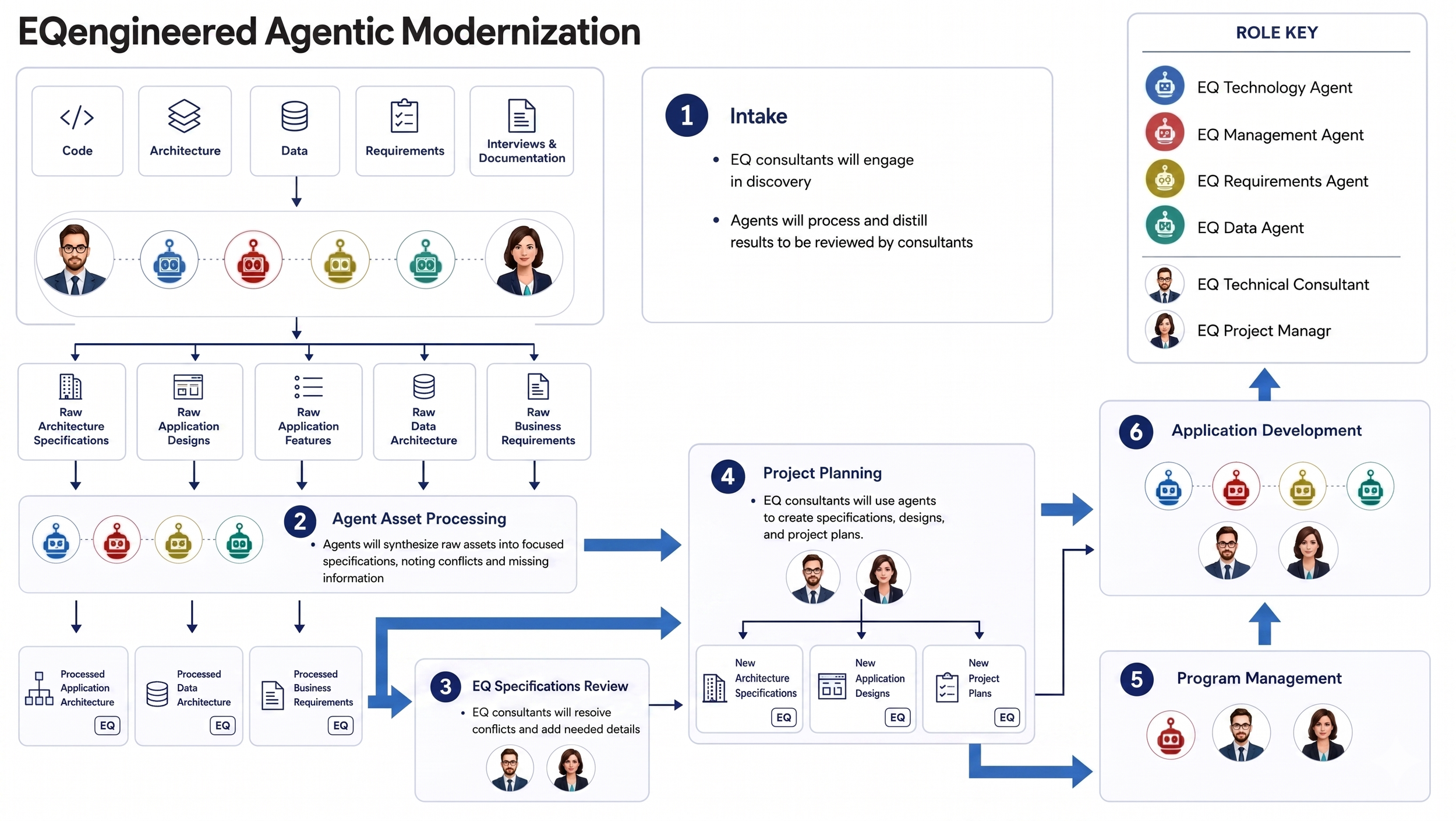
The Engineering Intelligence Framework is not just an automated tool; it’s built around the principle of human-in-the-loop governance. While AI agents accelerate analysis and insight, the final decisions, whether in understanding legacy complexities or defining greenfield requirements, are validated by human expertise. Furthermore, security and compliance are paramount. The framework ensures that all legacy data and knowledge artifacts are handled with enterprise-grade security, ensuring data integrity and compliance with regulatory frameworks. In this way, enterprises gain not only speed and clarity but trust and control.
1. Why did EQengineered develop the Engineering Intelligence Framework?
Legacy Systems: We saw enterprises struggling to modernize while preserving institutional knowledge. We created the framework to decode legacy complexity and retain insights.
EQengineered developed the Engineering Intelligence Framework to address the dual challenges of legacy modernization and future-proofing new systems. For legacy environments, it was born out of the need to decode deeply entrenched systems, often entangled with decades of technical debt, while preserving institutional knowledge.
Greenfield: We developed it to ensure that from day one of a new project, business intent is captured and translated into clear, lasting technical foundations.
In greenfield environments, the challenge isn’t technical debt, it’s ambiguity. When building something entirely new, organizations often struggle to translate broad business goals into concrete, validated technical requirements. EQengineered’s framework ensures clarity from the start. It captures business logic early, building a relational intelligence framework that maps these requirements into architectural structures. This reduces the risk of costly rework down the line. With the framework, business intent is continuously aligned with development, accelerating delivery and ensuring future changes can be built on a solid foundation.
2. What challenges do enterprises face in these scenarios?
Legacy Systems: They face hidden dependencies, outdated logic, and incomplete documentation, making modernization risky and slow.
In legacy environments, enterprises encounter a web of challenges that accumulate over time. First, there is deeply embedded technical debt, often spanning decades, which obscures the original business intent. Documentation is usually outdated, and the system’s functional logic is entangled with workarounds or obsolete dependencies. Moreover, legacy systems often lack a clear map of interdependencies across modules, making any change risky. Businesses also struggle to fully understand what the system currently does, which delays modernization efforts and increases operational risk. By addressing these complexities, the Engineering Intelligence Framework reveals the core business logic, so enterprises can modernize confidently, grounded in clarity.
Greenfield: They struggle to translate broad business goals into well-defined, validated requirements upfront.
In greenfield scenarios, the framework ensures that business goals are not lost in translation. From the outset, it captures detailed requirements, mapping them into a relational structure. The framework acts as a living knowledge layer, ensuring alignment between business intent and architecture. This reduces ambiguity and rework, accelerating development cycles. Moreover, it provides a foundation for future evolution by maintaining a structured repository of decisions and logic, the framework ensures that as the business grows, its engineering intelligence is preserved and leveraged, leading to faster, more aligned innovation over time.
3. How does the framework accelerate results?
Legacy Systems: It creates a persistent knowledge graph, clarifying what systems do, so modernization is confident and efficient.
In legacy environments, accelerating modernization requires overcoming complexity and uncertainty. The Engineering Intelligence Framework is pivotal here. First, it ingests the legacy codebase, building a comprehensive knowledge graph. This graph clarifies what the system does, disentangling dependencies and revealing hidden functionality. Once clarified, the framework generates detailed "as-is" specifications, outlining functional flows, technical summaries, and architectural views. This gives both business and technology teams clarity on the current state before any new code is written. By anchoring modernization in a precise understanding of legacy systems, the framework reduces risk, accelerates delivery, and ensures alignment from the past into the future.
Greenfield: It captures requirements early, mapping business needs to architecture, accelerating iteration and reducing rework.
In greenfield scenarios, the framework accelerates results by ensuring clarity and alignment from day one. When embarking on a new initiative, the framework captures business requirements in detail, translating them into a structured relational model. This model links business intent directly to architectural decisions, reducing ambiguity throughout the development process. By establishing this foundation early, it minimizes the risk of costly mid-project rework. Additionally, as the project evolves, the framework continues to track decisions and logic, creating a persistent knowledge layer. This ensures not only faster initial delivery but also future scalability, as teams can build on a well-defined and validated foundation.
4. What outcomes do enterprises gain?
Legacy Systems: Faster modernization, reduced risk, and lasting alignment between business and tech.
In legacy contexts, enterprises gain transformative outcomes by leveraging the Engineering Intelligence Framework. First, modernization efforts are faster because the harness removes uncertainty, enabling teams to confidently act on clear specifications. Second, they reduce the risk associated with legacy systems by understanding what the system does before touching code, enterprises avoid costly errors. Third, the framework creates lasting alignment between business and technology by transforming legacy complexity into understandable, repeatable patterns. Ultimately, enterprises gain clarity, speed, and a knowledge foundation that supports ongoing modernization efforts.
Greenfield: Faster time-to-market, traceable business-technical alignment, and a structured framework for future growth.
In greenfield projects, enterprises achieve faster time-to-market because the framework captures and aligns requirements early on, avoiding costly rework. They gain traceable alignment between business intent and the final product, ensuring that the delivered solution reflects the initial goals. Additionally, the framework provides a structured framework that supports future growth, as all decisions and logic are retained. Thus, enterprises gain not just a solution but a scalable, validated foundation that allows them to innovate rapidly and with confidence.
Take Aways
The Engineering Intelligence Framework is more than a modernization tool; it’s a strategic framework for building lasting engineering intelligence. By blending human oversight with AI acceleration, it empowers enterprises to confidently navigate both legacy and greenfield challenges. As organizations evolve, the framework provides the clarity, security, and alignment needed to transform complexity into opportunity. With a focus on both innovation and governance, EQengineered stands ready to help enterprises build resilient, future-proof systems.
Part II of the EQengineered Engineering Intelligence Framework Series is located here.