
Beyond the Curve: Reassessing the Analytics Maturity Curve for the GenAI Era by Ranjan Bhattacharya
Why the Analytics Maturity Model Still Matters
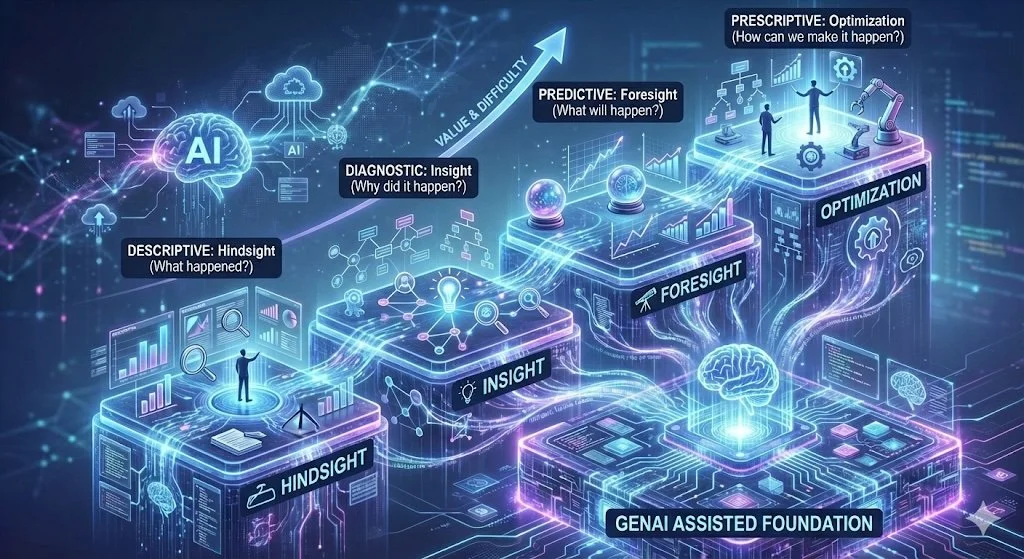
For over two decades, the analytics maturity model has served as the practical framework for organizations to structure their progression from basic reporting to advanced decision support. Popularized by industry analysts, it guided investments in talent and data platforms by defining a clear, linear path toward sophistication.
The rapid emergence of Generative AI, particularly large language models, has prompted a reassessment of this framework. Capabilities such as natural language interaction with data, automated insight generation, and reasoning across diverse information sources have led to questions around the relevance of this view of the analytics maturity journey.
This article argues that the analytics maturity model remains relevant, but its role has evolved. While disciplined data practices remain essential, Generative AI allows organizations to capture value much earlier in the journey and lower the barrier to sophisticated insights through natural language interaction. It also enables analytics teams to conduct rapid experimentations to develop advanced analytics capabilities. With the help of Generative AI assisted tools, organizations can now unlock meaningful benefits earlier, and operate with unprecedented agility.
The Traditional Analytics Maturity Journey
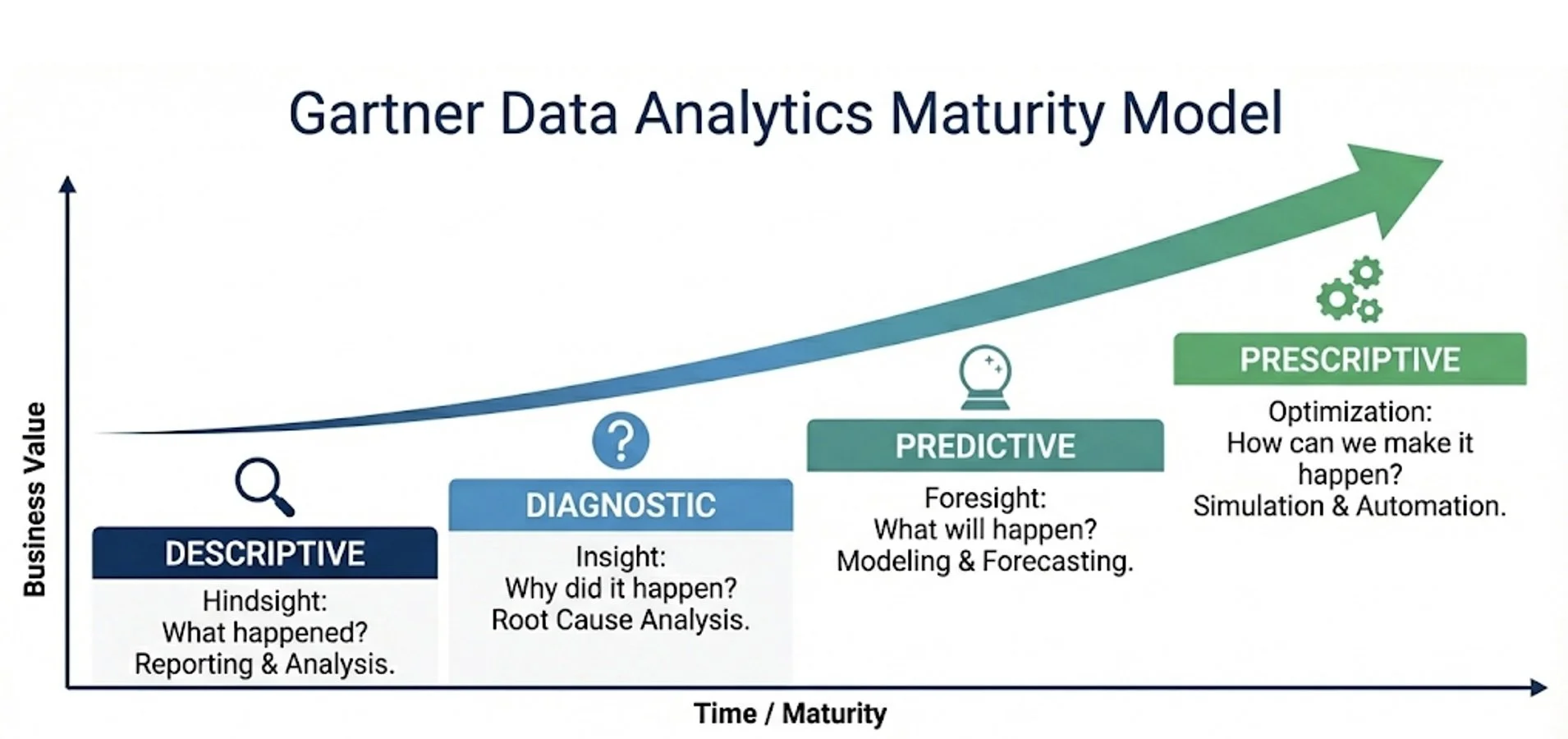
The analytics maturity model emerged to describe how organizations typically develop analytical capabilities over time. While variations exist, most formulations converge on a common progression that reflects increasing sophistication in how data is used to support decision-making.
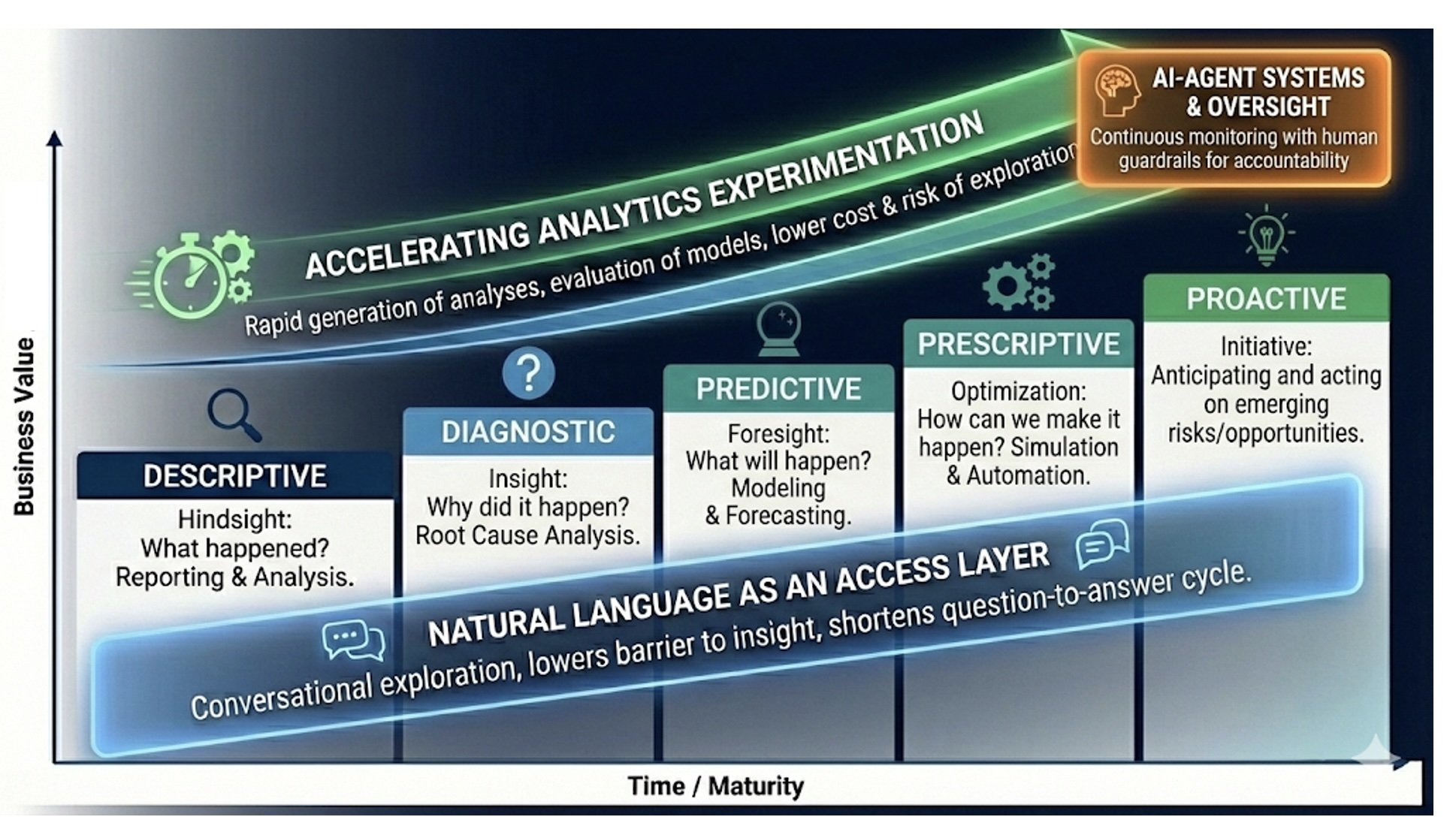
At its core, the model consists of four stages:
Descriptive analytics focuses on understanding what has happened by summarizing historical data through reports and dashboards.
Diagnostic analytics builds on this foundation by examining why certain outcomes occurred, often through deeper analysis and correlation across multiple data sources.
Predictive analytics looks ahead, using statistical and machine learning techniques to forecast future outcomes based on historical patterns.
Prescriptive analytics attempts to close the loop by recommending actions likely to produce desired results.
Historically, organizations moved through these stages sequentially. Each step required additional investments in data infrastructure, analytical tools, and specialized skills. Descriptive and diagnostic analytics were often supported by business intelligence platforms and centralized data warehouses, while predictive and prescriptive analytics depended on statistical machine learning algorithms and dedicated data science teams. As a result, later stages of maturity were typically accessible only to organizations with significant scale and resources.
This sequential progression shaped how analytics programs were planned and funded. Maturity was treated as a prerequisite for value. Organizations were expected to establish stable pipelines, consistent metrics, and governance frameworks before attempting more advanced analytics. While this approach reduced risk, it also increased time to value and limited experimentation, leaving many organizations stalled at earlier stages.
How Generative AI Augments Traditional Analytics
The traditional analytics maturity model assumes that organizations need a comprehensive set of capabilities before advanced analytics could deliver meaningful value. These assumptions reflect the realities of earlier tooling and the high cost of experimentation.
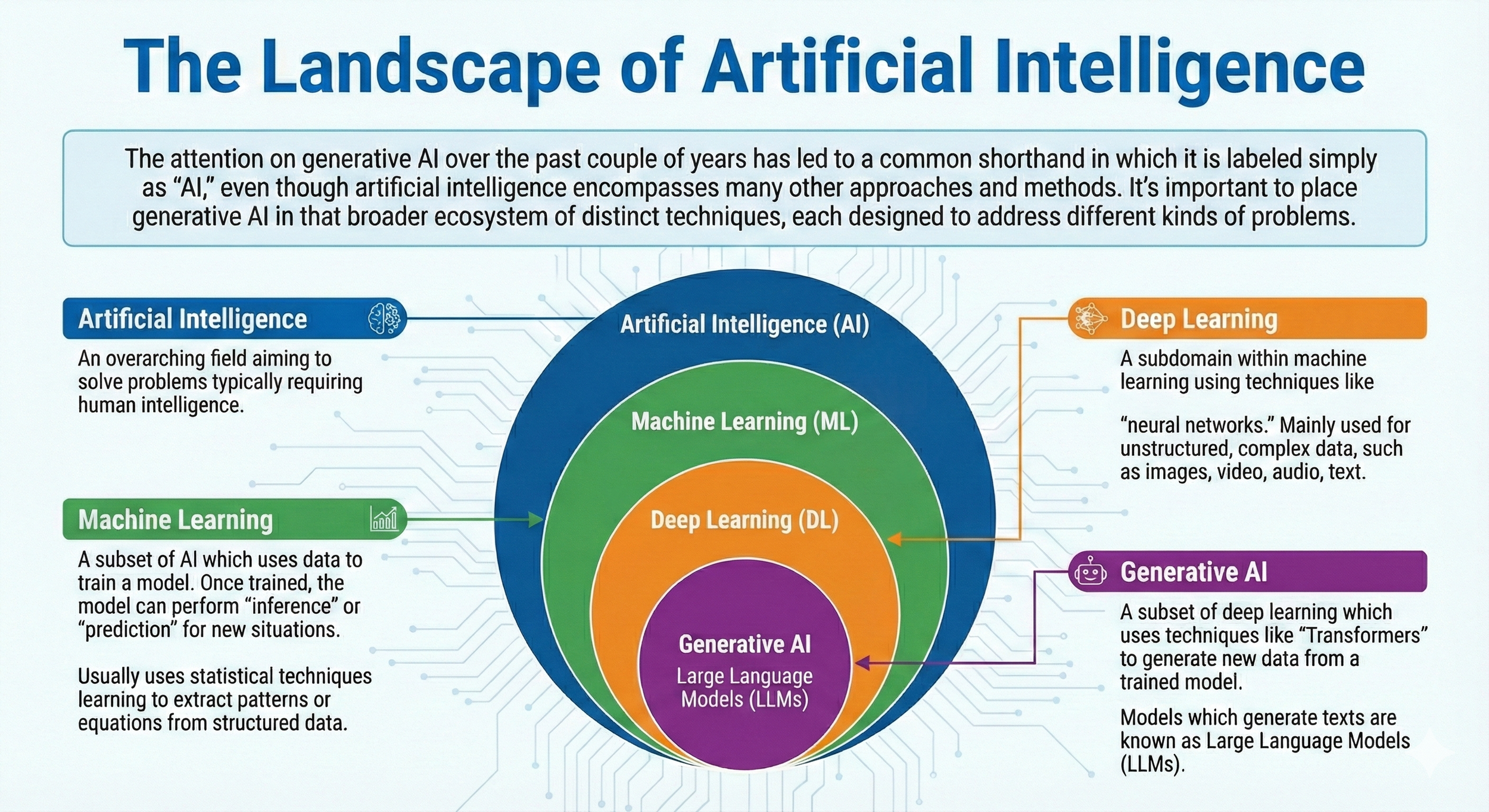
Generative AI changes this dynamic by reducing friction across the analytics lifecycle. Rather than replacing established analytical methods, it augments them in practical ways that allow organizations to extract insights earlier and learn faster.
Natural Language as an Access Layer
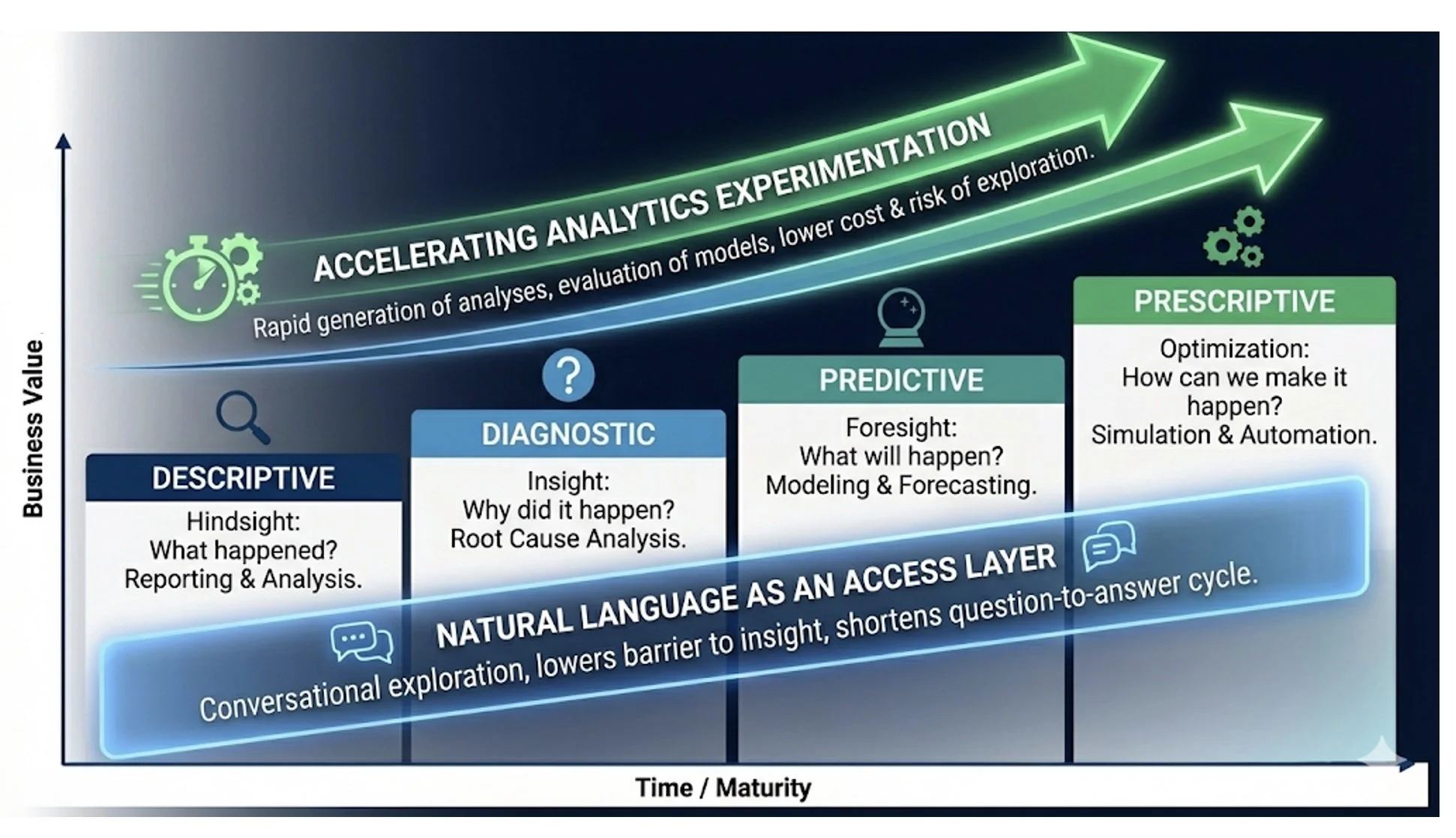
One of the most immediate augmentation capabilities of Generative AI is natural language interaction with data. Reports, dashboards, and analytical outputs no longer need to be accessed exclusively through predefined views or specialized query languages. Users can ask questions, request explanations, and explore trends conversationally.
This lowers the barrier to insight for business users and small data teams, reducing dependence on specialized skills and shortening the cycle between question and answer. As a result, organizations can make better use of existing data assets even when formal analytics processes are still maturing.
Accelerating Analytics Experimentation
Generative AI also changes how organizations experiment with analytics. Historically, exploring new analytical approaches required significant time and expertise, limiting experimentation to a small number of prioritized use cases. AI-assisted exploration allows teams to generate alternative analyses, evaluate modeling approaches, and compare outcomes more quickly.
This lowers the cost and risk of experimentation, enabling organizations to explore diagnostic and predictive techniques earlier in their maturity journey. Advanced analytics becomes a learning mechanism rather than a distant milestone.
Expanding Insight Through External Context
Traditional analytics programs often focus narrowly on internal data, which can limit perspective, particularly for organizations with limited historical depth. External signals such as market trends, benchmarks, news, weather patterns, and demographic data provide valuable context but have historically been difficult to integrate.
Generative AI makes it possible to reason across internal and external information without extensive data engineering. By synthesizing these sources, organizations can better contextualize performance, improve forecasting, and identify emerging risks or opportunities earlier.
A More Flexible View of Maturity
Taken together, these capabilities change how analytics maturity should be understood. Organizations can start exploring various analytical scenarios even before achieving maturity of earlier stages. Values can be realized incrementally through improved access, faster experimentation, and richer context, even as foundational capabilities continue to mature.
Extending the Journey: The Proactive Stage of Analytics
The traditional maturity model culminates in prescriptive analytics, where systems recommend actions based on predicted outcomes. While valuable, this stage remains largely reactive, relying on human initiation and interpretation.
Generative AI enables a further evolution toward a proactive stage of analytics. In this stage, systems continuously monitor data and surface insights as conditions change, rather than waiting for explicit queries. The emphasis shifts from responding to events to anticipating them.
From Recommendation to Initiative
Proactive analytics is defined by initiative. Systems identify emerging risks, opportunities, or deviations and bring them to attention at the moment they become relevant. This reduces decision latency and aligns analytics more closely with operational realities.
Agentic Systems with Human Oversight
Proactive analytics is enabled by agentic systems that operate within clearly defined objectives and guardrails. These systems coordinate analytical tasks, invoke models, and synthesize information across sources. Autonomy is bounded, with human-in-the-loop oversight ensuring accountability, governance, and trust.
Governance, Data Quality, and the Operating Model
While Generative AI accelerates analytics maturity, it does not change a fundamental requirement: analytical outputs are only as reliable as the data, definitions, and controls that support them. As access broadens and experimentation accelerates, weaknesses in data quality and governance become more visible and more consequential.
Governance extends beyond access control to include validation of analytical outcomes, model monitoring, and clearly defined escalation paths. As organizations move toward proactive analytics, governance must also define where initiative is permitted and when human review is required.
A data and analytics operating model provides the structure to sustain this balance. It clarifies ownership, defines decision rights, and establishes repeatable processes for quality management and evaluation. Generative AI can assist with documentation, anomaly detection, and policy-driven checks, but it cannot replace organizational clarity.
Conclusion
The analytics maturity model remains a useful way to describe how organizations develop analytical capabilities. What has changed is the pace and accessibility of the journey. Generative AI reduces friction across analytics workflows, allowing organizations to unlock value earlier through natural language access, faster experimentation, and richer context.
At the same time, established analytical methods remain essential. Large language models enhance reasoning and communication, but classical machine learning and analytical systems continue to provide scalable, precise computation. The most effective strategies treat Generative AI as an augmentation layer that strengthens, rather than replaces, these foundations.
For leaders, readiness is about accelerating learning while building sustainable foundations in parallel. Over time, proactive analytics extends the maturity journey from retrospective reporting toward continuous, decision-oriented intelligence. Organizations that combine AI-assisted augmentation with disciplined governance and strong operating models will be best positioned to sustain this evolution with confidence and trust.