
Agentic AI vs Automation: The Difference Executives Must Understand by Mark Hewitt
For decades, enterprises have used automation to increase efficiency. Automation has quietly powered progress across finance, operations, customer service, supply chain, and software delivery. It has reduced manual effort, improved consistency, and helped organizations scale.
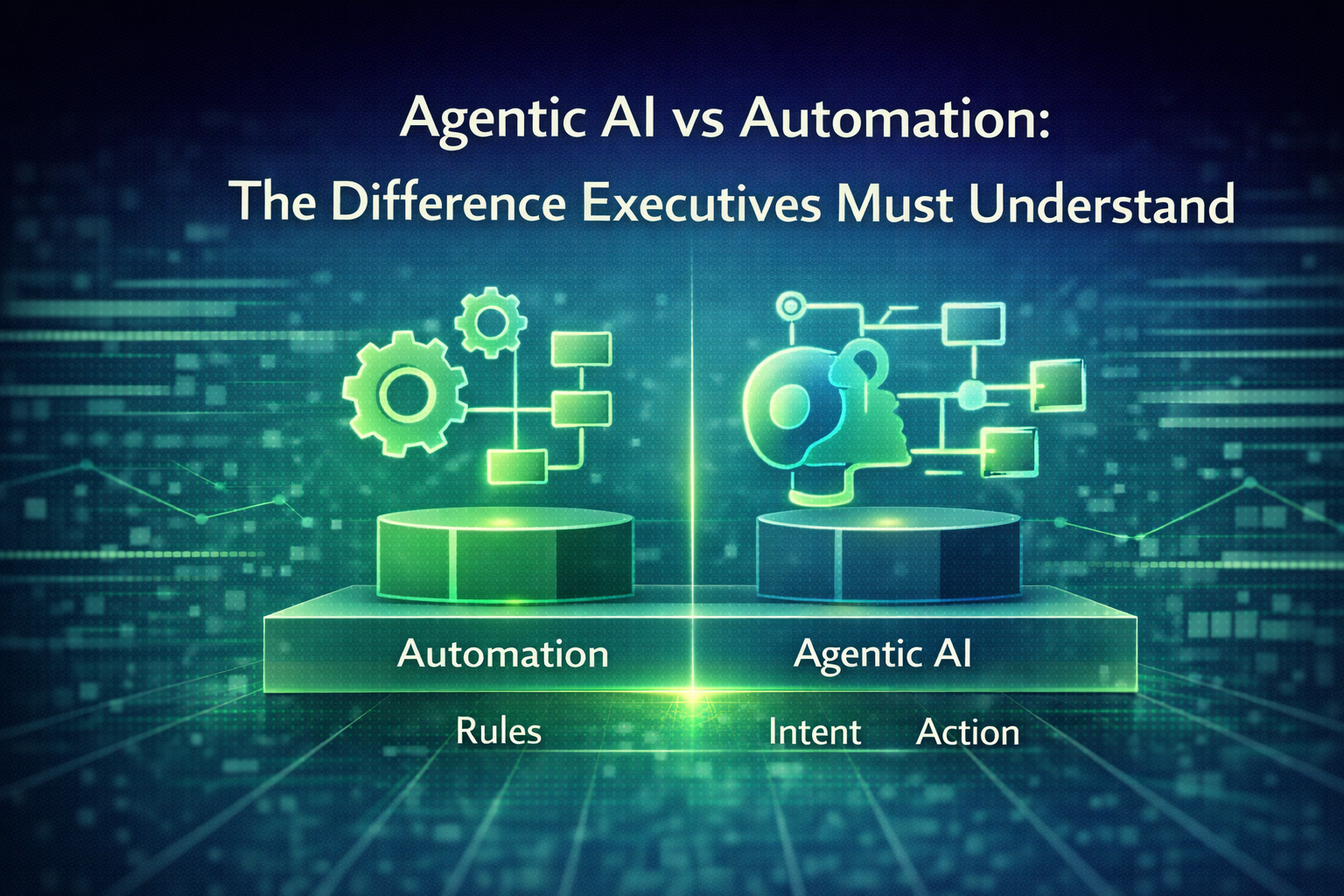
Now a new category is emerging that looks similar on the surface but is fundamentally different in practice: Agentic AI. Many leaders hear “agentic AI” and assume it is simply automation enhanced by AI. That assumption can be costly.Automation follows rules. Agentic AI interprets intent and takes action. Understanding the distinction is not a technical detail. It is a governance and enterprise risk issue. Enterprises that treat agentic AI like traditional automation will move fast, but often without the control mechanisms required for safety, reliability, and accountability.
What Automation Is, and Why It Works
Traditional automation is deterministic. It executes predefined workflows and business rules. It is designed to behave the same way every time when the inputs match the expected conditions. Automation succeeds because it has three core properties.
Predictability. If the rules are correct, the output is consistent.
Testability. Automation can be validated through scenario testing. Edge cases can be enumerated.
Containment. Automation is typically scoped to a defined workflow within a limited boundary.
When automation fails, the failure mode is usually simple. The rules were wrong, the process changed, or the input violated assumptions. The fix is usually engineering and process correction. Automation is fundamentally an efficiency tool. It reduces cost and manual work. It creates leverage through repeatability.
What Agentic AI Is, and Why It Changes Everything
Agentic AI is not rule execution. It is intent-driven reasoning and action. An agentic system can interpret an objective, assess context, plan actions, select tools, query data, and execute steps across systems. In many cases, it can do this with minimal human prompting, often chaining actions together. This creates a new class of enterprise capability. An agentic AI system behaves less like a script and more like a junior operator with access to tools. It can navigate ambiguity and make decisions under uncertainty. This is where governance changes. Because the system is not only executing a rule, it is deciding what to do next.
The Core Distinction: Deterministic Workflows vs Probabilistic Decision-Making
Automation is designed for deterministic workflows. Agentic AI introduces probabilistic decision-making. In practical terms:
automation executes what you specify
agentic AI decides how to accomplish what you intend
That difference changes risk, oversight, and accountability. Executives must understand that agentic AI increases the enterprise’s ability to act, but it also increases the enterprise’s exposure if the system acts incorrectly. The value is higher. The risk is higher. The governance must be stronger.
Why Agentic AI Fails Differently Than Automation
Automation fails when the rules are wrong. Agentic AI fails when boundaries are unclear, data is untrusted, and oversight is absent. Common agentic failure modes include:
Incorrect interpretation of intent. The system takes a plausible but wrong action because the objective was underspecified.
Unreliable data and context. The system queries data that is outdated, inconsistent, or unauthorized and makes decisions based on incorrect context.
Tool misuse and unintended actions. The agent selects a tool or takes a step that is technically valid but operationally unsafe.
Cascading failure across systems. The agent triggers actions across dependent systems, amplifying impact.
Lack of traceability. Leaders cannot easily determine why the agent acted as it did, what inputs it used, and who is accountable.
These failures are not solved by simply adjusting rules. They require operational controls and oversight models.
The Executive Implication: Agentic AI Requires a Control Model
Agentic AI should be treated as an operating model change, not a feature rollout. Executives should require five disciplines before scaling agentic systems.
1. Controlled use cases and risk tiering
Start with use cases that are bounded and low risk. Define risk tiers and match oversight levels to risk. Not every workflow requires human-in-the-loop approval. But every workflow requires boundaries.
2. Defined authority levels
Define what an agent is allowed to do.
Can it draft recommendations only?
Can it update records?
Can it trigger workflows?
Can it execute actions across production systems?
These authority levels should be explicit, role-based, and enforced by access controls.
3. Strong observability and traceability
If an agent can act, the enterprise must be able to observe. Executives should insist on telemetry that answers:
what data the agent used
what tools it invoked
what actions it took
what decision points it encountered
what confidence thresholds were applied
what approvals were captured
Without this, the system cannot be governed.
4. Clear ownership and accountability
Agentic AI creates a common leadership failure: no one owns the outcome. Agents must have an accountable owner, just as critical systems do. Ownership includes operational responsibility, incident response, and performance monitoring. If accountability is unclear, risk becomes organizational.
5. Human oversight aligned to risk
Agentic systems require oversight models. Executives should specify which workflows require:
human-in-the-loop approval
human-on-the-loop supervision
autonomous execution under monitored thresholds
This creates a scalable governance structure that prevents bottlenecks while preserving control.
A Practical Executive Framework: The Agentic AI Operating Contract
One of the most effective governance tools for agentic AI is a formal operating contract. An operating contract defines:
objective and success criteria
permitted actions and prohibited actions
approved tools and data sources
confidence thresholds and escalation triggers
oversight level and approval requirements
evidence capture and audit requirements
owners and accountability model
monitoring, drift detection, and incident response
Without an operating contract, agentic AI will behave differently across teams and environments. That inconsistency creates enterprise risk.
Why This Matters Now
The reason this distinction matters today is that many enterprises are approaching agentic AI with the same mindset they used for automation. They are optimizing for speed and novelty. But agentic AI is not a faster automation tool. It is a new capability layer that changes the enterprise’s ability to act. That is why it must be introduced with operational controls, governance, and accountability.
Take Aways
Automation increases efficiency through predictable execution. Agentic AI increases capability through intent-driven action. Enterprises that treat agentic AI like automation will adopt quickly, but often without the control structures needed for safety and trust. Enterprises that treat it as an operating model upgrade will build durable advantage.
The goal is not to deploy more agents. It is to deploy agents with governance, visibility, and accountability. That is how agentic AI becomes an enterprise asset rather than an enterprise risk.