
The New Enterprise Workforce: Humans, Agents, Systems by Mark Hewitt
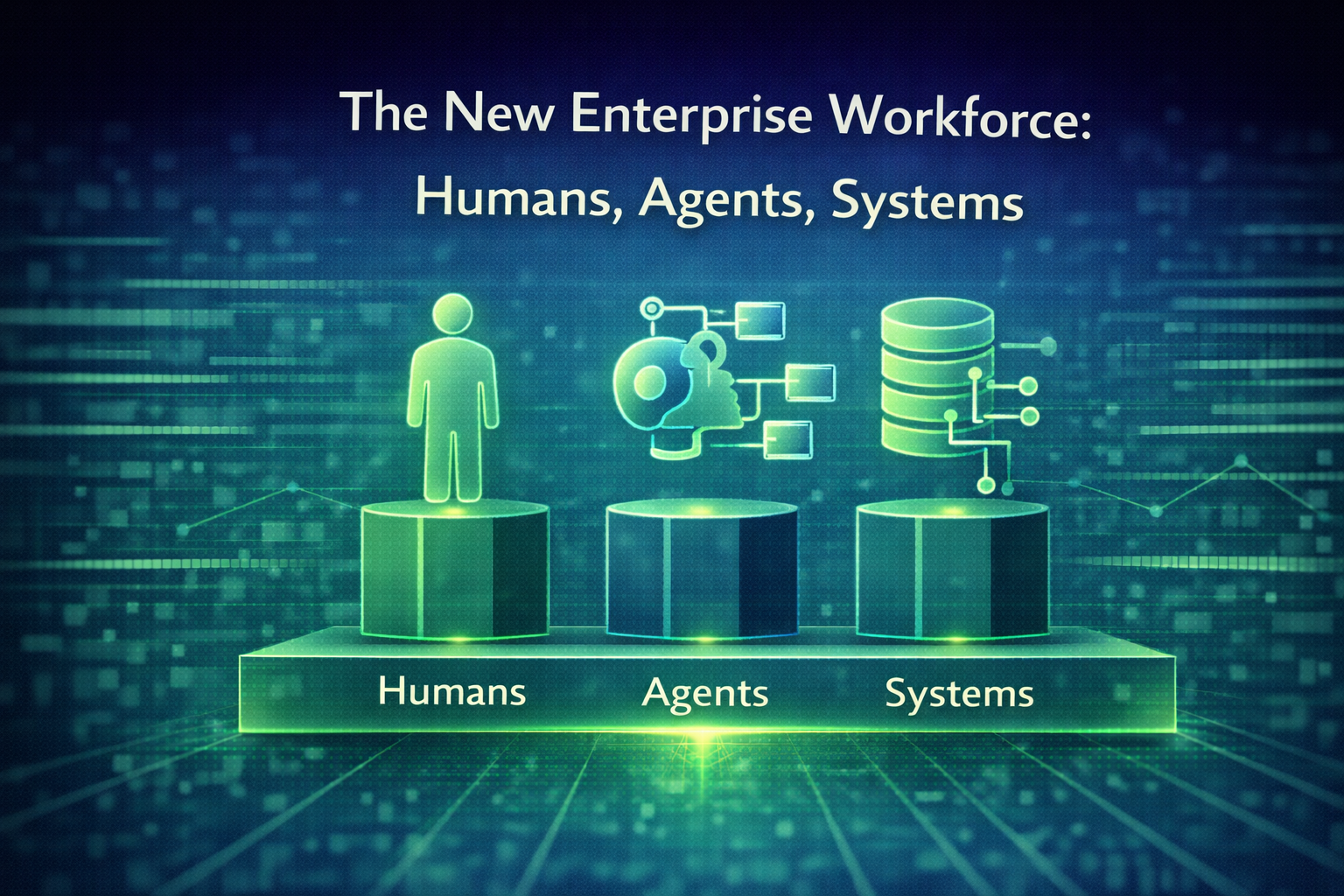
The enterprise workforce is changing. Not gradually, but structurally. For decades, enterprise productivity was a function of two forces. People and systems. People made decisions, performed work, and managed exceptions. Systems processed transactions, stored information, and enforced rules. The balance was relatively stable.
That balance is shifting. A third force is entering the operating environment. AI agents. Agents are not tools in the traditional sense. They do not simply deliver insights or surface information. They can interpret intent, execute workflows, coordinate across systems, and generate actions with speed that exceeds human attention. This changes what the workforce is. It is no longer only human. It is humans, agents, and systems operating together.
Executives must treat this shift as an operating model evolution, not a technology rollout. Organizations that design the three-part workforce deliberately will gain meaningful leverage. Organizations that adopt agents informally will introduce fragmentation, risk, and loss of accountability.
Why This Shift Is Different Than Previous Technology Adoption
Enterprises have adopted productivity technologies before. Email, ERP, cloud platforms, automation, and analytics each increased efficiency. AI agents are different because they introduce active operational capacity. An agent does not only support work. It participates in work. That participation affects the structure of roles, the design of workflows, the distribution of responsibility, and the enterprise’s risk posture. Agents change how decisions are made and how actions are executed. This is why executives must treat agents like workforce members with controlled authority rather than features embedded in software.
Defining the Three Components of the New Workforce
To govern and scale effectively, executives should define the roles of each component clearly.
Humans
Humans remain accountable. They provide judgment, ethical oversight, business prioritization, and responsibility for outcomes. They handle ambiguity that cannot be safely automated and ensure decisions remain aligned to organizational values and regulatory expectations.
Humans also set the boundaries for agents and systems.
Agents
Agents provide execution leverage. They interpret intent, retrieve information, draft work products, coordinate tasks, and in some cases take action across tools and systems. They reduce operational load and increase decision speed. Agents are not inherently reliable. Their outputs depend on data quality, system context, and governance boundaries.
Agents must be supervised and measured like operational systems.
Systems
Systems provide stability and integrity. Systems record transactions, enforce deterministic rules, maintain enterprise memory, and ensure consistency. Systems are the foundation of continuity. Agents often operate by interacting with systems. When systems are fragile or opaque, agent outcomes become unreliable.
This is why the health of systems remains a prerequisite for scaling the agent workforce.
The Core Executive Challenge: Accountability in a Mixed Workforce
The most important question executives must answer is simple: When work is performed by humans, agents, and systems together, who is accountable for the result? This is not only a governance question. It is an operational clarity question.
Enterprises that fail to define accountability will experience:
inconsistent outcomes across teams
increased operational risk from unclear ownership
slow adoption due to low trust
governance gaps during audits and incidents
increased complexity as agents are deployed inconsistently
tensions between innovation speed and risk management
The mixed workforce must have a clear accountability model. Without it, performance degrades rather than improves.
How Work Must Be Redesigned for Humans and Agents
Workflows designed for humans alone rarely translate well to mixed work.
Executives should expect to redesign workflows intentionally around the strengths of each component.
A practical approach is to categorize work into three types.
Work where agents assist humans. Examples: drafting, summarization, research, analysis, translation of information across domains, decision support.
Work where agents execute within boundaries. Examples: ticket triage, compliance evidence collection, data validation, report generation, system monitoring recommendations, controlled workflow initiation.
Work where systems remain dominant. Examples: financial transactions, access control enforcement, regulated process execution, system-of-record operations.
The goal is to place agents where they improve speed and decision quality without introducing new exposure. Executives should avoid the common mistake of treating agents as replacements rather than collaborators. Agents create leverage when they reduce operational burden and improve throughput, not when they displace accountability.
Why Trust Becomes the Limiting Factor
Executives often believe AI adoption is primarily a tooling and training problem. The real limit is trust. Employees will not rely on agents they do not trust. Leaders will not scale agents they cannot govern. Customers will not tolerate agent-driven errors in high-impact workflows.
Trust is established through four conditions.
Data trust. If agents operate on inconsistent or low-quality data, they will produce unreliable outcomes.
System trust. If the systems agents depend on are fragile, agent workflows will fail unpredictably.
Governance trust. If leadership cannot trace what agents did and why, adoption will stall.
Ownership trust. If no one is accountable, the organization will default to risk avoidance.
Trust is not created through policy statements. It is created through operational controls and measurable reliability.
The Enterprise Must Define a Workforce Control Model
Agents introduce a new class of enterprise governance requirement. The organization must define what can be delegated, what must be supervised, and what must remain human-led.
Executives can establish a control model using three oversight tiers.
Human-in-the-loop. Humans approve actions before execution. Appropriate for high-risk workflows involving production systems, sensitive data, financial decisions, or regulated processes.
Human-on-the-loop. Agents execute within boundaries. Humans supervise via monitoring and intervene when thresholds are exceeded. Appropriate for medium-risk workflows.
Human-out-of-the-loop. Agents execute autonomously with limited oversight. Appropriate only for low-risk tasks where errors are easily reversible.
This model must be applied consistently across the enterprise. If each team invents its own approach, governance becomes fragmented.
The New Operating Requirement: Engineering Intelligence
The three-part workforce cannot operate reliably without engineering intelligence.
Engineering intelligence provides:
observability across systems, data, and agent behavior
traceability for actions and decisions
drift monitoring for data and AI outputs
governance controls embedded into workflows
evidence capture for audits and compliance
accountability mapping tied to ownership and response
Engineering intelligence is how the enterprise maintains control as it introduces active agent capacity into operations. Without it, the organization experiences more activity but less stability.
A Practical Executive Starting Point
Executives can begin designing the new workforce through five steps.
Identify high-leverage workflows where agents can reduce operational burden
Define risk tiers and oversight models for each workflow
Establish data and system prerequisites for agent reliability
Define the agent operating contract including boundaries and monitoring requirements
Measure outcomes across operational, financial, and talent indicators
This approach turns agent adoption into a deliberate workforce strategy rather than an unstructured tool rollout.
Take Aways
The enterprise workforce is evolving from a human and system model to a human, agent, and system model. This transition will create meaningful advantage for organizations that treat it as an operating model redesign. It will create risk and fragmentation for organizations that treat it as a tool deployment.
Executives should focus on accountability, trust, workflow design, and governance. Agents do not replace responsibility. They amplify capability inside responsibility. The question is not whether enterprises will deploy agents. They will. The real question is whether the enterprise will redesign work and governance to make the new workforce reliable, measurable, and controllable. That is how the mixed workforce becomes a durable advantage.