
Your Developers Are Using AI -Your Engineering Organization Probably Isn’t by Mark Hewitt
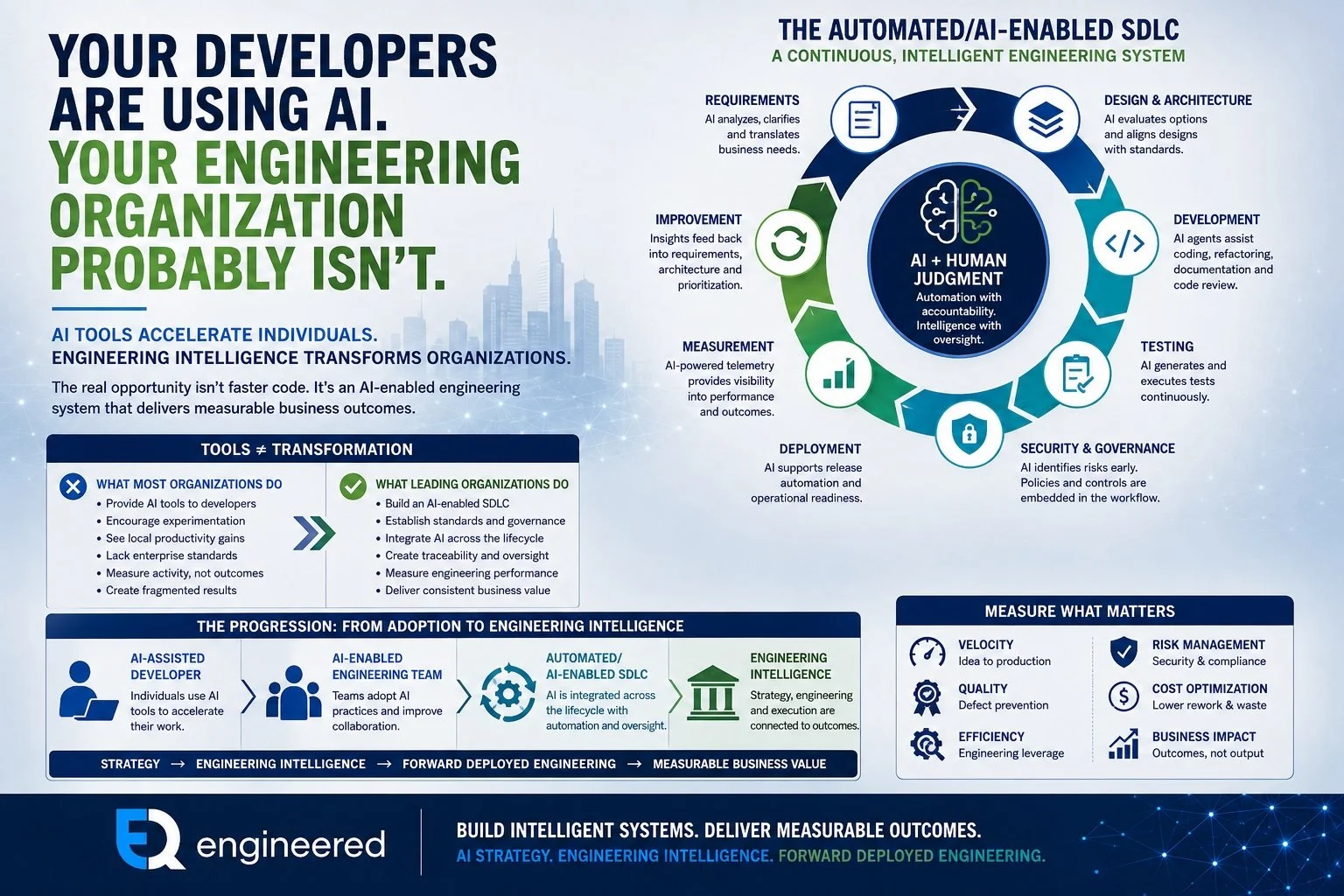
Walk through almost any enterprise engineering organization today and you will find developers using artificial intelligence. They are generating code, troubleshooting defects, creating documentation, writing tests and asking AI assistants to explain unfamiliar codebases. Tools such as GitHub Copilot, Claude Code and Cursor are rapidly becoming part of the developer toolkit.
That is progress, and it is also easy to mistake this activity for something much larger. Giving developers access to AI does not create an AI-enabled engineering organization. It creates developers who use AI. The distinction matters because the real opportunity is not simply to make individual developers faster. It is to make the entire engineering system more intelligent.
The Developer Is Only One Part of the System
Software engineering begins long before someone writes code. Business requirements must be understood. User needs must be translated into specifications. Architecture decisions must be made. Data must be accessible and trustworthy. Software must be designed, developed, tested, secured, deployed, monitored and continuously improved. AI can influence every one of these activities.
Requirements can be evaluated for completeness and ambiguity before development begins. Architecture decisions can be assessed against enterprise standards. Development environments can increasingly understand not simply a repository, but the business context surrounding an application. Testing can become more intelligent and automated. Security vulnerabilities can be identified earlier. Documentation can evolve alongside the software. Production telemetry can feed insights directly back into requirements and future development. This approach is considerably more powerful than generating code faster, and it is also the foundation for something much larger: the Automated/AI-Enabled Software Development Lifecycle.
From AI Tools to an Automated/AI-Enabled SDLC
Most organizations currently have an AI adoption model centered around tools. A developer receives access to an AI assistant. Teams experiment. Productivity improves in certain activities. New tools appear and additional experimentation follows. What is often missing is an enterprise engineering model. The next stage is an Automated/AI-Enabled SDLC, where AI is no longer an isolated capability used by individual developers. It becomes integrated across the engineering lifecycle.
Requirements can be analyzed and translated into specifications, architecture and design can be evaluated against established standards, AI agents can support development, code review and documentation, testing can be generated and executed continuously, and security and governance controls can become part of the workflow rather than activities performed near the end of delivery.
Production telemetry can then inform future requirements, architecture and development. The result is a continuous engineering system:
Requirements → Design → Architecture → Development → Testing → Security → Deployment → Measurement → Improvement
Each stage becomes increasingly intelligent, connected and automated. And importantly, automation does not mean eliminating human accountability. The strongest AI-enabled engineering organizations will establish deliberate points for human judgment, approval and oversight while automating activities where AI can improve speed, consistency and quality. AI provides acceleration, analysis and automation and engineers provide context, architecture, creativity and accountability.
Engineering Intelligence Is the Operating Model
Technology alone will not create this environment. Organizations must determine how AI should be used during requirements development. They need standards governing architectural decisions and AI-generated code. They need policies defining what information can safely enter AI systems. Testing, traceability, security, governance and human review must become repeatable engineering practices.
This is where Engineering Intelligence becomes important. At EQengineered, we define Engineering Intelligence as the discipline of connecting enterprise strategy, AI-enabled engineering and execution to measurable business outcomes. The Automated/AI-Enabled SDLC is one practical manifestation of that model.
Engineering Intelligence provides the enterprise framework.
The Automated/AI-Enabled SDLC becomes the engineering operating system.
Forward Deployed Engineering provides an execution model for accelerating transformation.
Together, these capabilities create something more powerful than AI-assisted development. They create an engineering organization designed around AI.
Productivity Is Not the Same as Performance
This distinction also changes how organizations should measure AI. If a developer completes a coding task 30 percent faster, that is useful. It does not necessarily mean the organization delivers software 30 percent faster. The constraint may exist somewhere else.
Requirements may take weeks to approve. Architecture decisions may create delays. Testing may remain largely manual. Security reviews may happen late. Deployment processes may still require significant intervention. Optimizing one stage of a system does not necessarily optimize the system. Engineering leaders therefore need to move beyond measuring individual AI productivity and begin measuring engineering performance.
How quickly does an idea move from requirement to production?
How frequently does software require rework?
How quickly are defects discovered?
How consistently are architectural standards followed?
How much engineering capacity is consumed maintaining legacy systems?
How reliably can teams translate technology investment into measurable business outcomes?
Those are Engineering Intelligence questions.
The Competitive Advantage Is Moving Up the Stack
AI coding capabilities will continue improving rapidly. Agents will become increasingly capable of completing larger portions of the software development lifecycle. The tools available to developers will become more autonomous and more deeply integrated into enterprise engineering environments. That means access to AI coding tools will increasingly become table stakes. The competitive advantage will move higher. It will belong to organizations that redesign their engineering systems around these capabilities and create repeatable, governed and increasingly automated processes spanning requirements, architecture, development, testing, security, deployment and continuous improvement.
The progression is already becoming visible:
AI-Assisted Developer → AI-Enabled Engineering Team → Automated/AI-Enabled SDLC → Engineering Intelligence
The question for technology leaders is therefore changing. It is no longer: Are our developers using AI? The more important question is: Has AI changed how our engineering organization works? If the answer is no, your developers may be using AI. Your engineering organization probably isn't.