
CEO Corner: The Enterprise AI Operating System - Turning AI from Projects into Enterprise Capability by Mark Hewitt (part 1 of 10 in the series)
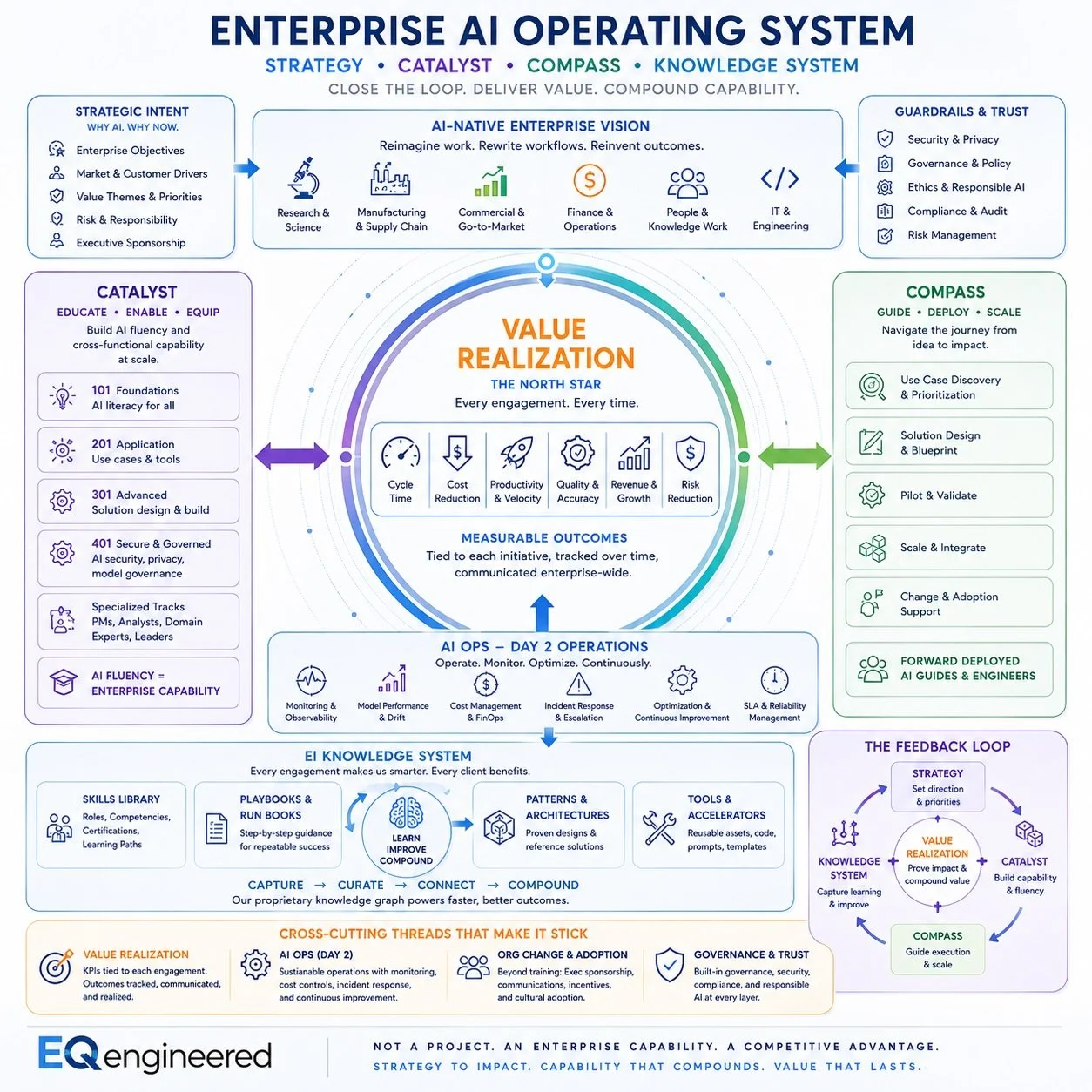
For the past several years, the enterprise conversation around artificial intelligence has largely centered on technology. Front of mind questions have included:
Which models should we use?
Which tools should we deploy?
Where can generative AI improve productivity?
Those questions still matter, but they are no longer sufficient. The more important question is how an enterprise builds the organizational capability to continuously identify, deploy, govern, operate, measure, and improve AI at scale. The challenge requires enterprises to have an Enterprise AI Operating System which is more than an AI strategy or a collection of AI initiatives. At EQengineered, this represents the continued evolution of our Engineering Intelligence approach. It connects strategy, people, execution, operational discipline, reusable knowledge, governance, and measurable business outcomes into one reinforcing system.
Value Realization as the North Star
At the center of the operating system is not AI. It is value realization. Every AI initiative should ultimately demonstrate measurable improvement in business outcomes. Depending on the organization and opportunity, those outcomes might include reduced cycle time and cost, increased productivity and velocity, improved quality and accuracy, revenue growth, or reduced risk.
This sounds obvious, yet it remains one of the biggest challenges we see with enterprise AI. Organizations are experimenting rapidly, teams are deploying new tools, employees are finding individual productivity gains, and new use cases appear almost daily. What is often less clear is how those activities translate into measurable enterprise performance. An effective AI operating system changes the results. Outcomes are established at the beginning, measured throughout execution, and communicated across the enterprise. Enterprise value is the objective rather than simply AI adoption itself.
Four Reinforcing Elements of Engineering Intelligence (EI)
EQengineered’s Engineering Intelligence operating model brings together four capabilities that continually strengthen one another.
Engineering Intelligence Strategy. EI Strategy establishes direction. It begins with business objectives and determines where AI, modernization, and automation can create meaningful value. From there, it connects business strategy with architecture, data, governance, responsible AI, and an executable transformation roadmap.
Engineering Intelligence Catalyst. EI Catalyst develops the people and organizational capabilities required to execute on the strategy. Through role-based 101, 201, 301, and increasingly advanced learning, leaders, engineers, designers, project managers, analysts, and domain experts develop practical AI fluency. The goal is to prepare people to work differently inside an AI-native enterprise, not just upskill the team.
Engineering Intelligence Compass. EI Compass connects strategy and capability to execution. Forward Deployed Engineers, architects, designers, data practitioners, and strategists work alongside enterprise teams to discover opportunities, design solutions, validate outcomes, integrate into real workflows, measure impact, and continuously improve.
Engineering Intelligence Knowledge System. EQengineered increasingly believe this may become one of the most important components of the entire model. The Knowledge System captures what the organization learns and makes that knowledge reusable. Skills libraries, playbooks, runbooks, reusable patterns, reference architectures, governance templates, prompts, accelerators, and lessons learned all become part of an expanding body of institutional intelligence.
Every engagement should make the system smarter, and every subsequent team and client should benefit from what came before. This creates a continuous feedback loop between Strategy, Catalyst, Compass, and the Knowledge System.
The Capabilities That Make AI Sustainable
There are also several capabilities that must cut across the entire operating system. AI operations addresses what happens after deployment. Monitoring, model performance and drift, cost management and FinOps, incident response, reliability, optimization, and continuous improvement become permanent operational disciplines rather than afterthoughts.
Governance and trust must also exist throughout the system. Security, privacy, policy, responsible AI, compliance, and risk management cannot simply be checkpoints at the end of an initiative. They need to be designed into how AI is selected, built, deployed, and operated.
Finally, Organizational change and adoption extends well beyond training. Executive sponsorship, communications, incentives, operating practices, leadership behaviors, and cultural adoption ultimately determine whether new technology becomes a new way of working.
Together, these disciplines move AI beyond experimentation and into sustainable enterprise capability.
The Compounding Advantage
Perhaps the most important characteristic of this operating model is that it learns. A Compass engagement produces patterns, assets, and lessons that enter the knowledge system. Those assets improve future Catalyst programs. Catalyst exposes new opportunities and organizational friction that inform Strategy. AI operations provides real production data. Value realization tells leadership what is creating measurable impact and what is not. Then the cycle begins again, with the enterprise better informed and better equipped than it was before.
This is how an organization moves from simply using AI to becoming AI-native. It also represents an important evolution in how we think about digital transformation at EQengineered. Our objective is not simply to help enterprises implement AI projects. It is to help them develop the organizational capability to repeatedly turn emerging technology into measurable business value.
That distinction matters because technologies will continue to change. Models will improve, tools will be replaced, and today's breakthrough capabilities will eventually become commonplace. The durable advantage will belong to organizations that have built the operating model, people, knowledge, governance, and execution capabilities to continuously take advantage of what comes next. This is not a project. It is an enterprise capability and a competitive advantage: strategy to impact. capability that compounds. value that lasts.