
The New Reliability Stack: Observability, Policy, Automation, Autonomy by Mark Hewitt
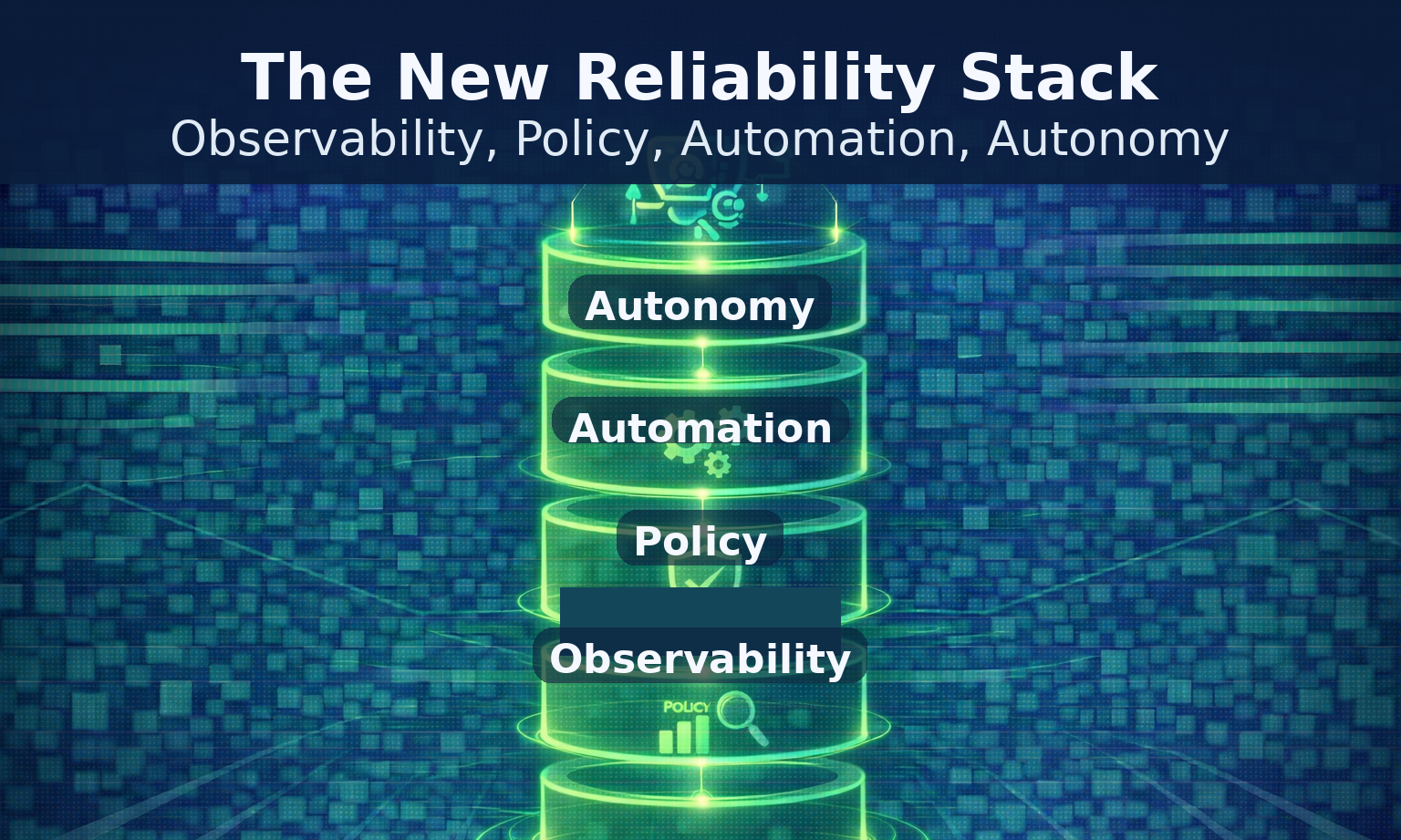
Reliability used to be measured by uptime. Today reliability is measured by continuity, recoverability, and governability under change. This shift requires a new reliability stack. In 2026, resilient enterprises build reliability through four layers: observability, policy, automation, and autonomy.
Layer 1: Observability
Observability is the foundation. It is not only monitoring. It is the ability to understand system behavior across dependencies, including data flows and operational pathways. Without observability, leaders cannot govern. They can only react. Observability should include:
service and dependency health across critical pathways
telemetry that ties technical signals to business outcomes
drift detection in data and operational behavior
traceability of changes and decision inputs
Layer 2: Policy
Policy is the control boundary. It defines what is allowed, what must be reviewed, and what must be prevented. In modern enterprises, policy cannot remain a document. It must be enforceable. Policy should be embedded into:
delivery pipelines through automated gates
access and authorization models
runtime guardrails for actions and data access
evidence capture for compliance and audit readiness
Policy makes reliability governable.
Layer 3: Automation
Automation turns control into action. It reduces toil, increases speed, and creates repeatable response. Automation should focus on:
standardized remediation and recovery workflows
evidence capture and audit automation
policy enforcement mechanisms
incident response accelerators and runbooks
Automation improves reliability when it is constrained by policy and observable in real time.
Layer 4: Autonomy
Autonomy is the highest layer and the most dangerous if built prematurely. Autonomy introduces systems and agents that can decide and act. It can create major leverage, but it can also create major exposure. Autonomy is safe when it is:
bounded by policy and authority levels
observable with traceability and confidence thresholds
supervised through human-in-the-loop or human-on-the-loop models
recoverable through kill-switch, rollback, and containment mechanisms
Autonomy is not the starting point. It is the outcome of engineered control.
Engineering Intelligence connects the stack
Engineering Intelligence is the connective layer that makes the stack coherent. It turns observability into decision context, policy into enforceable control, automation into orchestrated action, and autonomy into supervised capability. This is why Engineering Intelligence is the foundation of resilient AI-enabled enterprises.
Take Aways
Enterprises that attempt autonomy without observability and policy will scale risk. Enterprises that build the reliability stack deliberately will scale capability with control. Reliability is no longer a single metric. It is a layered operating system.