
The Enterprise Fabric: Systems, Data, Teams, Governance by Mark Hewitt
Most enterprises do not fail because they lack strategy. They fail because their operating fabric cannot sustain change.
Modernization is often approached through separate initiatives. Engineering teams modernize applications. Infrastructure teams optimize cloud environments. Data teams build platforms and pipelines. Security teams strengthen controls. Product teams ship customer experiences. AI teams experiment with models and copilots. Each of these efforts may be rational. The problem is that they rarely operate as one coherent system. The result is an enterprise that looks modern on paper but remains fragile in practice. Work slows unexpectedly. Incidents become frequent. Data trust declines. Governance becomes reactive. The organization becomes harder to change at scale.
In 2026, modernization requires a different lens. It requires executives to understand and strengthen the enterprise fabric.
What the Enterprise Fabric Really Is
The enterprise fabric is not a technology concept. It is the set of interdependencies that determine how the organization functions under pressure.
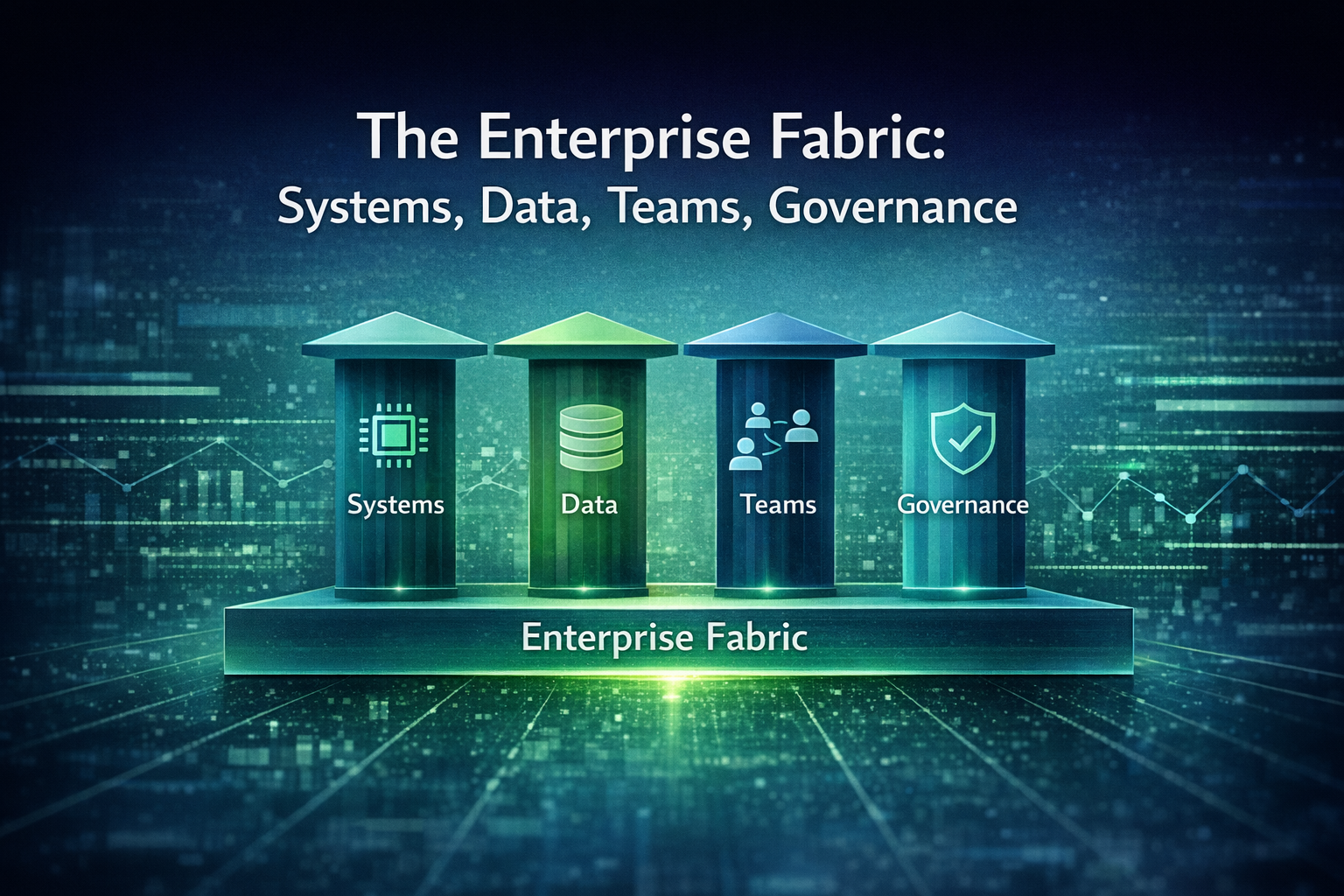
It includes four components.
Systems
The applications, platforms, and integrations that deliver products and operate the business.Data
The pipelines, definitions, governance, and analytics that support decision-making, compliance, and AI.Teams
The people, practices, ownership models, and incentives that create and operate technology.Governance
The controls, policies, risk mechanisms, and accountability structures that ensure continuity, compliance, and trust.
These four elements form the operational backbone of the enterprise. If they align, modernization accelerates with confidence. If they fragment, modernization becomes risk.
This is why modernization is not only a technical effort. It is an operating model effort.
Modernization Breaks When the Fabric Becomes Fragmented
Fragmentation is the most common modernization failure mode.
It occurs when:
systems evolve faster than governance
data platforms expand faster than trust mechanisms
teams ship independently without consistent operational standards
ownership of critical services is unclear
controls are implemented after delivery instead of embedded in delivery
architecture decisions are made locally while risk accumulates globally
AI adoption accelerates while observability and traceability remain weak
In this environment, the enterprise becomes harder to understand and more expensive to operate. Risk rises faster than capability. Executives often experience this as a persistent sense that the organization is always working hard but never truly stable. The enterprise is constantly busy and frequently surprised. That is a fabric problem.
The Role of Systems: Continuity Under Dependency
Systems are no longer contained. Modern enterprises run on distributed services, APIs, third-party integrations, and cloud-native platforms. This creates dependency chains that few leaders can fully see. Systems become fragile when:
dependencies are undocumented or unknown
shared services become bottlenecks
architecture lacks clear boundaries
telemetry is incomplete
incident response relies on tribal knowledge
recovery procedures are not practiced
changes propagate unpredictably
Modernization must strengthen systems so they can degrade gracefully, recover quickly, and be governed at speed. Without this, the enterprise cannot scale change safely.
The Role of Data: Trust and Traceability as Risk Controls
Data is often treated as a platform initiative. Build a lakehouse. Move to new tooling. Centralize analytics. Enable self-service. But data modernization fails when trust is absent. Data becomes a risk factor when:
definitions vary across business units
quality is inconsistent
lineage is unclear
drift is not measured
governance is manual
ownership is ambiguous
When trust declines, leaders lose confidence in reporting, forecasting, compliance, and AI outputs. The organization begins to operate on conflicting truths. Modernization must treat data trust as a control function. Data quality, lineage, and drift detection are not nice-to-have features. They are continuity mechanisms.
The Role of Teams: Ownership and Operating Standards
Most modernization problems that appear to be technical are often human and organizational. Not because people are incapable, but because operating standards are inconsistent and ownership is unclear. Teams become a source of fragility when:
service ownership is unclear or shared without accountability
practices vary widely across delivery groups
incentives reward speed without stability
incident response is ad hoc
documentation and runbooks are not maintained
knowledge is concentrated in a few individuals
Modernization must strengthen teams through clear ownership models, shared reliability practices, and repeatable operating habits. When these conditions exist, the enterprise can scale both technology and resilience.
The Role of Governance: Controls That Operate at the Speed of Delivery
Governance is often treated as the thing that slows modernization down. That belief is one of the reasons modernization fails. Governance does not have to slow change. But it must be designed for modern delivery conditions. Modern enterprises cannot rely on manual reviews, committee approvals, and after-the-fact audits. They require governance that is embedded into delivery workflows through automation, policy-as-code, and continuous controls. Governance maturity means:
controls are built into pipelines and deployment processes
risk is measured continuously, not quarterly
security is integrated into engineering habits
compliance evidence is collected automatically
ownership and accountability are clear
exceptions are managed transparently
This is what allows modernization to move quickly without creating fragility.
The Fabric Strength Test: Four Questions for Executives
Executives can assess the strength of the enterprise fabric by asking four simple questions.
Do we have visibility across critical dependencies, or do we learn about them during incidents?
Do we trust our data and know where it comes from, or do we debate the numbers?
Do we have clear ownership of systems and operational readiness, or do we rely on heroes?
Does governance operate within delivery workflows, or does it happen after the fact?
If the answers are unclear, the modernization risk is high.
How Engineering Intelligence Strengthens the Fabric
Engineering intelligence is the connective layer that strengthens the enterprise fabric by creating continuous visibility and governable action across systems, data, teams, and governance. It enables:
shared observability across critical pathways
early detection of drift and fragility
decision workflows that turn signals into response
objective operational metrics that leadership can trust
governance embedded into delivery and operations
It makes the enterprise measurable, and therefore governable. In a complex environment, this is the foundation of both resilience and modernization.
Take Aways
Modernization is not only a technology upgrade. It is the strengthening of the enterprise fabric. Systems, data, teams, and governance must operate as one coherent system or modernization becomes fragmented progress with rising risk.
In 2026, the most modern enterprises will not be those that move the fastest. They will be those that can change safely, recover quickly, and govern continuously. That is what enterprise strength looks like.