
The Executive Playbook: Building Resilient, AI-Enabled Enterprises by Mark Hewitt
Enterprise leaders are facing a defining moment.
AI is accelerating into every industry. Competitors are adopting copilots and agents. Vendors are promising automated operations and AI-first workflows. Boards are asking how fast the enterprise can capture value. Employees are adopting tools on their own, often outside governance.
In this environment, executives face a tension: Move fast enough to stay competitive, but with enough control to remain safe, compliant, and resilient. The enterprises that succeed in 2026 will not be those that adopt the most AI. They will be those that adopt AI with operational discipline.
This requires an executive playbook. A playbook that treats AI as an enterprise capability, not a collection of tools. A playbook that strengthens the enterprise fabric while introducing intelligence. A playbook that scales AI without scaling fragility.
Below is a practical executive playbook for building resilient, AI-enabled enterprises.
1. Treat Modernization as Enterprise Risk Reduction
The strongest modernization case is not speed. It is survivability. Modern enterprises operate in conditions of continuous volatility. Cyber threats, vendor instability, regulatory pressure, changing customer expectations, and competitive disruption are constant. In this environment, modernization is how leaders reduce enterprise risk.
Modernization should be framed as:
reduced probability of failure
reduced blast radius when failures occur
faster recoverability
stronger governance and audit readiness
stronger data trust and decision confidence
reduced cost-to-change and operational friction
If modernization is treated only as a technology upgrade, it becomes fragmented. If it is treated as risk reduction, it becomes an executive discipline.
2. Strengthen the Enterprise Fabric: Systems, Data, Teams, Governance
Resilience is not achieved through one initiative. It is achieved when the enterprise fabric becomes coherent.
Resilient enterprises have:
systems with clear boundaries and observable dependencies
data that is trusted, governed, and traceable
teams with clear ownership and operational standards
governance embedded into delivery and runtime operations
If any part of the fabric is weak, fragility spreads. AI accelerates this fragility because it increases speed and complexity. Executives should approach resilience through fabric strength. Not through isolated modernization projects.
3. Build Engineering Intelligence as the Reliability and Governance Layer
Engineering intelligence is the connective layer between systems, data, teams, and governance.
It provides the operating visibility that executives need:
what is happening across critical pathways
where risk is accumulating
whether change can be delivered safely
whether data can be trusted
whether governance is operating continuously
whether AI behavior is stable and controlled
Engineering intelligence enables control at the speed of enterprise change. In 2026, it is the modern reliability layer. It is also the modern governance layer.
4. Establish a Governance Spine for AI and Agents
AI adoption without governance becomes risk at scale.
Executives must establish a governance spine that includes:
clear policy and risk tiering
automated controls embedded into pipelines and runtime systems
continuous monitoring, drift detection, and evidence capture
ownership and accountability for AI workflows
escalation and incident response pathways
approval models aligned to risk
Governance must be continuous. It cannot rely on periodic review. AI systems behave at runtime. Agents take action. Drift occurs silently. Without always-on governance, enterprises lose control.
The governance spine is what makes AI scalable.
5. Deploy AI Through Safe Sequencing
Many enterprises fail by scaling AI before foundations are mature.
Safe sequencing follows a simple path:
assistive use cases first
standardized patterns second
supervised autonomy third
broader autonomy only when trust is proven
This sequencing allows AI to create value while control structures mature. Executives should treat AI adoption as capability development, not as tool deployment.
6. Use Human-in-the-Loop and Human-on-the-Loop Models to Retain Accountability
AI will not scale through manual approvals alone. It also cannot scale through uncontrolled autonomy.
Executives should apply oversight models by risk tier:
Human-in-the-loop for high-risk actions. Humans approve decisions or actions before execution.
Human-on-the-loop for medium-risk workflows. AI operates within boundaries while humans supervise via monitoring and intervene through escalation triggers.
Human-out-of-the-loop only for low-risk tasks. AI operates autonomously where errors are easily reversible and contained.
These models preserve accountability while enabling speed. They also create clarity. Every AI-enabled workflow has a defined oversight model.
7. Measure Success Through Operational, Financial, and Talent Outcomes
AI programs often measure activity. Executives must measure outcomes.
Operational outcomes include:
incident reduction and faster recovery
lower operational toil
improved change safety
improved observability coverage
improved governance readiness
reduced drift and anomaly indicators
Financial outcomes include:
reduced cost-to-operate
reduced cost-to-change
improved productivity leverage
reduced volatility and risk exposure
faster time to value for strategic initiatives
Talent outcomes include:
reduced burnout and operational fatigue
faster onboarding and learning
improved satisfaction and trust
improved retention in critical roles
increased capability per team
If AI cannot demonstrate outcomes in these domains, it will remain a pilot-driven initiative.
8. Scale Through Organizational Design, Not Tool Proliferation
AI scales through an operating model.
Executives must design:
an AI platform and enablement capability
domain teams that own outcomes
governance and risk structures that enforce controls
data stewardship that ensures trust
shared standards for evaluation, monitoring, and evidence capture
a portfolio model that prioritizes pathways and risk tiers
Centralize standards and governance. Decentralize value creation. This is how the enterprise avoids fragmentation while enabling innovation.
9. Make Resilience the Competitive Advantage
AI will reward enterprises that can change quickly. However, change is not advantage without stability. The true advantage in 2026 is resilience with intelligence.
Enterprises that can:
deploy AI quickly
maintain continuous governance
observe systems and data in real time
recover quickly from failure
ensure accountability and auditability
scale autonomy safely
reduce cost and risk while increasing capability
will outpace competitors who adopt AI without control.
AI increases speed. Resilience preserves trust. Together they create durable advantage.
Key Take Aways
AI adoption is not a technology shift alone. It is an enterprise operating shift.
Executives who succeed in 2026 will treat AI as an enterprise capability built on modernization, governance, engineering intelligence, and organizational design.
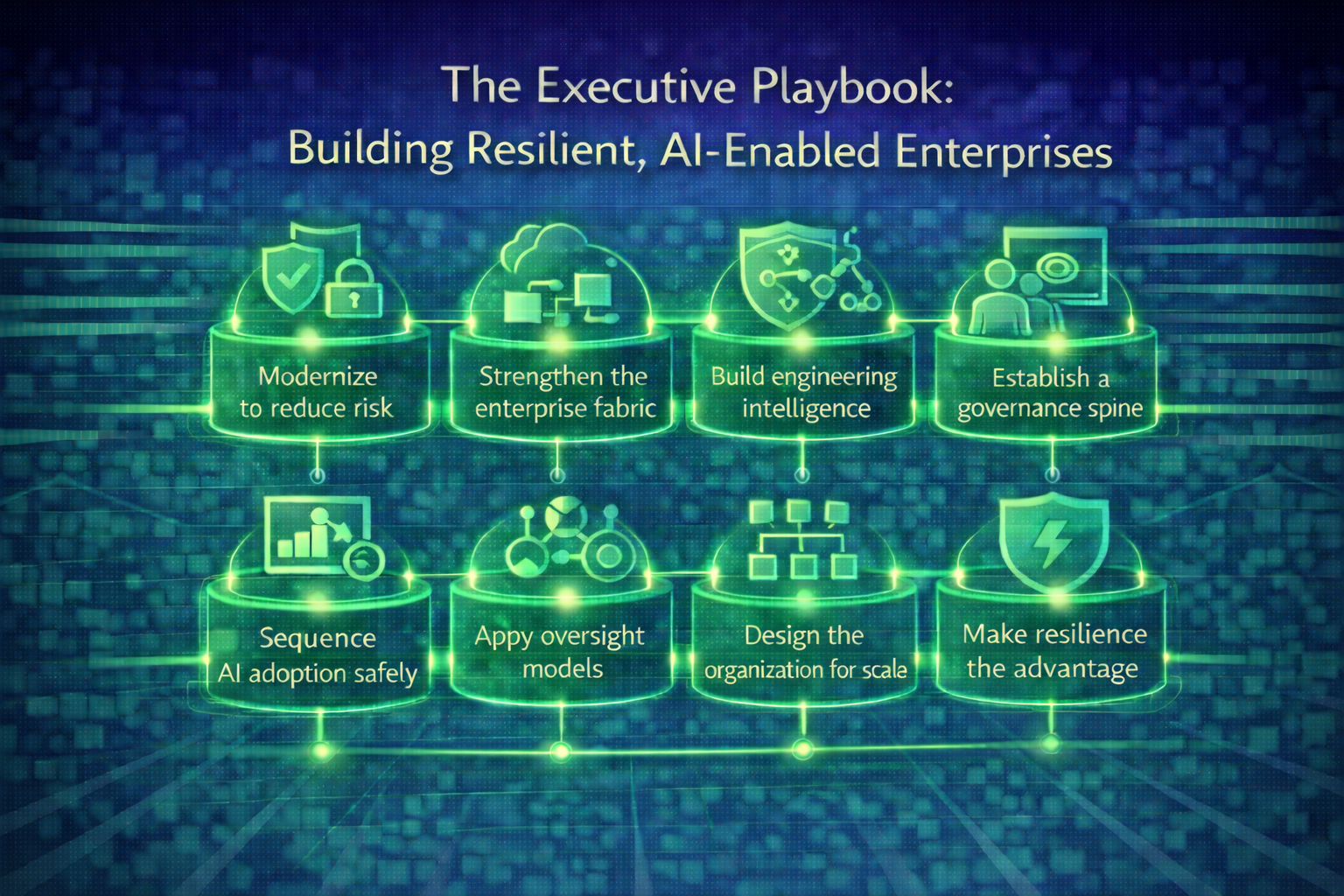
The playbook is clear: Modernize to reduce risk. Strengthen the enterprise fabric. Build engineering intelligence. Establish a governance spine. Sequence adoption safely. Apply oversight models aligned to risk. Measure outcomes. Design the organization for scale.
Enterprises that do this will not only adopt AI. They will become resilient, governable, and competitively advantaged in the AI era.