
Engineering Intelligence is the New Reliability Layer by Mark Hewitt
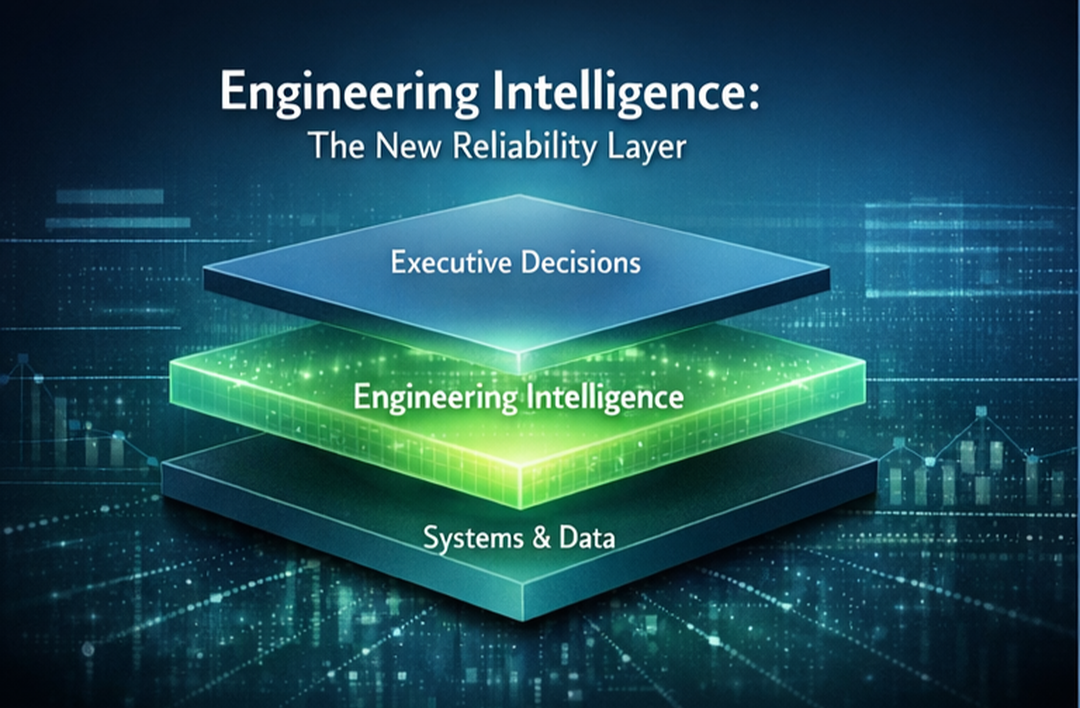
In the modern enterprise, reliability is no longer defined by uptime alone. It is defined by continuity. That means the organization’s ability to operate, adapt, and recover under pressure. This distinction matters because the forces shaping enterprise performance have changed. Distributed systems, multi-cloud infrastructure, accelerated shipping cycles, AI augmentation, supply chain volatility, heightened security threats, and regulatory demand for transparency now shape what “reliable” truly means.
Many companies still treat reliability as a technical discipline confined to SRE (Site Reliability Engineering) teams, monitoring dashboards, and incident response. That approach is outdated.
What enterprise leaders need now is a new operating capability: engineering intelligence. It is the ability to continuously understand the state of systems, anticipate failure, and orchestrate response across technology, data, and teams. It should not be treated as a toolset. It must be treated as an infrastructure layer.
Reliability Has Evolved. Intelligence Must Follow.
Historically, reliability meant ensuring the environment stayed online and stable. Today, stable is not enough. Modern enterprises require systems that are observable enough to understand behavior and root cause in real time, resilient enough to degrade gracefully rather than fail catastrophically, recoverable enough to restore operations without heroics, governable enough to prove control and accountability, and adaptive enough to evolve without introducing fragility.
Engineering intelligence becomes foundational because it extends reliability from infrastructure-centric stability into enterprise-wide operational continuity.
The Real Reliability Problem is Not Technology. It is Opacity.
Most failures in modern systems are not caused by a single bug or a missed alert. They come from not knowing what is happening until it is too late.
Enterprises operate complex, interconnected systems. Applications, APIs, data products, identity layers, vendor tools, and human workflows evolve in parallel. Often there is insufficient visibility into how changes propagate.When the system breaks, it often breaks silently first. Performance degrades. Data drifts. Dependencies fail. Integrations weaken. Access controls erode. Operational workarounds become permanent. The result is not just a technical incident. It becomes a business continuity event, often with reputational, financial, or regulatory cost.
Engineering intelligence closes the gap between assuming the system is fine and knowing the system is behaving correctly.
Engineering Intelligence: What It Actually Means
Engineering intelligence is the disciplined capability to convert engineering signals into executive confidence. It combines five elements.
Observability, meaning full-system visibility beyond basic monitoring
Operational analytics, meaning interpretation of system behavior over time
Predictive insight, meaning early warning indicators and anomaly detection
Decision orchestration, meaning automated or assisted response workflows
Governance and accountability, meaning clear ownership, traceability, and control
This is not simply AIOps. It is not just a better logging stack. It is not another platform investment. It is an enterprise operating layer that enables leaders to answer questions that matter.
Are we stable, or just quiet?
Where is fragility building?
What is the next incident likely to be, and when?
Which dependencies are most likely to trigger cascading failure?
Are we confident in our controls and compliance posture?
Can we explain our systems to regulators, auditors, and boards?
If organizations cannot answer these questions, their reliability posture is not mature. It is exposed.
The CEO and COO Lens: Reliability is Business Resilience
From an executive perspective, reliability is not a technical metric. It is a resilience measure. It affects revenue continuity, operational continuity, risk posture, and strategic capacity.
Engineering intelligence is the mechanism that connects technical state to business continuity with speed, clarity, and accountability.
What This Means for Modernization
Modernization programs often stall because they focus on transformation as a project. Migrate systems. Refactor apps. Update tooling. Adopt agile. Layer on AI. Modernization, however, is not only movement. It is strengthening. If you modernize without engineering intelligence, you may end up with systems that are newer but still opaque. You will still be at risk, only now with more complexity and faster change velocity.
The organizations that win will treat engineering intelligence as a prerequisite to modernization, not a phase after it.
A Practical Starting Point
Engineering intelligence does not begin with buying a platform. It begins with defining operational outcomes and instrumenting the enterprise to produce measurable confidence.
A practical starting sequence is as follows.
Define what reliability means in business terms such as continuity, resilience, and recoverability
Map the critical operational pathways across customer, revenue, safety, and compliance
Identify where opacity exists across signals, ownership, dependencies, and controls
Build an engineering intelligence baseline using observability, analytics, and workflows
Establish executive-level operational metrics focused on risk, drift, and resilience
This creates a system that is not only measurable, but also governable.
Take Aways
Reliability is a strategic enterprise posture. Engineering intelligence is the new reliability layer because it transforms reliability from a reactive discipline into a continuous, governed capability. It gives leaders the confidence that systems are not merely running, but functioning correctly, securely, and resiliently under change.
In the modern enterprise, that is not optional. It is the foundation.