
Robotics, AI, and the Cost of Precision: Building Sustainable Intelligent Systems by Mark Hewitt
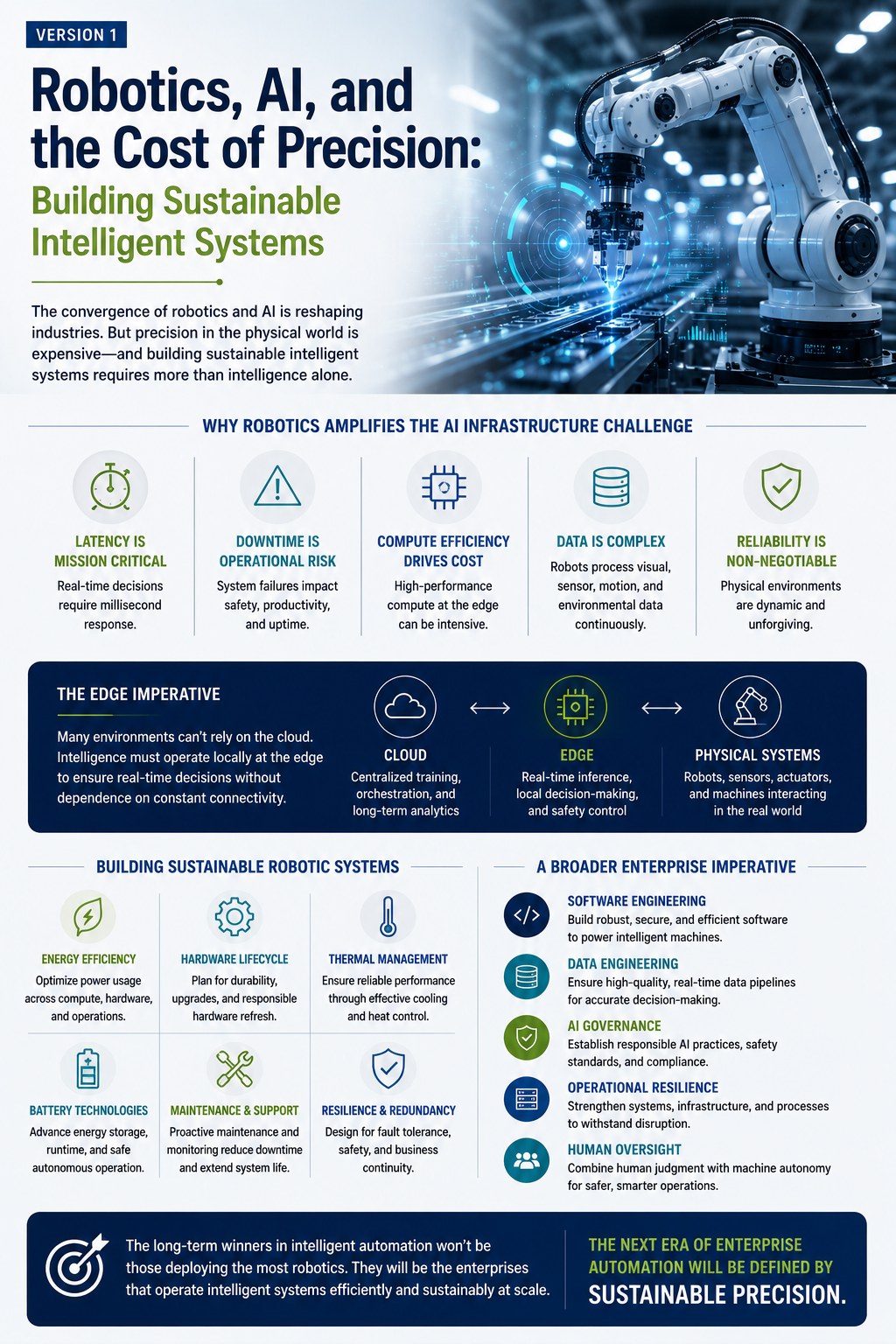
The convergence of robotics and artificial intelligence is rapidly reshaping how enterprises think about automation, operations, and productivity. Across manufacturing, logistics, healthcare, defense, agriculture, and infrastructure management, intelligent physical systems are moving from experimentation into real-world deployment at increasing scale.
Yet beneath the excitement surrounding robotics and AI lies a growing operational reality that enterprises must carefully consider: precision is expensive. Unlike software-only AI systems, robotics introduces an entirely different layer of complexity. Intelligent machines must interact with physical environments that are dynamic, unpredictable, and unforgiving. Real-time decision-making, sensor fusion, edge processing, safety systems, and mechanical reliability all require substantial computational and operational sophistication.
As organizations deploy robotics at scale, they are discovering that the challenge is not simply making systems intelligent. It is making them intelligent reliably, safely, and sustainably. The compute demands behind robotics are significant. Autonomous systems continuously process visual data, environmental signals, movement calculations, and operational decision trees, often in milliseconds. This creates substantial requirements for localized compute infrastructure, energy consumption, thermal management, and operational resilience.
In many ways, robotics amplifies the infrastructure challenges already emerging within enterprise AI. For example, latency becomes mission critical, downtime becomes operational risk, and compute efficiency becomes directly tied to cost and scalability. This is particularly important because many robotic environments cannot rely exclusively on centralized cloud systems. Factories, warehouses, hospitals, autonomous vehicles, and field operations often require intelligence to operate locally at the edge, where systems can make decisions in real time without depending on persistent connectivity.
As a result, enterprises are increasingly moving toward hybrid intelligent architectures that combine cloud orchestration with localized edge intelligence. Smaller optimized AI models, specialized hardware accelerators, and distributed operational systems are becoming essential components of scalable robotics strategies.
At the same time, organizations must also consider the sustainability implications of physical AI systems. Intelligent robotics deployments involve not only software infrastructure, but also energy usage, hardware lifecycles, maintenance requirements, cooling systems, battery technologies, and operational redundancy planning. The long-term winners in intelligent automation may not simply be the organizations deploying the most robotics, but may be the enterprises that learn how to operate intelligent physical systems efficiently and sustainably at scale. This represents a broader shift in enterprise technology strategy.
The future of intelligent systems will increasingly depend on the integration of software engineering, data engineering, AI governance, operational resilience, infrastructure optimization, and human oversight. Robotics makes this convergence impossible to ignore because the consequences of system failure move beyond digital inconvenience into physical operational impact. The next era of enterprise automation will not be defined solely by intelligence. It will be defined by sustainable precision.