
Quantum Computing Could Change the Economics of Intelligence by Mark Hewitt
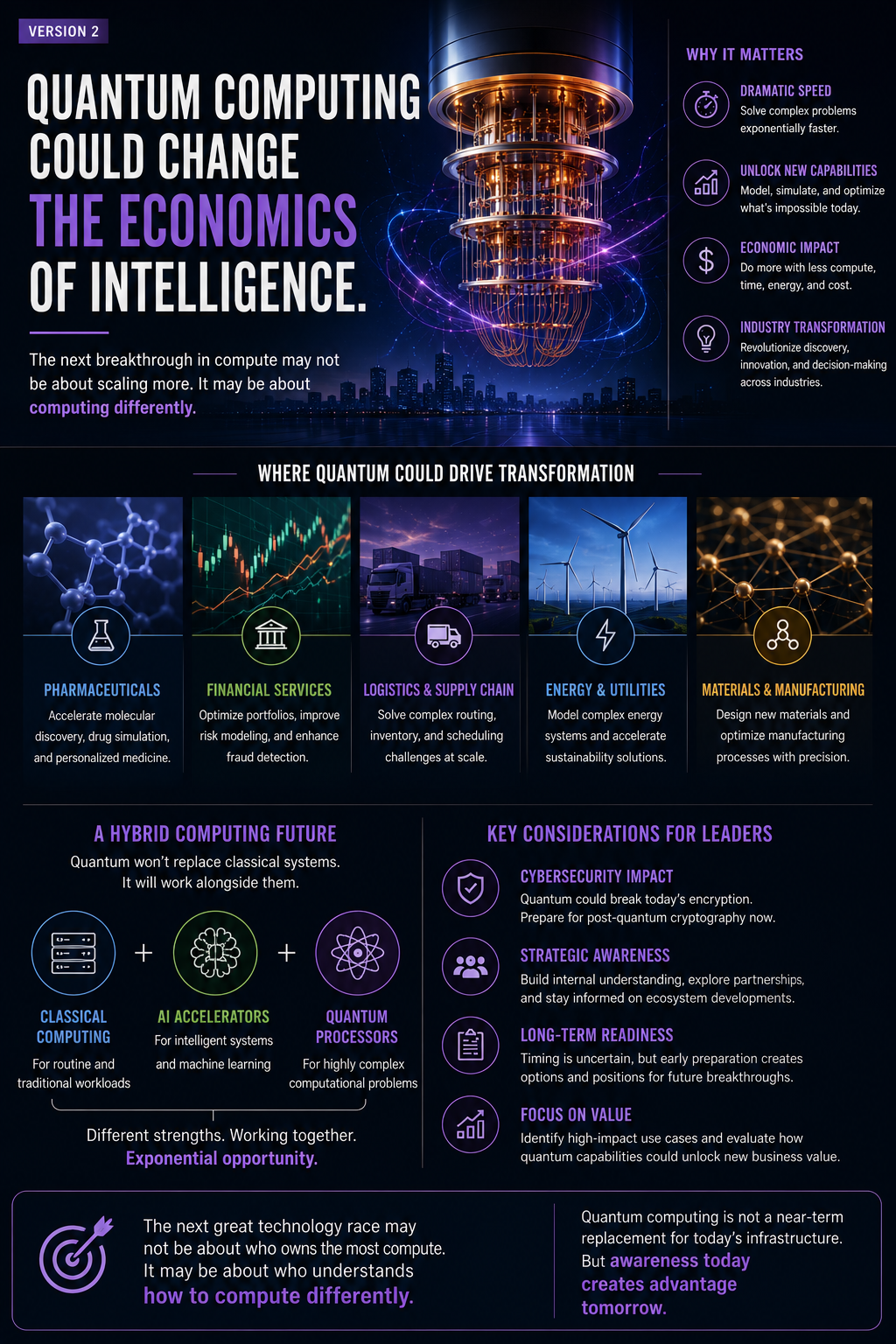
For decades, enterprise technology strategy has largely followed a predictable pattern: more power requires more infrastructure including more servers, more storage, more energy, and more compute. The AI era has accelerated this pattern dramatically. Enterprises are now investing heavily into data centers, GPU clusters, and cloud infrastructure to support increasingly compute-intensive systems. But what if the future of computational progress is not simply about building larger infrastructure footprints? What if the next breakthrough changes the economics of compute itself? That is the long-term promise of quantum computing.
Quantum computing remains early, experimental, and technically complex. Yet beneath the headlines and hype is a possibility that enterprise leaders should not ignore: certain classes of computational problems may eventually become solvable at efficiencies that traditional computing cannot realistically achieve. If that happens, entire industries could change.
Optimization problems that currently require enormous compute resources may be solved dramatically faster. Complex simulations that take days could take minutes. Material science, logistics, energy modeling, financial forecasting, and pharmaceutical discovery could operate at entirely different levels of capability. This is not simply another infrastructure upgrade. It is a potential shift in the physics of computing itself, and that distinction matters.
The current AI race is consuming enormous amounts of energy and capital. Enterprises are scaling infrastructure aggressively to remain competitive. But eventually, leaders will begin asking a different question: Can intelligence become more computationally efficient, not just more computationally powerful?
Quantum computing introduces that possibility. The implications extend beyond performance. Cybersecurity may face one of its largest transformations in decades as quantum systems potentially challenge current encryption models. Governments and enterprises are already beginning to explore post-quantum cryptography strategies because some encrypted data being captured today could theoretically become vulnerable in the future.
At the same time, the future enterprise environment is unlikely to become purely quantum. More realistically, organizations will operate hybrid ecosystems including classical computing for traditional workloads, AI accelerators for intelligent systems, and quantum processors for highly specialized computational problems. This creates a new strategic reality for enterprise leadership.
The organizations that prepare early may gain asymmetric advantages in optimization, research, simulation, and computational efficiency. The organizations that dismiss quantum computing entirely may eventually find themselves reacting to a market shift rather than helping shape it. Importantly, quantum computing is not a near-term operational replacement for today’s infrastructure. Most enterprises do not need immediate deployment strategies, but they do need awareness.
Because history suggests that once foundational technologies cross practical thresholds, adoption can accelerate much faster than expected, the next great technology race may not be about who owns the most compute, but rather about who understands how to compute differently.