
Observability for Intelligent Systems: Managing AI at Enterprise Scale by Mark Hewitt
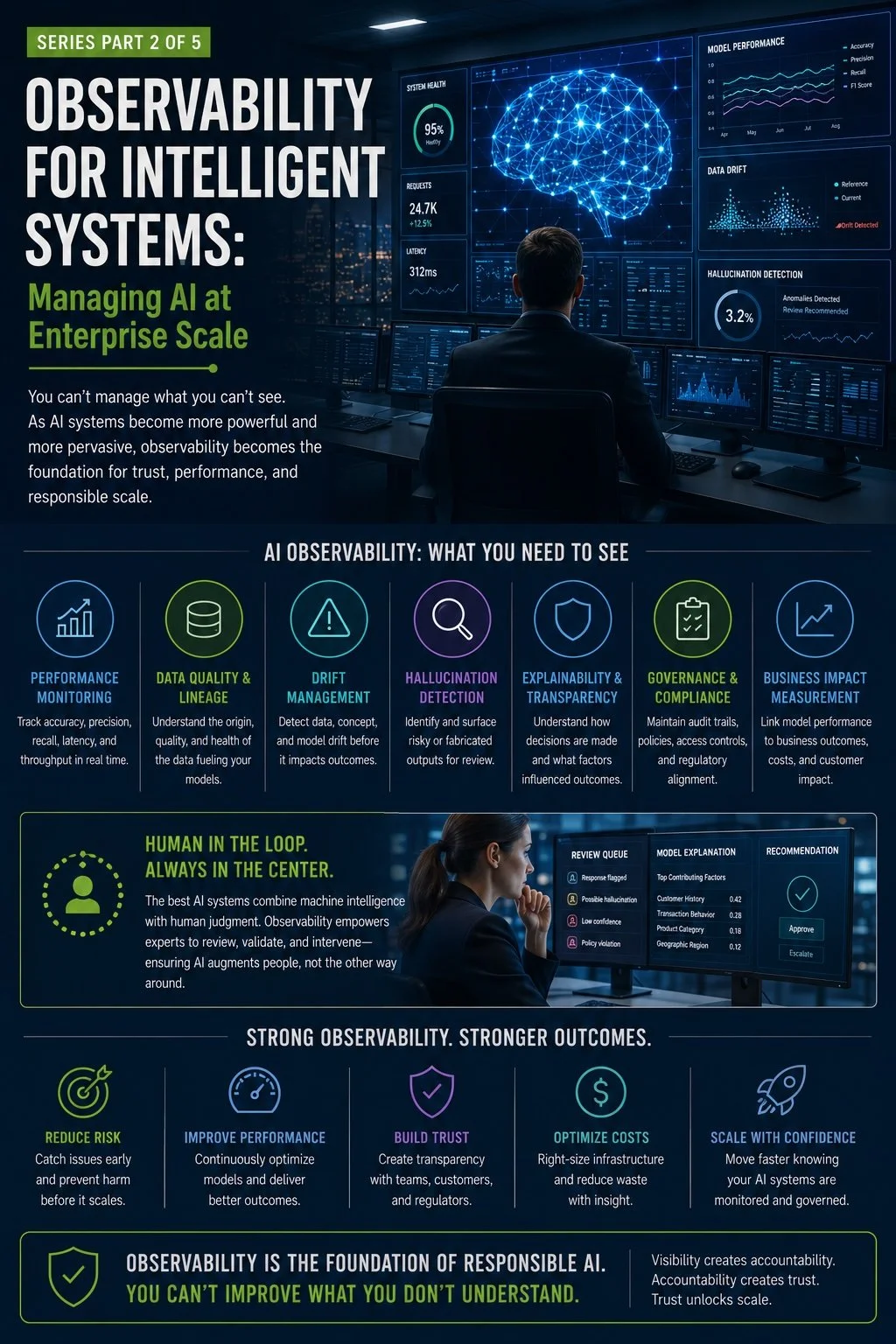
Artificial intelligence is rapidly evolving from an experimental capability into a foundational component of enterprise operations. Organizations are embedding AI into customer engagement platforms, software development lifecycles, cybersecurity programs, supply chain operations, decision support systems, and countless business processes. As adoption accelerates, however, many leaders are beginning to confront a new challenge. How do you effectively manage systems that are increasingly capable of making decisions, generating content, and influencing outcomes when those systems often operate in ways that are difficult to fully understand?
For decades, enterprise technology environments were built around deterministic systems. Traditional applications followed predefined rules, generated predictable outputs, and could be monitored through well-established operational metrics. Artificial intelligence introduces an entirely different operating model. AI systems learn from data, adapt to changing conditions, generate probabilistic outputs, and can evolve over time. While these capabilities create tremendous business value, they also introduce a new level of operational complexity that many organizations are only beginning to appreciate.
This is why observability is emerging as one of the most important disciplines in enterprise AI. As organizations deploy intelligent systems at scale, visibility becomes just as important as capability. Leaders need to understand not only whether AI systems are functioning, but how they are functioning, why they are producing specific outcomes, and when those outcomes begin to deviate from expectations.
The challenge becomes increasingly significant as AI moves deeper into critical business operations. Models can drift as customer behavior changes. Data quality issues can quietly degrade performance. Generative AI systems may produce responses that appear credible while containing inaccurate or fabricated information. Complex AI workflows can create decision paths that are difficult for operators, regulators, and business leaders to explain. Without meaningful visibility into these systems, organizations risk making decisions based on outputs they do not fully understand.
As a result, leading enterprises are beginning to treat AI observability as a foundational operating capability rather than a technical enhancement. Much like organizations monitor infrastructure, applications, networks, and cybersecurity environments, they are now building mechanisms to monitor intelligence itself. This includes visibility into model performance, data lineage, confidence levels, response quality, latency, resource utilization, anomaly detection, and business outcomes. The objective is not simply to identify failures. It is to create a continuous feedback loop that allows intelligent systems to be measured, improved, governed, and trusted.
Explainability is becoming an equally important part of this conversation. Enterprise leaders, regulators, customers, and employees increasingly expect transparency regarding how AI-driven decisions are made. Trust becomes difficult to establish when organizations cannot explain the reasoning behind recommendations, predictions, or actions. Observability provides the foundation for explainability by creating visibility into the factors that influence outcomes and the conditions under which those outcomes are generated.
The growing importance of observability also reinforces the need for human oversight. Despite advances in automation, the most effective AI operating models are not fully autonomous. They are built around human-in-the-loop and human-on-the-loop governance structures that allow experts to review decisions, validate outputs, investigate anomalies, and intervene when necessary. Observability makes this oversight possible by providing the information required for informed human judgment.
Beyond risk management and governance, observability creates significant operational advantages. Organizations with strong visibility into their AI environments can identify performance issues faster, improve model quality more efficiently, optimize infrastructure costs, reduce operational risk, and accelerate innovation. Visibility becomes a force multiplier because leaders can scale AI with confidence rather than relying on assumptions about system behavior.
This represents a broader shift in how enterprises will manage intelligent systems in the years ahead. The first phase of AI adoption focused on access to capability. The next phase will focus on operational control, accountability, and trust. As AI becomes embedded across every layer of the enterprise, organizations will increasingly expect the same level of visibility into intelligent systems that they demand from every other mission-critical technology asset.
The enterprises that ultimately succeed with AI may not be the ones deploying the largest models or the greatest number of use cases. They may be the organizations that develop the clearest understanding of how their intelligent systems operate, how they create value, and how they can be governed responsibly at scale. In the emerging era of enterprise AI, visibility is becoming a competitive advantage. The organizations that can see their intelligence most clearly may be the ones best positioned to trust it.