
Black Box AI Is Becoming a Business Liability by Mark Hewitt
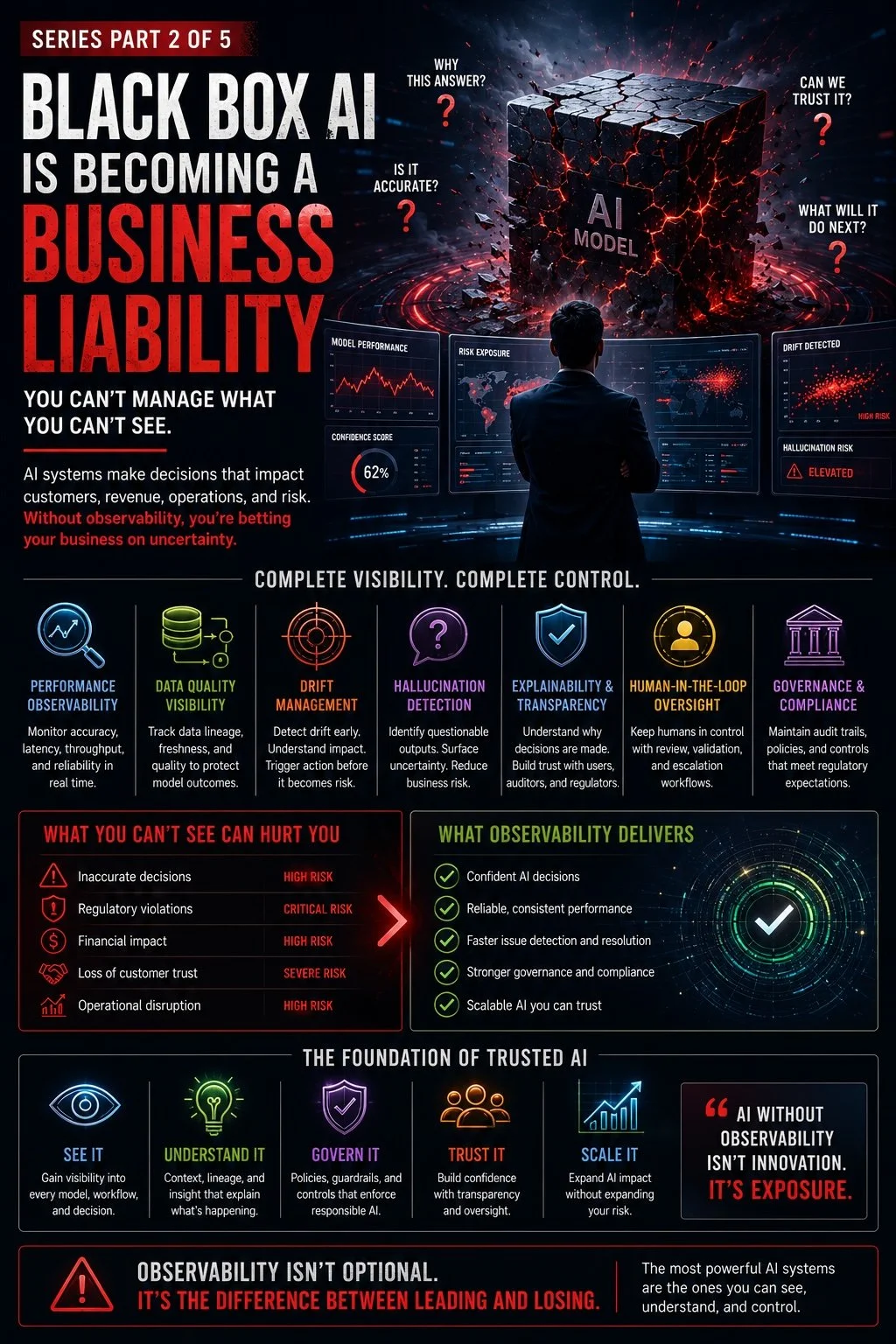
For years, enterprise leaders have been told that artificial intelligence is the future. Deploy AI. Scale AI. Transform with AI. The message has been consistent: move faster or risk falling behind. But as AI becomes more deeply embedded in business operations, a more important question is emerging. What happens when organizations can no longer explain how these systems work?
Across industries, enterprises are deploying intelligent systems into customer service, software development, cybersecurity, financial operations, supply chains, and executive decision-making. These systems are becoming more powerful, more autonomous, and more influential. Yet many organizations are making a dangerous assumption. They assume that because an AI system produces results, it must be working correctly.
That assumption may become one of the most significant business risks of the AI era. Many AI systems operate as black boxes, generating recommendations, predictions, classifications, and decisions that influence revenue, operations, compliance, and customer trust. But when executives are asked why a particular outcome occurred, the answer is often unclear.
This is where the AI conversation shifts from innovation to accountability. A model that cannot be monitored cannot be governed. A model that cannot be explained cannot be trusted. And a model that cannot be trusted eventually becomes a liability.
The risks are already visible. Generative AI systems hallucinate information that appears authoritative. Models drift as market conditions evolve. Data quality issues quietly degrade performance. Automated workflows can amplify errors at machine speed. By the time these issues become obvious, the operational, financial, or reputational damage may already be done.
The problem is not simply that AI makes mistakes. Every technology does. The deeper issue is that many organizations lack the visibility to know when those mistakes are occurring, why they are happening, and how quickly they are spreading. That creates a governance problem, a compliance problem, and ultimately a leadership problem.
Boards are asking harder questions. Regulators are demanding greater transparency. Customers increasingly expect accountability. Executives are discovering that “the model said so” is not an acceptable explanation.
This is why observability is becoming one of the most important disciplines in enterprise AI. Observability gives organizations visibility into model behavior, decision quality, data lineage, performance degradation, hallucinations, drift, operational anomalies, and business impact. It transforms AI from an opaque technology experiment into a manageable business capability.
Just as enterprises monitor cybersecurity threats, financial systems, infrastructure, and applications, they must now monitor intelligence itself. The organizations that recognize this shift early will gain more than risk reduction. They will gain trust from regulators, customers, employees, and leadership teams making increasingly important decisions based on AI-driven insights.
The companies that thrive in the next decade of AI will not necessarily be those deploying the most models. They will be the organizations that can see inside them. In the emerging AI economy, visibility is no longer a technical feature. It is a business requirement. Black box AI is rapidly becoming a liability that enterprises can no longer afford to ignore.