CEO Corner: Engineering Intelligence Compass: From AI Strategy to Execution (part 5 of 10 in the series) by Mark Hewitt
Over the past year, I have spent a great deal of time talking with business and technology leaders about artificial intelligence. One thing has become increasingly clear to me. Most organizations do not have an AI idea problem. They have more potential use cases than they could realistically pursue, access to increasingly capable technology, talented teams, and significant executive interest. The harder problem is turning all of that potential into something that actually works and creates measurable value for the business.
There is often a considerable distance between identifying an opportunity and embedding a working AI-enabled solution into the way an organization operates. Strategies become roadmaps, roadmaps become pilots, and pilots generate enthusiasm. Too often, however, they never make the transition into a durable enterprise capability. This is the execution gap, and it is the problem we designed Engineering Intelligence Compass to address.
Within our Engineering Intelligence framework at EQengineered, Strategy helps an organization determine where it should focus. Catalyst prepares its people and organization to work differently. Compass is where those ideas and capabilities meet execution. It answers what I believe is one of the most important questions in enterprise AI today: How do we actually execute and continuously improve?
Execution Needs to Stay Close to the Problem
One of the lessons we have learned through our work is that successful execution needs to stay close to the people, workflows, systems, and business problems involved. Traditional technology delivery models often begin by gathering requirements, documenting them, handing them to a team, translating them into specifications, and eventually building software. That approach can work very well when both the problem and the desired solution are reasonably well understood.
AI changes that dynamic. The technology is evolving quickly, the quality and usefulness of data may not be fully understood until teams begin working with it, and users frequently discover what they actually need after interacting with an early solution. Models can also behave differently in production than they did during experimentation. Perhaps most importantly, new opportunities tend to emerge once people begin seeing what is possible. This makes AI execution much more iterative than a traditional requirements-to-delivery process.
That is one of the reasons I believe so strongly in Forward Deployed Engineering and the AI-enabled SDLC. Rather than having a distant development team simply receive requirements, Forward Deployed Engineers work alongside the people closest to the problem. They collaborate with business leaders, users, architects, data practitioners, designers, product teams, and existing engineering organizations. Their job is not simply to write code. Their job is to understand the business problem and help solve it.
At EQengineered, we deliberately think about Forward Deployed Engineering as multidisciplinary. Depending on the problem, a team might include senior engineers, architects, data practitioners, designers, strategists, project and program managers, or domain experts. We want to assemble the capabilities required to solve the problem rather than force the problem through a predetermined delivery structure.
The Engineering Intelligence Compass
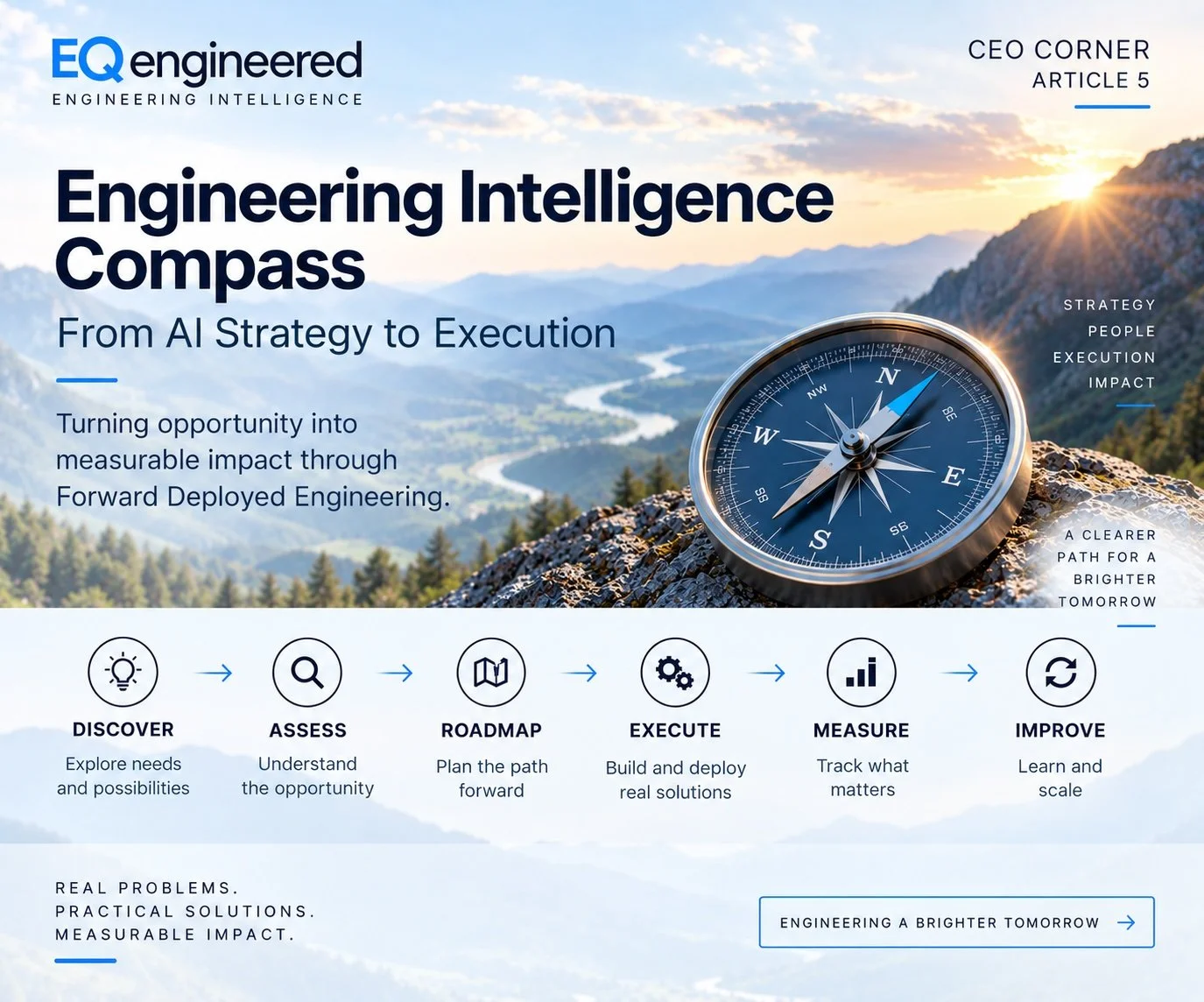
We describe the Compass as a continuous cycle: Discover, Assess, Roadmap, Execute, Measure, Improve. While the model itself is straightforward, the discipline behind it is what matters.
Discovery starts by exploring the business opportunity before assuming we know the answer. It creates space to challenge existing assumptions, uncover opportunities that may not yet be visible, and consider how AI, automation, modernization, or process redesign could change the way work gets done.
Assessment then grounds those possibilities in the environment as it actually exists. What is the business trying to accomplish? How does the work get done today? Where is the friction? What data is available? What technical dependencies exist? Where are the organizational or governance constraints? Before recommending a solution, we need to understand the work, determine what is feasible, and be clear about the outcome we are trying to improve.
From there, we can develop a roadmap that connects opportunity to execution. Some opportunities can move quickly. Others depend on better data, architectural changes, new skills, security controls, or changes to an existing workflow. A useful roadmap recognizes those dependencies and sequences the work accordingly rather than simply creating a long list of AI use cases.
Execution is where the ideas become real. Teams build, integrate, test, and deploy solutions within the actual enterprise environment. But we do not consider deployment the end of the process. We need to know whether the solution accomplished what we set out to accomplish in the first place.
That is why Measure and Improve are part of the Compass. Did cycle time decline? Did quality improve? Were costs reduced? Did engineering velocity increase? Did employees adopt the new workflow? Did the customer experience improve? If the answer is no, deploying the technology is not enough. We need to understand why and continue improving it.
The Goal Is Value, Not Activity
I think this distinction is especially important as organizations accelerate their AI investments. It is relatively easy to measure activity. We can count licenses, pilots, use cases, prompts, users, or models in production. Those numbers can be useful, but they do not necessarily tell us whether the business is better as a result. Every Compass engagement should therefore begin with a clear understanding of the business outcome we are trying to affect. That could be productivity, cost, quality, engineering velocity, revenue, customer experience, risk reduction, or another meaningful enterprise measure. The question should not simply be, “Did we deploy the solution?” The better question is, “Did the solution create the value we expected?” That sounds obvious, but I think it changes the way teams approach AI. When the outcome is defined at the beginning, technology becomes a means of achieving that outcome rather than the objective itself.
AI Should Eventually Change the Workflow
Some of the most interesting opportunities I see today emerge when organizations stop thinking about AI as an individual productivity tool and begin thinking about how entire workflows could operate differently. A developer using AI to generate code can become more productive. A project manager using AI to summarize a meeting can save time. An analyst using AI to explore data can reach conclusions more quickly. Those are worthwhile improvements, but they are still largely improvements to individual tasks.
Now consider what happens when those capabilities begin connecting. Requirements can inform architecture. Architecture can inform development. Development activity can automatically update project status. Testing can identify patterns of risk. Production information can feed future planning. Knowledge generated throughout the process can become available to other teams. Human intervention can increasingly focus on the points where experience, creativity, accountability, and judgment add the most value. At that point, we are no longer simply making individual tasks faster. We are changing the workflow itself. I believe that is where some of the most significant enterprise value from AI will ultimately be created.
Production Is Where the Next Phase Begins
We also need to change the way we think about going live. With traditional software, deployment can sometimes feel like the finish line. With AI, I see it much more as the beginning of the next phase. Once an AI-enabled solution is operating in production, we need to understand how it performs over time. Models need to be evaluated. Costs need to be monitored. Security and governance controls need to remain effective. Reliability matters. User behavior matters. Sometimes the model needs to change. Sometimes a smaller or more localized model can deliver the required outcome at a significantly lower cost. Sometimes the workflow needs to change because people use the system differently than we expected. All of that operational experience should inform what happens next. Execution, measurement, operations, and continuous improvement cannot be treated as separate activities. They are parts of the same system.
Every Engagement Should Make Us Smarter
There is another dimension of Compass that I believe will become increasingly important as organizations mature. Every engagement should make the next engagement better. Teams learn constantly as they solve real problems. They discover patterns that work, create reusable architectures, develop prompts and agents, improve testing approaches, refine governance practices, and learn where particular models or techniques perform well. They also learn what does not work. That knowledge should not disappear when the engagement ends or remain isolated within the team that discovered it. It should become part of the organization's institutional knowledge through playbooks, patterns, runbooks, skills, reference architectures, reusable assets, and lessons learned.
This is the connection between Compass and our Engineering Intelligence Knowledge System. People improve the system through experience, and the system makes people more capable the next time around. Over time, that creates a compounding effect. Execution becomes faster, knowledge becomes deeper, and the organization becomes increasingly capable of turning new opportunities into measurable outcomes.
From Strategy to Impact
Ultimately, that is what Engineering Intelligence Compass is about. Strategy gives us direction. Catalyst develops organizational capability. Compass takes those priorities and capabilities into the enterprise and turns them into action. Measurement tells us whether we created value, and everything we learn feeds back into the system so we can improve the next time (Discover. Assess. Roadmap. Execute. Measure. Improve).
For me, becoming AI-native is not about how many AI projects an organization completes or how many tools it deploys. It is about developing the organizational ability to repeatedly identify meaningful opportunities, execute against them, measure the results, learn from the experience, and do it better the next time. That is the transition from AI strategy to execution. More importantly, it is the transition from AI experimentation to enterprise capability.