CEO Corner: Engineering Intelligence Catalyst: Building an AI-Ready Organization (part 4 of 10 in the series) by Mark Hewitt
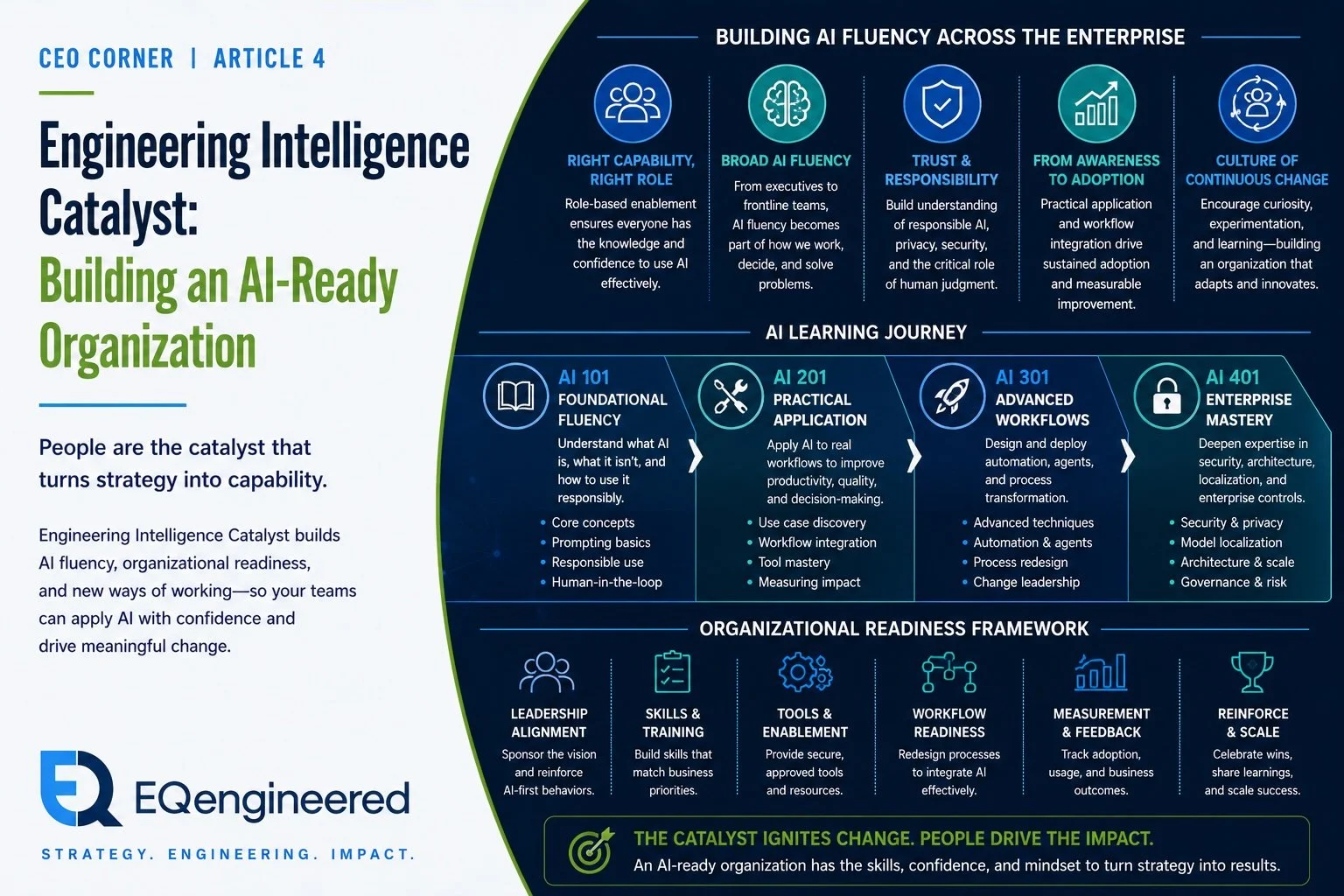
An enterprise can have a clear AI strategy, a well-defined roadmap, strong technology platforms, and executive sponsorship and still struggle to create meaningful value from AI. The reason is fairly simple: becoming AI-native ultimately requires people to work differently. Most organizations have already moved beyond simply giving employees access to AI tools. The harder challenge now is developing the skills, confidence, judgment, processes, and organizational readiness required to incorporate AI into how work actually gets done. This is the role of Engineering Intelligence Catalyst.
If Engineering Intelligence Strategy answers the question, “What should we do?”, Catalyst addresses “How do we prepare our people and organization to do it?”
AI Fluency Cannot Be Limited to Technologists
One of the early assumptions about enterprise AI was that most of the expertise would sit within engineering, data science, or dedicated AI teams. We are quickly discovering that the opposite is true. AI increasingly touches nearly every part of an organization. Project managers can use it to synthesize requirements and identify risks. Analysts can use it to explore data. Designers can accelerate research and prototyping. Engineers can incorporate AI throughout the software development lifecycle. Business leaders can use it to evaluate information, challenge assumptions, and make better decisions.
That means AI fluency needs to extend across the enterprise, although that does not mean everyone needs the same level of technical expertise. People need the appropriate level of capability for the work they perform. The goal is not to turn every employee into an AI engineer. It is to create an organization where people understand how AI can augment their work, recognize its limitations, and know how to use it responsibly.
Training Is Necessary, but Training Alone Is Not Transformation
Most organizations have started some form of AI education. Introductory courses, prompt engineering sessions, acceptable-use policies, and training on specific tools are becoming common. These are good starting points, but building an AI-native organization requires a more systematic approach.
At EQengineered, we think about AI capability development as a progression.
AI 101 establishes foundational fluency. Employees learn what modern AI can and cannot do, how to interact with it effectively, and where security, privacy, responsible use, and human judgment fit into the equation.
AI 201 moves from understanding to practical application. People begin applying AI to their actual work and identifying opportunities to improve productivity, quality, decision-making, or customer outcomes.
AI 301 develops more advanced capabilities. Teams begin exploring automation, agents, intelligent workflows, deeper engineering applications, and ways AI can redesign processes rather than simply make individual tasks faster.
As organizations mature, AI 401 addresses what is required to operate AI securely and economically at scale. Security architecture, model localization, data protection, model selection, compute economics, and enterprise controls become increasingly important as experimentation moves into production.
This progression matters because enterprise capability is not built in a single workshop. It develops over time through learning, application, feedback, and improvement.
Technical Readiness and Human Readiness Are Different Things
Organizations understandably spend significant time assessing whether their technology is ready for AI. Is the data available? Can the architecture support it? Which models should be used? Can existing systems integrate with them? What security controls are required? Those questions are important, but there is another question that deserves just as much attention: Is the organization itself ready?
A technically sound AI solution can still fail if employees do not trust it, managers do not reinforce its use, workflows are not designed to accommodate it, or people do not understand when human intervention is necessary. Human readiness needs to be treated as a core part of AI transformation. Teams need to understand how their roles may change. Leaders need to explain why AI is being introduced. Employees need opportunities to experiment safely. New workflows need to reflect how people actually work, rather than simply what the technology can theoretically accomplish. Technology adoption and organizational adoption are different things. Both need to be engineered.
Move From Generic Training to Role-Based Capability
As an organization becomes more mature in its use of AI, broad education should gradually give way to role-based enablement. A software engineer needs different capabilities than a project manager. A product leader needs a different understanding than someone working in customer operations. Executives need enough fluency to make informed decisions about investment, governance, risk, and organizational change without becoming AI practitioners themselves. This creates an opportunity to develop learning around the work people actually perform.
For engineering teams, that might include AI-assisted requirements development, architecture, coding, testing, documentation, security, and operations. For project and program managers, it could include requirements synthesis, planning, risk identification, status reporting, knowledge management, and intelligent workflow orchestration. Business teams might focus on analysis, decision support, process automation, customer interaction, and use cases specific to their domain. The closer learning gets to the actual work, the more likely it is to create measurable value.
AI Should Change the Workflow, Not Just the Task
There is an important difference between using AI to improve an individual task and redesigning an entire workflow around AI. Consider a project manager using AI to summarize a meeting. Saving 20 minutes is useful, but now imagine connecting meeting transcripts, requirements, project plans, decisions, risks, development activities, and status reporting into an intelligent workflow. Information moves automatically, while people become involved primarily when their judgment is needed.
That represents a very different level of value. The first example improves productivity. The second changes the operating model. Catalyst should help people move beyond asking, “How can AI help me do this task faster?” A more interesting question is, “If AI were a native capability of this organization, how would we design this work differently?” That is where capability building begins to become transformation.
Trust Must Be Learned Alongside Capability
As people become more capable with AI, judgment becomes increasingly important. AI can produce remarkably useful results, but it can also produce remarkably convincing mistakes. Employees need to know when an output should be verified, when sensitive information should not be shared, when human approval is required, and how company policies apply to different tools and use cases.
This is why governance and trust cannot be separated from enablement. Security, privacy, responsible AI, human oversight, and acceptable-use principles should be part of the learning journey from the beginning, rather than treated as a separate compliance exercise. The goal is not simply to create confident AI users. It is to develop capable, responsible AI practitioners throughout the enterprise.
Leaders Have to Change Too
AI transformation is sometimes treated as something leaders sponsor and employees execute. That is unlikely to be enough. Executives and managers need to change how they operate as well. They need to model appropriate AI use, make room for experimentation, communicate expectations, remove organizational barriers, and create incentives that encourage new ways of working. They also need to become comfortable asking different questions. Where is AI changing our economics? Which workflows should no longer exist in their current form? What decisions could improve with better intelligence? Where are employees developing valuable AI practices that should be shared across the organization? Organizational change and adoption extend well beyond training. Executive sponsorship, communication, incentives, management behavior, and cultural reinforcement all contribute to building an AI-native organization.
Capability Should Become Institutional Knowledge
There is another important step if we want this capability to last. Organizations need to capture what their people learn. A team develops an effective prompt pattern. An engineer creates a reusable agent architecture. A project manager redesigns a workflow. A security team develops a better control. A business unit discovers where human review produces the best outcome. Those lessons should not remain with the individual or team that discovered them. They should become part of the organization's Engineering Intelligence Knowledge System, including its skills library, playbooks, patterns, runbooks, reference architectures, governance practices, and reusable accelerators. This creates a powerful cycle. People improve the Knowledge System, and the Knowledge System makes people more capable. Over time, capability begins to compound.
From Capability to Execution
This is where Catalyst fits into the broader Enterprise AI Operating System. Strategy identifies where the organization should focus. Catalyst prepares people to operate differently. The Knowledge System captures what they learn and makes it available to others.
Eventually, however, strategy and capability have to become execution. Prioritized opportunities need to become working solutions embedded in real enterprise workflows. That requires engineering, architecture, data, design, product thinking, and business expertise working together close to the problem. This is where Engineering Intelligence Compass and Forward Deployed Engineering enter the operating system. Compass answers the next question: “How do we execute and continuously improve?” An AI-native enterprise is not created simply by having an AI strategy or training thousands of employees. It emerges when capable people, working within the right operating model, can repeatedly turn AI into measurable business value. Strategy creates direction. Catalyst creates capability. Compass turns that capability into action.