
Why Modern Enterprises Break: The Hidden Technical-Debt Flywheel by Mark Hewitt
Modern enterprises rarely fail all at once. They weaken gradually, often while appearing successful. Revenue grows, products expand, teams ship faster, and technology footprints modernize. From the outside, everything looks functional. Inside the enterprise, however, a slow degradation begins.
This degradation is not the result of a single bad decision. It is the result of compounding technical debt that accumulates over time and accelerates under pressure. It builds quietly, then expresses itself loudly through outages, security incidents, data failures, costly delays, and ultimately a loss of operational confidence.
Most executives understand technical debt as a backlog of engineering cleanup work. That is an incomplete view. Technical debt is not simply an engineering inconvenience. It is a structural business risk. The real danger is not debt itself. It is how debt behaves. Technical debt does not grow linearly. It grows like a flywheel.
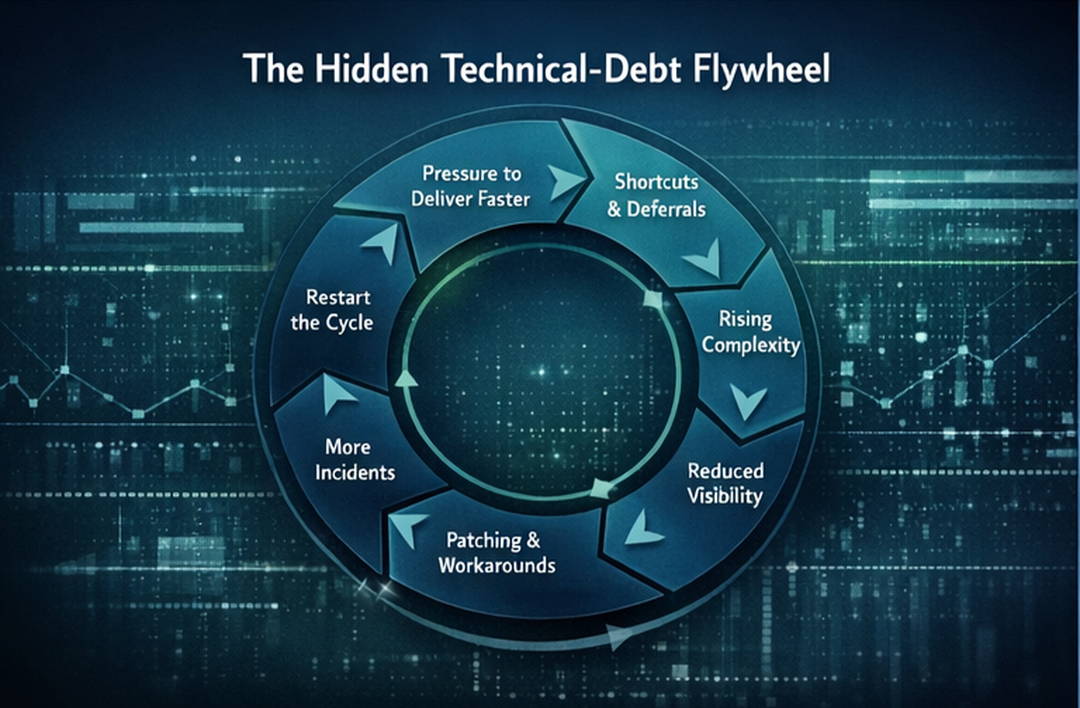
The Hidden Technical-Debt Flywheel
A flywheel starts slowly and becomes powerful through repeated motion. Technical debt behaves the same way. Small compromises multiply through systems, teams, and decision pathways. Over time, the cost to change rises and the probability of failure increases.
The flywheel often looks like this:
Pressure increases to ship faster and reduce cost
Teams take shortcuts and defer foundational work
Complexity expands through integrations, tooling, and dependencies
Visibility declines because systems become harder to understand
Incident frequency rises and delivery friction increases
Teams respond with more patches, workarounds, and defensive development
Modernization slows, morale declines, and leadership confidence erodes
Pressure increases again, restarting the cycle
The enterprise becomes trapped. Leaders believe they need more speed. The system requires more stability. The mismatch creates chronic fragility. This is why modern enterprises break. Not because they are incompetent, but because the operating environment forces local optimizations that create global risk.
Technical Debt is Not Just Code Debt
Most enterprises underestimate technical debt because they define it too narrowly. Code refactoring is only one category. In reality, technical debt spans four interdependent domains.
Architecture debt. Systems evolve without clear boundaries. Dependency chains deepen. Shared services become bottlenecks. Teams lose autonomy.
Data debt. Data pipelines drift. Definitions diverge. Quality and lineage degrade. Trust erodes. AI initiatives become high-cost experiments.
Process debt. Delivery practices become inconsistent. Workflows fragment across teams. Governance becomes manual and reactive. Control declines.
Operational debt. Monitoring is incomplete. Observability gaps widen. Ownership becomes unclear. Incident response becomes heroic rather than repeatable.
Each form of debt amplifies the others. As a result, the enterprise becomes harder to understand and more expensive to operate. The system does not only become slower. It becomes unpredictable.
Why Debt Accelerates in “Successful” Enterprises
Technical debt is often framed as a problem of poorly run organizations. In reality, it accelerates most rapidly in organizations that are growing, scaling, or modernizing aggressively.
Successful enterprises create debt because:
growth increases operational complexity
acquisitions introduce inconsistent technology stacks
cloud adoption expands tool sprawl and integration risk
agile delivery increases release velocity faster than governance maturity
teams optimize for local delivery outcomes rather than global stability
executives reward speed while the system silently accumulates risk
This is why technical debt is frequently invisible until it becomes disruptive. The enterprise can carry a surprising amount of hidden fragility while still achieving business growth. Then one day, it cannot.
The “Breaking Point” is Usually a Trust Failure
The most damaging part of technical debt is not the outage itself. It is what happens after repeated incidents.
Leaders begin to lose confidence in:
operational reporting
delivery commitments
data accuracy
compliance posture
security controls
forecasting and planning
When trust degrades, decision-making slows. Teams become defensive. Modernization becomes harder to justify. The organization begins to operate from a posture of risk avoidance rather than opportunity creation. This is the true breaking point. The enterprise is no longer able to move decisively.
The Debt Flywheel is Powered by Opacity
The technical-debt flywheel accelerates when the enterprise cannot see itself clearly. Opacity creates the conditions for debt to grow because leaders cannot identify risk early, measure the impact of shortcuts, or connect system behavior to business outcomes.
When visibility is incomplete:
dependencies remain unknown
failures appear random
teams struggle to identify root cause
leadership sees incidents as isolated events
investment decisions become reactive rather than strategic
In this environment, the enterprise responds to symptoms, not causes. The flywheel continues spinning. This is why engineering intelligence matters. It is the mechanism that makes debt visible, measurable, and governable.
Breaking the Flywheel Requires a New Discipline
Enterprises do not eliminate technical debt. They manage it. The question is whether debt is controlled or whether it controls the organization. Breaking the technical-debt flywheel requires a disciplined shift from reactive remediation to proactive operational control.
A practical approach begins with five moves.
Make dependencies visible. Create continuous maps of system, data, and integration dependencies. Most debt is hidden inside dependency chains.
Establish debt metrics, not anecdotes. Track measurable indicators such as change failure rate, mean time to recovery, service health drift, data quality drift, and cost of change.
Improve observability and operational analytics. Observability is the foundation. Operational analytics converts signals into decisions. Together, they create visibility.
Embed governance into delivery. Controls that happen after release are too late. Fortification requires guardrails that operate within delivery workflows.
Prioritize resilience outcomes, not cleanup work. The goal is continuity and confidence. Debt remediation should be anchored to operational outcomes such as stability, recoverability, and security posture.
This is not a program that ends. It is an operating capability.
Take Aways
Modern enterprises break because technical debt compounds invisibly. It turns complexity into fragility and speed into risk. Left unmanaged, it forces leaders into a cycle of reactive firefighting that eventually erodes trust, slows modernization, and reduces strategic capacity.
Technical debt should not be treated as an engineering concern. It should be treated as a core enterprise risk. The organizations that win will not be those with the least debt. They will be those with the strongest ability to observe it, govern it, and prevent it from becoming systemic fragility. That is the role of engineering intelligence. It turns hidden decay into operational control.