
Why Enterprise AI Must Be Grounded in Engineering Reality by Mark Hewitt
Enterprise AI has entered a new phase. Leaders are moving beyond experimentation and into operational ambition. They want copilots that accelerate engineering. Agents that execute workflows. AI systems that reduce cost and improve service. They want intelligence embedded across the enterprise.
The ambition is justified. The opportunity is real. The failure mode is also predictable. Many enterprises treat AI as a capability that can be layered on top of existing systems and processes. They assume the model will absorb complexity and create clarity. They assume the AI layer will make legacy systems easier to operate and fragmented data easier to interpret. That assumption is wrong.
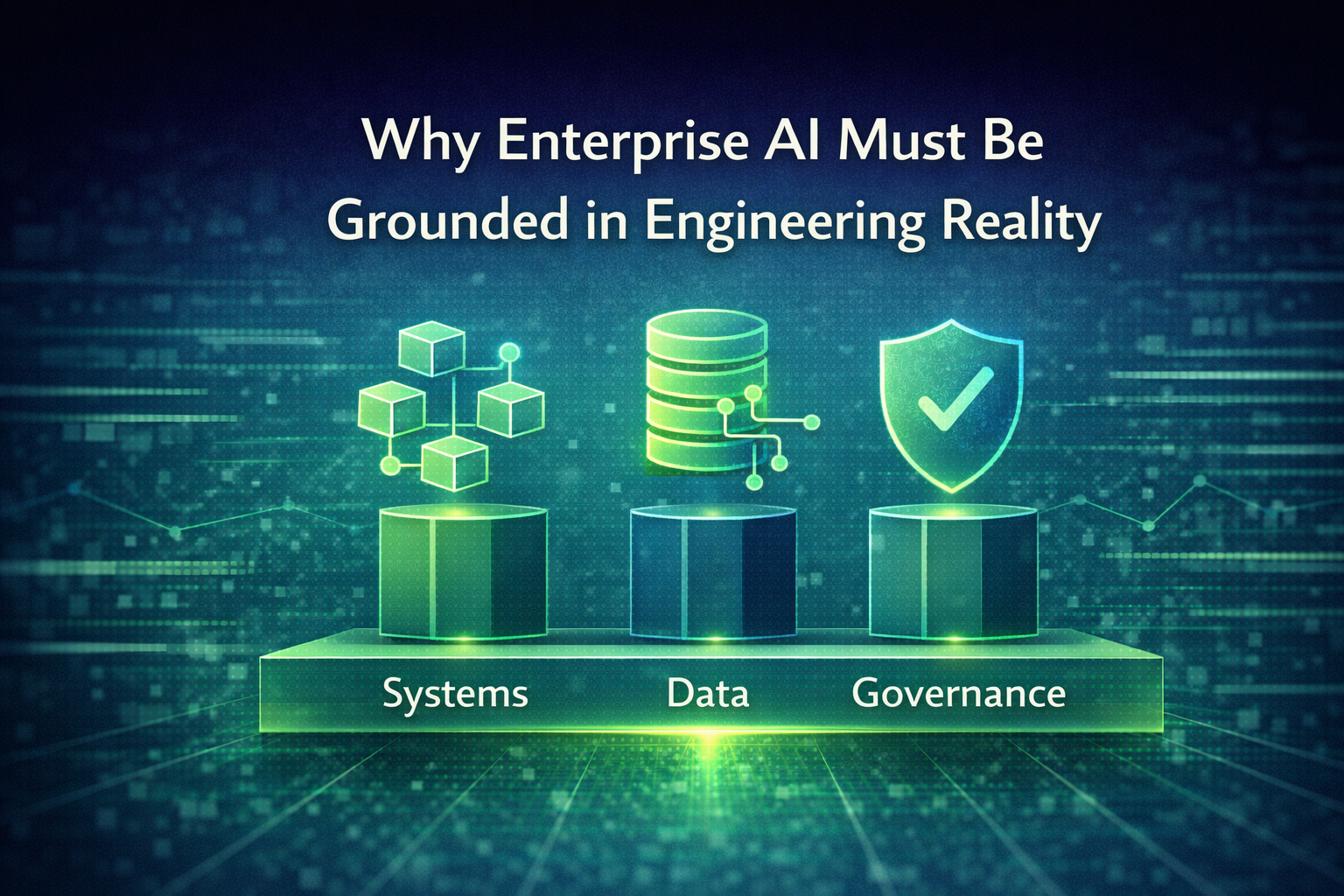
Enterprise AI success depends less on model capability and more on engineering reality. AI must operate inside the constraints of systems, data, dependencies, and governance. If those foundations are weak, AI outcomes will be fragile. If those foundations are strong, AI becomes a multiplier. This is why AI strategy must be grounded in engineering reality.
AI Does Not Replace Engineering Discipline
AI can accelerate work. It can improve decision-making. It can reduce operational load. It can augment talent. It cannot replace engineering discipline.
Engineering discipline is what makes systems observable, changeable, governable, and resilient. It is what ensures data is trusted. It is what creates repeatable delivery and recovery practices. It is what prevents complexity from becoming fragility.
When enterprises treat AI as a shortcut around engineering discipline, they create three predictable outcomes.
AI becomes unreliable because it operates on incomplete signals
AI becomes ungovernable because outputs cannot be traced and controlled
AI becomes a source of operational noise rather than operational strength
This is why engineering intelligence must come first. It creates the foundation for AI to operate safely.
Engineering Reality One: Systems Are Not Simple
Enterprise systems are not clean environments for AI. They are distributed, interdependent, and shaped by years of evolving decisions. Most enterprises include:
multiple architectures running in parallel
service dependencies that span teams and vendors
brittle integration points
inconsistent identity and access controls
varying levels of observability across systems
legacy workflows embedded into modern platforms
AI solutions that assume clean, structured environments often fail at the boundary with real operations. When an AI agent triggers an action that depends on a fragile integration, the action fails. When an AI assistant recommends changes without understanding system boundaries, it introduces risk. When AI lacks visibility into dependency chains, it cannot anticipate cascading effects. Engineering reality is complexity. AI must be designed for it, not in spite of it.
Engineering Reality Two: Data Is Not Trusted by Default
AI systems rely on data. Enterprise data is rarely clean, consistent, and unified. Common data issues include:
inconsistent definitions across departments
pipeline drift and unknown lineage
missing context and poor metadata
data quality variation across sources
fragmented data platforms and shadow analytics
access control complexity and compliance requirements
AI can produce plausible outputs even when data is incorrect. This is one of the greatest risks in enterprise use. The output may appear confident while being wrong. Executives must understand a simple principle, “If the enterprise does not trust its data, it will not trust its AI.” Data governance, lineage, drift detection, and quality measurement are not secondary. They are operational prerequisites.
Engineering Reality Three: Governance Must Operate at Runtime
Enterprise AI introduces a new governance challenge. Traditional governance models assume deterministic systems. AI systems can be probabilistic, adaptive, and capable of generating unexpected outcomes.This creates new requirements. Executives must govern:
who can access which datasets for which use cases
what actions an agent is allowed to execute
how decisions are traced and audited
how drift is detected and corrected
how human oversight is enforced
how exceptions are managed transparently
If governance is only policy documentation, AI will outpace oversight. Governance must operate at runtime. This requires observability, continuous controls, and evidence capture embedded into AI delivery and AI operations.
AI Success Requires a Clear Operational Contract
One of the most important ideas executives can adopt is the concept of an operational contract for AI. An operational contract defines:
what the AI system is allowed to do
what data it can use
what boundaries and controls apply
what level of confidence is required for action
what human oversight is mandatory
what telemetry is captured for monitoring and audit
who owns the system and who owns the outcome
Without this contract, AI systems become ambiguous. Ambiguity is risk. This contract also forces alignment between business ambition and engineering reality.
The Shift Leaders Must Make: From AI Tools to AI Systems
Many AI initiatives focus on tools: chat interfaces, copilots, workflow assistants, and knowledge bots. These can be valuable. But the enterprise advantage will come from AI systems. AI systems are integrated into operations. They use governed data. They operate with controls. They have observability. They have measurable outcomes. This requires engineering intelligence.
Engineering intelligence provides:
shared observability across systems and data
traceability for decisions and actions
drift detection across data and AI behavior
automated governance enforcement
operational metrics that leadership can trust
recovery readiness when AI workflows fail
It turns AI into an enterprise capability rather than an experiment.
A Practical Path to Grounded AI Adoption
Executives can sequence AI adoption to align with engineering reality.
Start with use cases that reduce operational load and improve decision clarity. Avoid high-risk autonomous execution as an initial step.
Strengthen the data foundation for the targeted workflows. Establish authoritative sources, lineage, quality measurement, and drift detection.
Improve observability across the dependency chain. Ensure the enterprise can detect issues quickly and understand root cause.
Define the operational contract and governance boundaries. Clarify what AI can do, what it cannot do, and how it is monitored.
Scale AI only when trust is measurable. Expand based on operational confidence, not novelty.
This approach allows AI to increase capability without increasing fragility.
Take Aways
Enterprise AI succeeds when it is grounded in engineering reality. AI does not eliminate complexity. It operates inside it. AI does not create trust. It relies on it. AI does not replace governance. It increases the need for it.
The enterprises that will succeed will not be those that adopt AI fastest. They will be those that adopt AI with the strongest foundations. Systems that are observable. Data that is trusted. Governance that is continuous. Teams that operate with discipline.Engineering intelligence is what makes that possible.