
The Relationship Between Values, Trust, and Culture by Jessica Vaughan
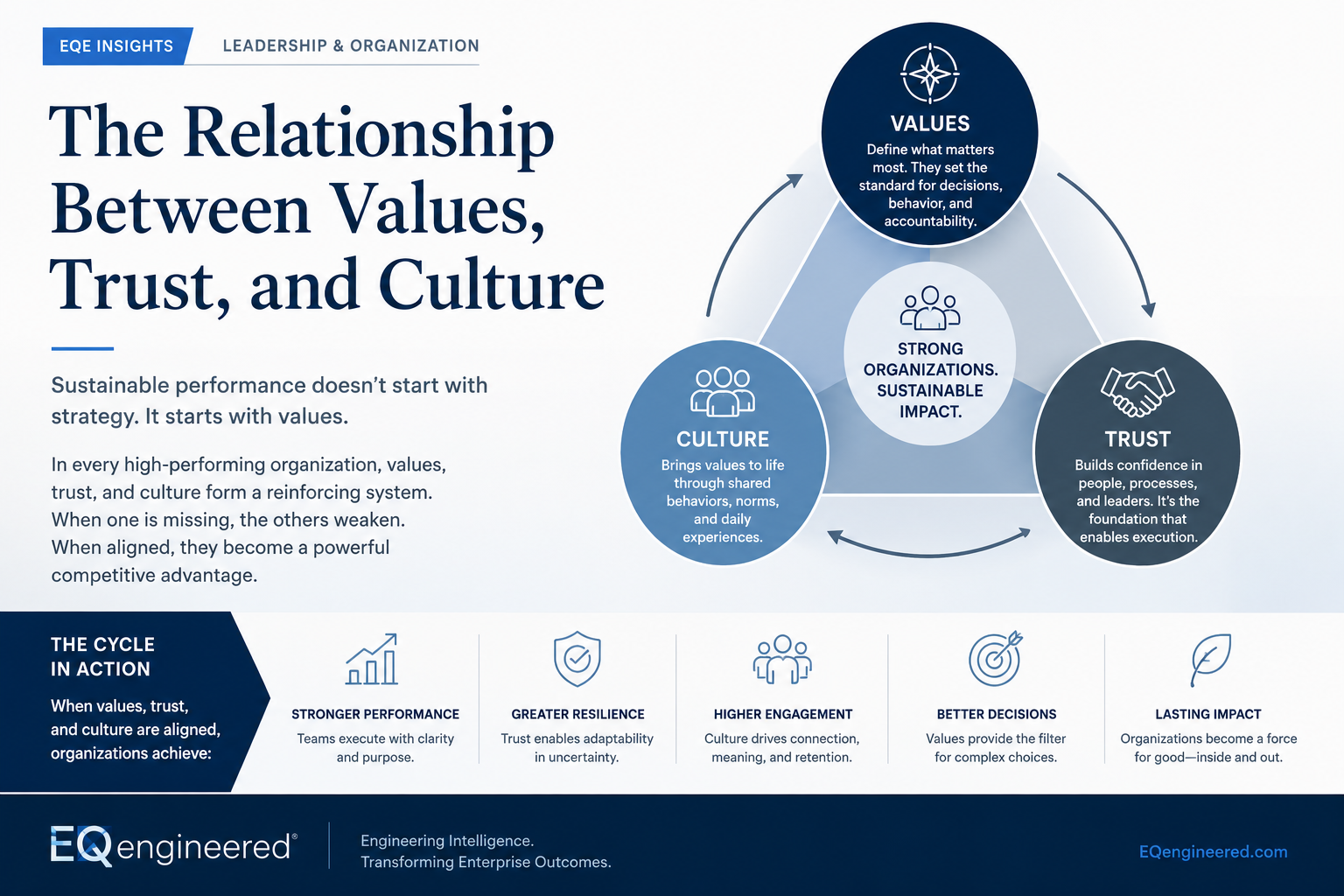
Most organizations spend significant time discussing culture. They invest in employee engagement programs, communication initiatives, recognition efforts, leadership development, and countless other activities designed to strengthen it. They measure culture, assess culture, and seek to improve culture.
Yet in many cases, they are focused on the wrong starting point. Over the course of my career in people leadership, I have come to believe that one of the most common misconceptions in organizational leadership is the belief that culture can be built directly. I do not believe it can. Culture is not a cause. It is an outcome. It is the result of thousands of decisions, interactions, behaviors, and experiences that accumulate over time. It reflects how people experience an organization, not how an organization describes itself.
This distinction matters because many organizations attempt to improve culture by focusing on culture itself. In reality, sustainable culture is often created indirectly through something much more fundamental. I often think about organizational culture through a simple framework:
Values → Behaviors → Trust → Culture → Performance
Values establish expectations. Behaviors bring those values to life. Trust develops when behaviors consistently align with values. Culture emerges from the presence, or absence, of trust. Performance is ultimately influenced by the culture people experience every day.
When organizations attempt to improve culture, they often focus on the end of the chain rather than the beginning. In my experience, the most effective organizations do the opposite. They focus on values, reinforce behaviors, and earn trust. Culture follows.
Every organization has values. Whether formally defined or informally understood, values influence how decisions are made, how people interact, how leaders lead, and how organizations respond when circumstances become difficult. Values matter not because they describe an organization at its best, but because they establish expectations for how it will operate when faced with uncertainty, pressure, competing priorities, and change.
At EQengineered, our values are Integrity, Transparency, Reliability, and Trust. While each serves a distinct purpose, together they create a foundation that influences how we work with one another, support our clients, and approach the responsibilities entrusted to us. More importantly, they provide standards against which behavior and decisions can be evaluated. The challenge, of course, is that values become meaningful only when they move beyond language and into practice.
Values as Organizational Commitments
One of the most common misconceptions about values is that they exist primarily to inspire. While they can certainly be aspirational, their greater purpose is operational. Values should influence how leaders communicate, how teams collaborate, how performance is evaluated, and how decisions are made. They should provide clarity when circumstances are ambiguous and consistency when priorities compete.
Without practical application, values risk becoming little more than organizational branding. Employees are remarkably perceptive when it comes to identifying the difference between stated values and lived values. They notice which behaviors are rewarded, tolerated, and corrected. They pay attention to whether leaders demonstrate the same standards they expect from others. For this reason, values should not be viewed as declarations. They should be viewed as commitments. Organizations earn credibility when those commitments are visible in everyday actions.
Where Organizations Get Culture Wrong
Many organizations attempt to strengthen culture by focusing directly on culture. They launch engagement initiatives, recognition programs, culture committees, and communication campaigns. While these efforts can be valuable, they often address symptoms rather than causes.
Culture is what employees experience. If trust is weak, culture suffers. If leadership behavior is inconsistent, trust suffers. If values are unclear or applied unevenly, behaviors become fragmented. The most effective way to strengthen culture is often to move upstream. Rather than asking, “How do we improve culture?” leaders may be better served by asking:
Are our values clear?
Are leaders consistently demonstrating them?
Are employees seeing alignment between what we say and what we do?
Do our decisions reinforce the standards we claim to uphold?
The answers to those questions often reveal more about culture than any engagement survey ever could.
The Role of Leadership
No group has a greater influence on the relationship between values, trust, and culture than leadership. While culture is shaped by everyone within an organization, leaders play a unique role because their decisions and behaviors carry disproportionate visibility. Employees naturally look to leaders for signals about what is important, what is acceptable, and which standards will be upheld. Leadership behavior serves as the bridge between values and trust.
Over the years, I have observed that employees rarely expect leaders to have all the answers. What they do expect is consistency. They want to see alignment between what leaders say, what leaders do, and how decisions are made. This becomes especially important during periods of challenge. When circumstances are favorable, most organizations find it relatively easy to demonstrate their values. During uncertainty, however, values become more visible.
In my experience, employees are generally understanding of difficult decisions when they believe those decisions have been made thoughtfully, communicated honestly, and guided by consistent principles. What undermines confidence is not necessarily the decision itself. It is the perception that values have been set aside in the process.
Trust as the Foundation of Culture
Trust is often discussed as a cultural outcome, but it is also a prerequisite for many of the conditions organizations hope to create. Collaboration depends on trust. Innovation depends on trust. Constructive feedback depends on trust. Healthy disagreement depends on trust. Without trust, communication becomes guarded and people become more focused on self-protection than contribution.
When trust is present, the opposite occurs. People are more willing to share ideas, challenge assumptions, raise concerns, and engage in honest dialogue. Teams collaborate more effectively because confidence exists in both intentions and capabilities.
Trust is rarely established through a single initiative. It develops through consistent experiences that reinforce confidence in leadership, colleagues, and the organization itself. Over time, those experiences become cultural norms.
Why Values Matter During Change
The importance of values becomes particularly evident during periods of organizational change. Growth, restructuring, market shifts, evolving client expectations, technological advancements, and leadership transitions all create uncertainty. Contrary to popular belief, people do not necessarily resist change. What they often resist is ambiguity. Values help reduce that ambiguity.
When employees understand the principles guiding organizational decisions, they are better equipped to navigate change, even when outcomes may be challenging. They may not agree with every decision, but they can understand the rationale behind it. Trust does not require universal agreement. It requires confidence in the integrity of the process.
The Impact on Client Relationships
While values play an essential role internally, their influence extends well beyond the employee experience. Clients experience organizational values whether they are explicitly aware of them or not. They experience integrity through honest conversations and ethical decision-making. They experience transparency through communication and partnership. They experience reliability through consistent delivery and accountability. They experience trust through every interaction that reinforces confidence in the relationship.
In professional services organizations, relationships are among the most valuable assets a company possesses. Technical expertise is important, but expertise alone rarely sustains long-term partnerships. Lasting relationships are built on confidence, credibility, and consistency. Values help create those conditions.
Culture as a Long-Term Investment
Culture is often discussed as though it were a program or initiative. In reality, culture is the cumulative result of choices made over time. It develops gradually through daily interactions, expectations, decisions, and behaviors. It is strengthened through consistency and weakened through contradiction.
The organizations that cultivate strong cultures understand that values require ongoing stewardship and that trust must continually be earned. Perhaps most importantly, they recognize that culture influences engagement, retention, collaboration, innovation, client relationships, leadership effectiveness, and ultimately performance.
Organizations often invest significant effort trying to shape culture directly. In my experience, culture is rarely improved that way. Strong cultures emerge when values guide behavior, behavior earns trust, and trust becomes embedded in the daily experience of work.
The responsibility of leadership is not to manufacture culture. It is to create the conditions that allow trust to grow. When that happens consistently over time, culture becomes less of an initiative and more of a reflection of who the organization truly is.