
The Executive Model: Data, Systems, People, AI by Mark Hewitt
Most enterprises approach modernization and AI adoption as technology initiatives. They invest in platforms, hire talent, build proofs of concept, and launch transformation programs. They expect results to follow. Sometimes they do. Often, they do not. The reason is not a lack of capability. It is a lack of coherence.
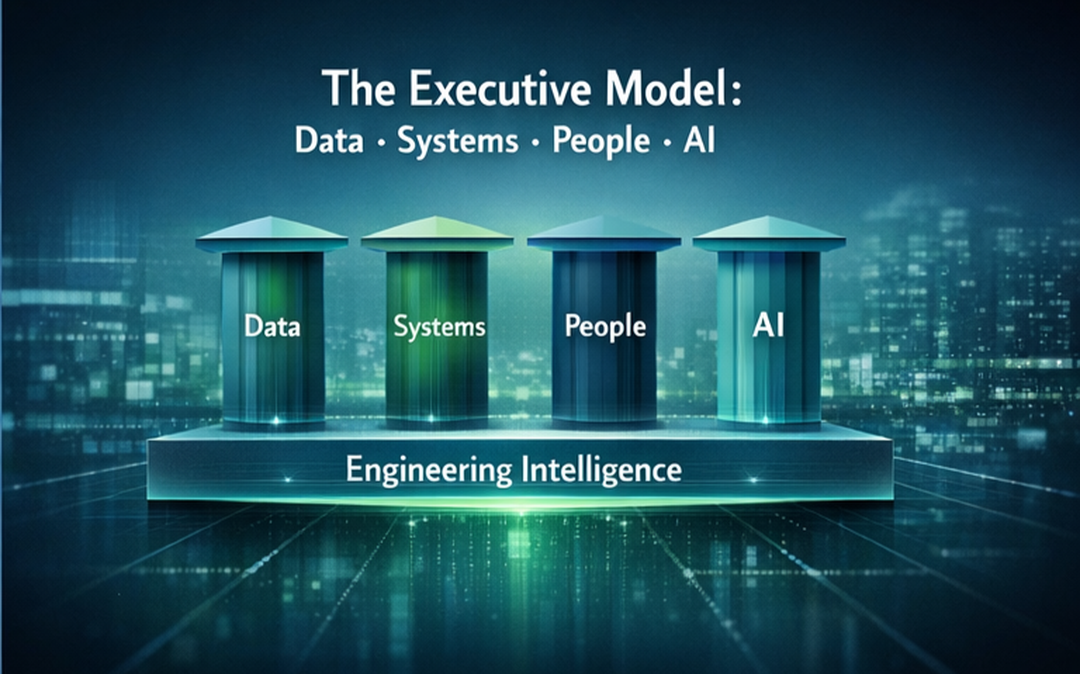
Enterprise performance is not determined by any single investment in data, cloud, AI, or engineering practice. It is determined by how well these elements work together, and whether the organization can operate them at scale with clarity, governance, and continuity. The enterprises that flourish will not be those with the best tools. They will be those with the strongest operating model for intelligence and resilience. This is where the executive model becomes essential. It can be simplified to four pillars that must operate in alignment: data, systems, people, and AI.
The Executive Challenge: Intelligence Without an Operating Model Becomes Chaos
Many enterprises have accumulated intelligence capabilities across the organization. Data teams build pipelines. Engineering teams modernize systems. Security teams tighten controls. Product teams launch customer experiences. AI teams experiment with agents and copilots.
Yet the organization still feels fragile. Incidents are frequent. Data trust is inconsistent. Delivery cycles are unpredictable. Governance is manual. AI initiatives struggle to move beyond pilots. Leaders still lack confidence in operational reporting. This is not because the enterprise lacks intelligence. It is because intelligence is not operationalized across the whole fabric. Engineering intelligence is not a product. It is the enterprise’s ability to connect signals, decisions, governance, and action into a coherent system.
The executive model is the blueprint for doing that.
Pillar One: Data
Data is the foundation of decision-making, automation, and AI. But data alone does not create intelligence. It creates potential. For data to function as a strategic asset, executives must ask three questions.
Do we trust our data enough to act on it?
Do we know where our data comes from and how it changes?
Can we measure data quality and drift in ways that are tied to business risk?
Most organizations struggle here because they treat data modernization as an infrastructure effort. They migrate storage, adopt new platforms, and build pipelines. They do not always build the governance, ownership, and operational controls required to sustain trust. Data maturity is not about volume. It is about integrity, lineage, and accountability. Without this, AI efforts become unstable and operational decisions become uncertain.
Pillar Two: Systems
Systems are the operational environment. They generate revenue, enable workforce productivity, support customer experience, and maintain compliance. Modern systems are distributed and deeply interconnected. Executives should care about systems because they determine continuity.
The key questions are:
Can we observe system health across dependencies in real time?
Do we know which systems are most fragile and why?
Can we change our systems quickly without causing new instability?
Modern enterprises break when systems become too complex to understand and too risky to change. System maturity is not about having microservices or cloud-native infrastructure. It is about boundaries, dependency clarity, recoverability, and operational resilience. Systems should be governable at speed. If they are not, transformation becomes fragility.
Pillar Three: People
People remain the most critical component of enterprise resilience. In the modern environment, complexity cannot be managed purely through tooling. It requires clear accountability, consistent practices, and strong operating habits. Many enterprises have talented people, but their systems still break. Why? Because resilience does not emerge from talent alone. It emerges from:
clear ownership of systems and data
shared operating standards across teams
well-practiced incident response and recovery
incentives aligned to stability, not only speed
leadership clarity around what matters most
Executives should focus here because cultural drift is operational drift. If teams build differently, measure differently, and respond differently, the enterprise cannot scale intelligence. It becomes fragmented. Resilience becomes accidental rather than intentional. People maturity is not about headcount. It is about operating clarity.
Pillar Four: AI
AI is a force multiplier, but it is not a stabilizer by default. AI can accelerate delivery and decision-making. It can also amplify risk, inconsistency, and governance gaps. The executive questions for AI are:
Where does AI create measurable operational advantage?
Where does AI introduce new risk or opacity?
Can we govern AI systems with the same discipline as software systems?
AI changes enterprise operations because it introduces a new class of behavior. AI systems can drift, behave probabilistically, and create outcomes that are difficult to explain. This is not a reason to avoid AI. It is a reason to operationalize it. AI maturity requires governance mechanisms that extend beyond policy. It requires observability, traceability, guardrails, human oversight, and clearly defined ownership. AI without operational controls does not create intelligence. It creates uncertainty.
The Model Only Works When the Pillars Align
The four pillars are not independent. They are interdependent. Misalignment creates systemic fragility.
If data is weak, AI outputs cannot be trusted. If systems are opaque, incidents become unpredictable. If people practices are inconsistent, governance becomes manual. If AI scales without oversight, risk multiplies.
The executive goal is not to perfect each pillar independently. The goal is to align them into a coherent operating system that produces measurable confidence. This is the purpose of engineering intelligence. Engineering intelligence is the connective layer that brings these pillars into operational alignment through:
shared observability across systems and data
continuous measurement of drift and risk
decision workflows that connect signals to actions
governance mechanisms embedded into delivery
executive-level metrics for resilience, trust, and continuity
It translates complexity into clarity.
A Practical Executive Starting Point
Executives can begin building this model without launching a large transformation program. A practical starting sequence is:
Define what operational confidence means for the organization
Identify critical pathways across revenue, customer, compliance, and workforce
Establish baseline visibility across systems and data in those pathways
Set ownership and governance standards that apply across teams
Introduce AI where it reduces operational load and improves decision quality
Measure resilience outcomes quarterly using business-aligned metrics
This creates a durable foundation for modernization and agentic AI adoption.
Take Aways
Engineering intelligence is not a toolset. It is a business capability. The executive model for engineering intelligence is the alignment of data, systems, people, and AI into a coherent operating system that produces resilience, continuity, and governable progress.
Enterprises that treat these as separate initiatives will continue to struggle with fragility. Enterprises that align them will build operational confidence at scale. That is what modern enterprise strength looks like.