
CEO Corner: The AI-Native Enterprise: When AI Becomes How the Business Operates (part 10 of 10 in the series) by Mark Hewitt
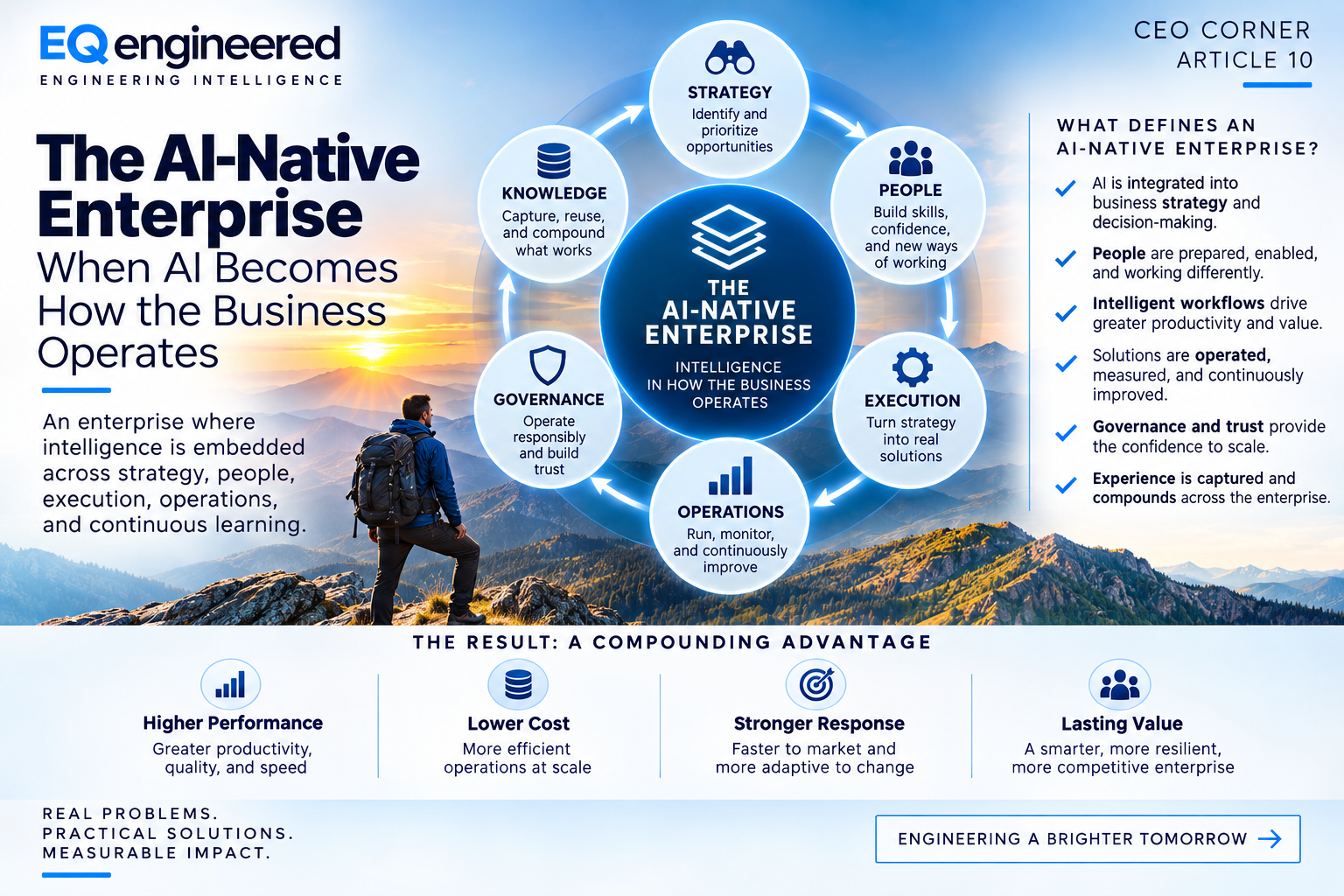
Over the course of this CEO Corner series, I have explored the capabilities I believe organizations need to develop as artificial intelligence moves from experimentation into everyday enterprise operations. We have examined strategy, organizational readiness, execution, institutional knowledge, value realization, operations, and governance. Each represents an important discipline, but their collective value becomes much more significant when they operate as an integrated system rather than a collection of independent initiatives.
This is the central idea behind our Enterprise AI Operating System at EQengineered. We believe the next phase of enterprise AI will be defined less by the number of technologies organizations deploy and more by their ability to integrate intelligence into how they make decisions, develop their people, engineer solutions, manage operations, and continuously improve business performance. That is what I mean when I describe an organization as AI-native.
I use that term deliberately because becoming AI-native is not simply a matter of adopting more artificial intelligence. An organization does not achieve that distinction by deploying hundreds of models, providing copilots to thousands of employees, introducing autonomous agents, or maintaining an ambitious portfolio of AI projects. Those activities may demonstrate progress, but they do not necessarily indicate that the enterprise has fundamentally changed how it operates.
An AI-native enterprise has developed the organizational capability to repeatedly identify where intelligence can create meaningful value, prepare its people and technology to pursue those opportunities, execute effectively, operate responsibly, measure outcomes, and apply what it learns to the next opportunity. Over time, AI becomes less of a distinct initiative and more of an integral part of how the organization conducts business.
AI Becomes Part of the Business
Most enterprises still approach artificial intelligence as a specialized initiative. They establish AI committees, develop dedicated strategies, allocate separate budgets, launch pilots, and create centers of excellence responsible for determining how the technology should be introduced. Given the pace of technological change and the uncertainty surrounding many applications, this approach is understandable and often necessary during the early stages of adoption.
However, I believe this distinction will gradually become less relevant as organizations mature. We no longer consider the internet a separate innovation initiative within most enterprises. Cloud infrastructure, analytics, APIs, mobile applications, and modern software engineering have similarly become fundamental elements of how businesses operate. They remain important technologies, but their value is increasingly understood through the business capabilities they enable rather than their existence as independent disciplines.
Artificial intelligence will follow a similar progression, although its implications for organizational design, decision-making, and the nature of work may be considerably more profound. The most mature enterprises will not begin every business challenge by asking where they can introduce AI. Instead, they will examine the opportunity and determine the most effective combination of people, processes, data, software, automation, and intelligent capabilities required to address it. When that happens, AI is no longer something the enterprise is trying to implement. It becomes one of the capabilities the organization naturally uses to solve problems, improve performance, and create value.
Business Strategy Still Comes First
Despite the remarkable capabilities emerging from artificial intelligence, I believe the starting point for meaningful enterprise transformation remains fundamentally unchanged. Leadership must first understand what the business is trying to accomplish and what stands in the way of achieving those objectives. Organizations need to examine where they intend to grow, where operating costs are increasing, where customers experience unnecessary friction, and where employees spend time on activities that contribute relatively little value. They must understand where technical debt constrains innovation, where fragmented information limits decision-making, and where existing processes prevent the business from responding effectively to changing conditions. These considerations should determine where AI investments are made, not the availability of an interesting new model or technology.
This is why our Engineering Intelligence framework begins with Strategy. At EQengineered, we believe technology decisions should follow a clear understanding of business priorities, operational realities, and the outcomes an organization is seeking to achieve. Artificial intelligence may be part of the answer, but modernization, traditional automation, process redesign, better data practices, or organizational changes may be equally important.
As enterprises become AI-native, this discipline becomes embedded in leadership decision-making. Executives develop a stronger understanding of where intelligence can improve economics, productivity, customer experience, responsiveness, and competitive position. Just as importantly, they become more effective at recognizing situations where AI introduces unnecessary complexity or fails to provide sufficient business value. The ability to determine where not to use artificial intelligence may ultimately prove just as valuable as knowing where to deploy it.
The People Need to Transform With the Technology
No organization can become AI-native through technology investment alone. The transformation depends equally on the people who will use, manage, improve, and ultimately remain accountable for the intelligent capabilities being introduced. Employees need to understand what AI can accomplish, where its limitations exist, and how it can be applied responsibly within their roles. Engineers, architects, designers, analysts, project managers, business leaders, and operational teams will increasingly encounter opportunities to rethink how their work is performed. Some activities will become more efficient, others will be redesigned, and entirely new responsibilities will emerge as intelligent systems become integrated into enterprise workflows.
This is why Engineering Intelligence Catalyst is a critical component of our operating system. We approach organizational readiness as a progression of capabilities, beginning with foundational AI fluency and advancing through practical application, workflow integration, and more sophisticated areas such as intelligent automation, agentic systems, security architecture, governance, model localization, and the economics of enterprise AI. However, education and technical proficiency represent only part of the transformation. Leadership behavior, communication, organizational incentives, trust, and management practices must evolve alongside the technology. Employees need opportunities to experiment responsibly, clear expectations regarding acceptable use, and confidence that leadership understands the implications of changing workflows and responsibilities.
An AI-native enterprise does not simply provide employees with increasingly sophisticated tools. It creates an environment where people develop the judgment, skills, and confidence to work differently because those capabilities exist. That requires sustained leadership commitment and a willingness to rethink established organizational practices rather than simply introducing technology into existing structures.
From Individual Productivity to Intelligent Workflows
Much of the initial value organizations are realizing from artificial intelligence has occurred at the individual level. Software engineers can accelerate development, analysts can examine information more efficiently, project managers can reduce administrative effort, designers can explore alternatives more quickly, and executives can synthesize complex information in a fraction of the time previously required. These improvements are meaningful, and they represent an important starting point for enterprise adoption. However, I believe the larger economic opportunity will emerge when organizations begin redesigning entire workflows rather than simply accelerating the individual tasks within them.
Consider the difference between helping an engineer generate code faster and improving the entire software delivery lifecycle. Faster code generation is valuable, but the broader process may still be constrained by requirements, architecture, testing, security reviews, deployment procedures, or operational handoffs. Accelerating one activity does not necessarily improve the performance of the overall system.
The same principle applies across the enterprise. Intelligent capabilities can help information move between activities, identify exceptions before they become significant problems, automate defined actions across applications, and support decisions within established boundaries. Employees can then focus more of their attention on the areas where human judgment, creativity, relationships, and accountability provide the greatest value. This changes the nature of the conversation. Instead of asking how AI can help someone complete an existing task more quickly, leaders can begin asking how the workflow itself should be designed if intelligent capabilities were available from the beginning. That distinction is important because it moves artificial intelligence from an individual productivity enhancement toward a more fundamental transformation of enterprise operations.
Execution Needs to Stay Close to the Business
Identifying opportunities and developing a roadmap are necessary steps, but neither guarantees that an organization will achieve meaningful results. Enterprise transformation requires execution that remains closely connected to the people, processes, technologies, and business conditions where the work actually occurs.
This is the role of Engineering Intelligence Compass and our approach to Forward Deployed Engineering. Our Compass methodology follows a continuous cycle of Discover, Assess, Roadmap, Execute, Measure, and Improve. Discovery creates the opportunity to explore business challenges, question assumptions, and identify possibilities that may not initially be apparent. Assessment evaluates those opportunities against the organization's actual environment, including technical dependencies, data readiness, operational constraints, governance requirements, and potential business value. The roadmap establishes a practical sequence of activities, while execution turns the strategy into working capabilities. Measurement and improvement complete the cycle by connecting implementation to business outcomes and using the results to inform subsequent decisions. This is particularly important with AI because the technology, operating environment, and organizational understanding will continue to evolve after a solution has been deployed.
Forward Deployed Engineers and multidisciplinary teams help maintain this connection between strategy and execution. By working alongside business leaders, users, architects, designers, engineers, data practitioners, and project and program managers, they develop a more complete understanding of the problems being addressed and the practical realities of implementing change. As intelligent capabilities become more deeply integrated into business operations, that proximity will become increasingly valuable. Successful execution will depend on understanding not only how the technology works, but how the organization itself works.
Going Live Is the Beginning
One of the recurring themes throughout this series has been that deploying an AI solution should never be confused with completing the transformation. Once intelligent capabilities begin operating within actual business workflows, organizations encounter a different set of responsibilities. They must monitor reliability, model performance, response quality, security, operating costs, employee behavior, and business outcomes. They need to understand when human intervention is appropriate, where greater automation may be justified, and whether the capability continues to perform as originally intended. This is why AI Operations, or Day 2 Operations, must become a permanent enterprise discipline rather than an activity performed only when something goes wrong.
Organizations need the ability to change models, optimize infrastructure and compute costs, respond to incidents, improve retrieval and data quality, refine governance controls, and adjust workflows as business requirements evolve. They also need operational visibility that connects technical performance to the economic and organizational outcomes the investment was intended to produce. The objective is not simply to keep AI systems functioning. It is to continuously improve the business capabilities those systems enable.
An AI-native enterprise recognizes that production is where the organization begins developing a deeper understanding of how intelligent technology performs under real operating conditions. That experience should become a source of continuous learning and improvement rather than merely another operational responsibility.
Governance Creates the Confidence to Scale
As organizations increase their reliance on artificial intelligence, governance and trust become essential to sustainable adoption. This is particularly important as intelligent systems gain greater autonomy and begin performing actions that previously required direct human involvement. Enterprises need a clear understanding of what information AI systems can access, what decisions they can influence, what actions they are authorized to perform, and where human approval or intervention is required. Accountability must remain explicit, even as the technology becomes more capable and the boundaries between human and automated activities evolve.
Within our Enterprise AI Operating System, Governance and Trust are designed to operate across Strategy, Catalyst, Compass, AI Operations, and the Knowledge System. Responsible practices must be reflected in architecture, access controls, security, policies, testing, monitoring, operational procedures, and employee behavior rather than being addressed through a separate approval process at the end of development. I believe this distinction is particularly important for executive leadership. Governance should not be understood primarily as a mechanism for restricting innovation. Effective governance establishes the clarity and confidence organizations need to pursue innovation responsibly.
When employees understand the boundaries, engineering teams have established standards, and leadership has appropriate visibility into risk and accountability, the organization can make decisions more confidently and scale successful capabilities more effectively. Trust is not something that can be established once and assumed to endure. It must be continuously reinforced through responsible design, operational discipline, transparency, and demonstrated performance.
Every Experience Should Make the Organization Smarter
Perhaps one of the most important characteristics of an AI-native enterprise is its ability to learn systematically from experience. Every implementation generates knowledge. Teams discover which models perform effectively for particular workloads, which architectures are reliable, which governance controls are practical, where users encounter difficulties, and how intelligent capabilities affect operational performance. They also learn which opportunities produce meaningful economic value and which approaches should be reconsidered.
Unfortunately, organizations frequently allow that knowledge to remain within individual project teams, isolated repositories, or the experience of a relatively small number of employees. When those people move to other assignments or new initiatives begin, much of the learning must be recreated. We at EQengineered believe that represents a significant missed opportunity. The Engineering Intelligence Knowledge System is designed to transform individual experience into reusable organizational capability. Skills, playbooks, implementation patterns, runbooks, reference architectures, governance practices, accelerators, and lessons learned become assets that other teams can access, apply, and improve.
Over time, the organization develops an increasingly valuable understanding of how to apply intelligence within its own operating environment. New teams begin with stronger foundations, new projects benefit from proven approaches, and subsequent investments are informed by a deeper understanding of what has already worked. This creates an important distinction between an enterprise that has completed numerous AI projects and one that has developed genuine institutional intelligence. The former accumulates implementations. The latter accumulates the knowledge and capability required to make future implementations more effective.
Value Needs to Remain at the Center
Every capability discussed throughout this series ultimately needs to contribute to one objective: creating measurable enterprise value. This is why Value Realization sits at the center of our Enterprise AI Operating System. Adoption rates, productivity improvements, employee participation, and the number of solutions deployed can all provide useful indicators of progress. However, none of those measures independently establishes whether an organization is performing better because of its AI investments.
Executives need to understand whether operating costs are declining, capacity is increasing, products are reaching customers more quickly, quality is improving, and employees are spending more time on activities that contribute meaningful value. They need to evaluate whether customer experiences are improving, risks are being reduced, and new revenue opportunities are emerging. These outcomes should be defined before investments begin, measured throughout execution, and continually evaluated once solutions enter production. Organizations also need the discipline to reconsider or discontinue initiatives that do not deliver sufficient value, regardless of how technically impressive those capabilities may be. An AI-native enterprise does not measure success primarily by how much artificial intelligence it has adopted. It measures success by how effectively intelligence contributes to the performance of the business.
The Compounding Enterprise
When the capabilities of the Enterprise AI Operating System begin working together, something important happens. The organization develops a reinforcing cycle in which each investment, implementation, and operational experience contributes to its ability to execute the next opportunity more effectively.
Engineering Intelligence Strategy identifies where intelligence can create meaningful business value. Catalyst prepares people and the organization to act on those opportunities. Compass translates priorities into practical execution, while AI Operations ensures that deployed capabilities remain reliable, economical, and continuously improving. Governance and Trust establish the boundaries required for responsible adoption, and Value Realization provides the evidence needed to understand whether the organization is achieving its intended outcomes. The Engineering Intelligence Knowledge System then captures what the organization learns and makes that experience available to inform future decisions.
As this cycle repeats, the benefits begin to compound. The next strategy benefits from better information. The next team begins with stronger skills and established practices. The next implementation can reuse proven architectures and engineering patterns. Governance decisions become more informed, and leadership develops a clearer understanding of the economics and operational realities of enterprise AI. The organization is no longer simply accumulating intelligent applications or expanding its portfolio of technology investments. It is developing a continuously improving capability for determining where intelligence creates value and how to deliver that value successfully. I believe this compounding effect will become one of the most important sources of sustainable competitive advantage as enterprise AI matures.
When AI Becomes How the Business Operates
We are still relatively early in this transformation, and the technology will continue evolving at an extraordinary pace. Models will improve, agentic systems will become more capable, computing economics will change, and new approaches will emerge that challenge many of today's assumptions. Some of the technologies currently considered industry-leading will inevitably be replaced by capabilities that are more effective, more accessible, or more economical.
For that reason, I do not believe the most durable competitive advantage will come from dependence on any particular model, vendor, or platform. Those technologies will remain important, but access to them will increasingly become available to organizations across industries and markets. The more meaningful advantage will come from the organizational capabilities surrounding the technology. It will come from leadership teams that understand where intelligence can improve business performance, employees who know how to apply it responsibly, engineering organizations capable of redesigning workflows, and operational disciplines that maintain reliability, security, and economic value. It will also come from the ability to capture institutional knowledge, learn from experience, and continually improve how the enterprise operates.
Importantly, human judgment remains central to this evolution. As AI reduces the effort required for certain forms of analysis, production, and coordination, the importance of leadership, creativity, critical thinking, accountability, and human relationships does not disappear. Organizations will need to become more intentional about where people contribute their greatest value and how intelligent capabilities can support rather than diminish those contributions.
This is the future we are working toward through Engineering Intelligence at EQengineered. Our objective is not simply to help organizations adopt artificial intelligence. It is to help them develop the strategy, people, engineering practices, operational capabilities, governance, and institutional knowledge required to make intelligence a sustainable part of how their businesses function.
As I conclude this ten-part series, I believe the central message is worth reinforcing. Becoming AI-native is not a technology milestone, a completed transformation program, or a destination reached after deploying a sufficient number of AI tools. It is an organizational capability that becomes stronger through continuous application, measurement, learning, and improvement. The enterprises that develop that capability will be better positioned not only to adopt today's technologies, but also to take advantage of whatever comes next. They will have built the organizational foundation required to convert emerging intelligence into measurable business outcomes, repeatedly and responsibly.
The AI-native enterprise is not the organization with the most AI. It is the organization that has become exceptionally good at turning intelligence into value. That is the future of Engineering Intelligence, and it is the future we are committed to helping our clients build: Strategy to impact. Capability that compounds. Value that lasts.