
The AI Infrastructure Race Is Becoming a Leadership Test by Mark Hewitt
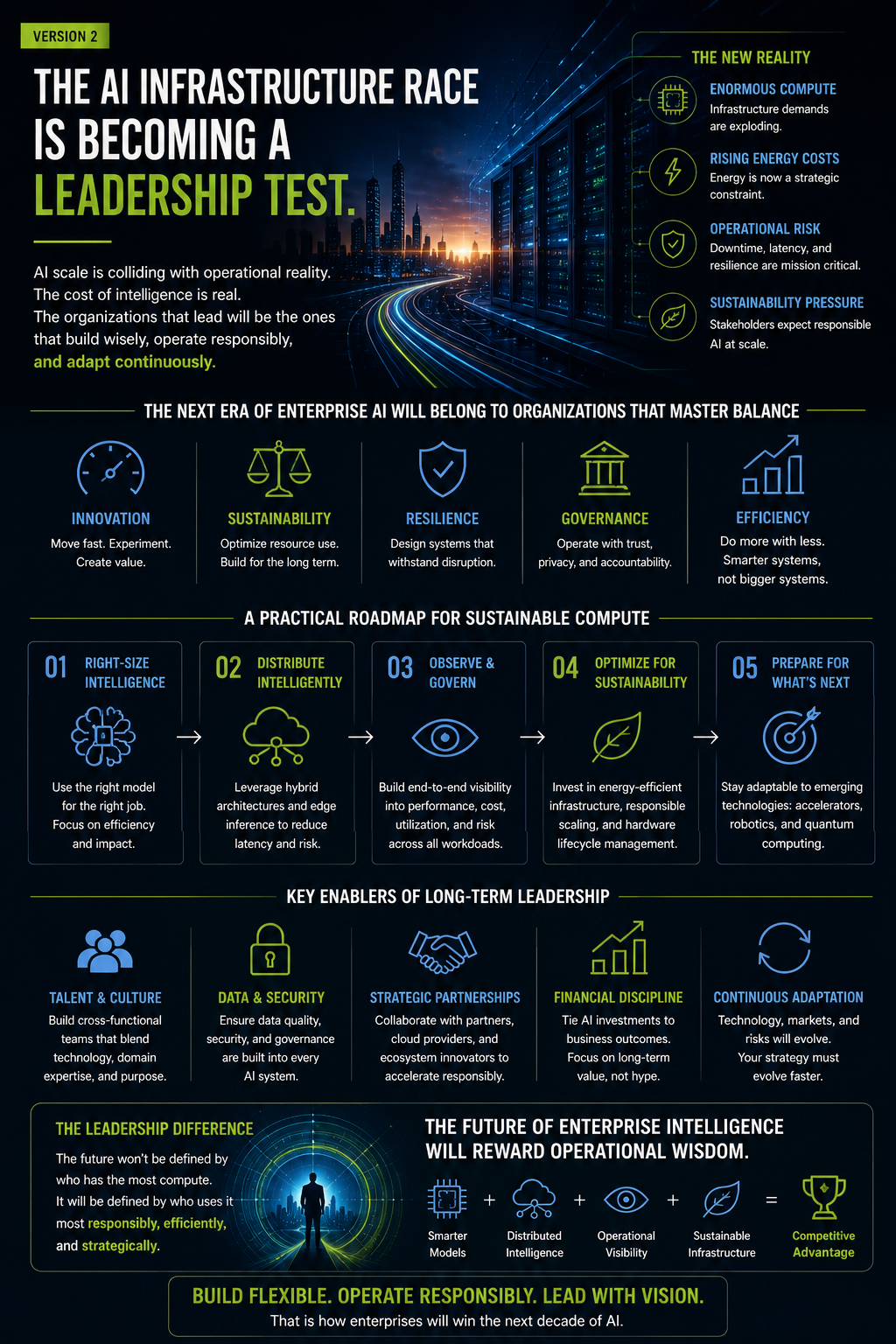
The enterprise AI race is no longer just about experimentation. It is becoming an infrastructure race, an energy race, a resilience race, and increasingly, a leadership test.
Across industries, organizations are deploying AI at extraordinary speed. Boards want AI strategies. Investors want AI narratives. Executives want operational efficiency and competitive differentiation. Technology teams are scaling compute infrastructure aggressively to keep pace with growing demand. But beneath the momentum lies a more difficult question many organizations are only beginning to confront: What happens when AI scale collides with operational reality?
The modern AI economy runs on enormous computational infrastructure. Data centers, GPUs, edge systems, networking environments, cooling technologies, and energy supply chains are becoming foundational components of competitive strategy. The cost of intelligence is no longer theoretical. It is operational, and it is growing. This creates a strategic challenge that goes far beyond technology selection.
Enterprises must now determine how to balance innovation with sustainability, speed with resilience, and capability expansion with long-term operational economics. Organizations pursuing AI growth without infrastructure discipline may eventually find themselves trapped inside increasingly expensive, energy-intensive operating models. This is why the next phase of enterprise AI may look very different from the first.
The future is unlikely to belong exclusively to organizations pursuing unlimited compute expansion. Instead, competitive advantage may increasingly come from efficiency: right-sized models, distributed intelligence, edge processing, optimized infrastructure, and adaptive compute strategies. In other words: smarter systems, not simply bigger systems. This shift is already happening.
Enterprises are beginning to adopt hybrid architectures that combine centralized cloud orchestration with localized edge inference. Smaller specialized models are proving capable of solving targeted business problems with dramatically lower infrastructure requirements. Observability and operational governance are becoming critical because leaders need visibility into how intelligent systems consume resources, create value, and introduce risk.
Meanwhile, emerging technologies continue to reshape the horizon. AI accelerators are evolving rapidly. Energy constraints are becoming strategic concerns. Robotics is increasing demand for real-time edge intelligence. Quantum computing may eventually redefine computational efficiency itself.
This means enterprise leaders are no longer simply planning technology investments. They are planning for uncertainty. The organizations most prepared for the future may not be the ones making the largest infrastructure bets today. They may be the companies building flexible operational models capable of adapting as compute economics, AI architectures, and infrastructure realities evolve.
That distinction matters because the next decade of AI transformation may not reward scale alone. It may reward operational wisdom. The future of enterprise intelligence will not be determined solely by how much compute organizations control. It may be determined by how responsibly, efficiently, and strategically they deploy it.