
Organizational Design for AI: Teams, Practices, Portfolio Model by Mark Hewitt
Enterprise AI adoption is accelerating. Most organizations now have a mix of pilots, production use cases, and early experiments with agents. Many have selected platforms, signed vendor contracts, and initiated AI enablement programs.
Yet most enterprises struggle to scale AI beyond pockets of success. The reason is not model capability. The reason is organizational design. AI scale is not a technology problem alone. It is an operating model problem. AI touches multiple domains simultaneously. Data, systems, security, governance, delivery workflows, customer experience, and compliance are all implicated. If the enterprise does not design teams, practices, and portfolio governance intentionally, AI becomes fragmented. Progress becomes inconsistent. Risk becomes uneven. Cost rises.
The enterprises that win will not be those with the most tools. They will be those with the clearest AI operating model.
Why AI Scale Creates Organizational Failure Modes
Enterprises experience four predictable failure modes when AI adoption grows without organizational design.
Tool sprawl. Different business units adopt different tools, vendors, copilots, and agent frameworks. Over time, integration becomes difficult and cost rises.
Inconsistent governance. Policies exist, but enforcement varies by team. Some systems are monitored and auditable. Others are not. Risk becomes uneven.
Confused ownership. When AI-enabled workflows fail, no one owns the outcome. Business blames technology. Technology blames data. Compliance blames lack of process. Accountability erodes.
Duplication and waste. Teams build similar capabilities independently. Data pipelines are repeated. Prompt libraries diverge. Monitoring standards vary. The enterprise pays repeatedly for the same work.
These are not technical failures. They are organizational failures. AI needs a deliberate structure that prevents these patterns and enables repeatable delivery with governance.
The Executive Goal: An AI Operating Model
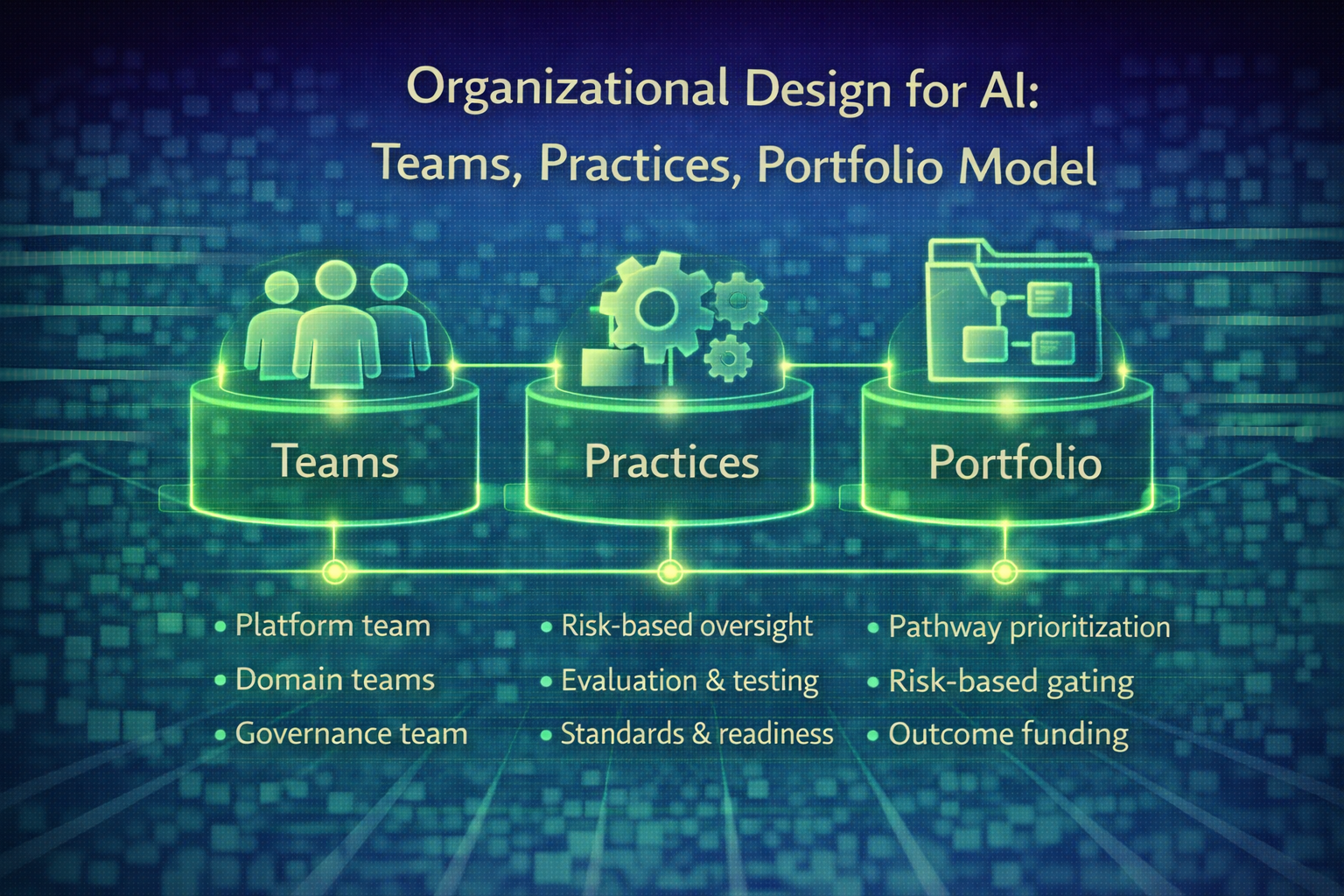
Executives should treat AI as a capability that must be built into the enterprise operating model. This operating model has three parts:
teams and responsibilities
practices and standards
portfolio governance
When these are designed deliberately, scaling becomes manageable. When they are not, scaling becomes chaotic.
Part 1: Teams and Responsibilities
A clear ownership model is the foundation of AI scale. Enterprises need a team structure that balances central enablement with distributed innovation. A practical model includes four key components.
1. An AI Platform and Enablement Team
This team owns shared capabilities.
approved tools, platforms, and patterns
identity and access models for AI and agents
shared libraries and templates
evaluation and testing frameworks
runtime monitoring and evidence capture systems
standards for prompts, retrieval, and agent workflows
developer experience and onboarding
This team reduces duplication and ensures consistency. It should not build every use case. It should make it easier for others to build use cases correctly.
2. Domain Product and Delivery Teams
These teams build AI-enabled workflows in business units.
customer experience workflows
finance and operations workflows
compliance workflows
engineering workflows
sales and revenue workflows
These teams own outcomes and adoption in their domain. They should work within enterprise standards and governance controls. They are the drivers of business value.
3. A Governance and Risk Function
This function ensures enterprise-level oversight.
policy definition
risk tiering and oversight models
compliance requirements
audit readiness expectations
model risk management requirements
escalation pathways
exception handling and approval boards for high-risk workflows
This function must work closely with the platform team and domain teams. Governance that is separated from engineering and operations becomes slow and ineffective.
4. Data and Architecture Stewardship
AI success depends on data trust and system integrity.
Data governance and architecture stewardship must be aligned to AI adoption. This includes:
authoritative sources and data definitions
lineage and metadata standards
quality measurement and drift detection
secure retrieval and classification
dependency mapping for critical pathways
Enterprises that separate AI initiatives from data and architecture realities will struggle to scale.
Part 2: Practices and Standards
AI cannot scale without repeatable practices. Executives should expect the enterprise to standardize around practices that make AI reliable, governable, and secure. Key practices include:
1. Risk-tiered oversight models
Every AI workflow should be assigned to an oversight tier:
human-in-the-loop
human-on-the-loop
human-out-of-the-loop
This ensures consistent governance and avoids ad hoc decisions.
2. Standardized evaluation and testing
AI needs testing that reflects real workflows. Standards should include:
regression testing for prompt and model updates
evaluation sets tied to domain use cases
adversarial testing for safety and injection
bias and fairness evaluation where relevant
performance and reliability testing under load
3. Standardized observability and evidence capture
Executives should require every AI system to produce:
traceability of decisions and actions
data sources and retrieval context
tool usage logs for agent workflows
confidence thresholds and escalation events
audit evidence automatically
This makes governance scalable and reduces manual compliance overhead.
4. Prompt, retrieval, and agent design standards
Without standards, every team builds differently. Risk increases and reuse declines. Standards should include:
prompt libraries and version control
retrieval sourcing and classification rules
tool allowlists and permission boundaries
action constraints and prohibited operations
kill-switch and rollback mechanisms
5. Operational readiness and incident response
AI systems must have operational ownership and incident response playbooks. AI failures are production failures. They require:
monitoring
escalation thresholds
rollback capability
post-incident remediation processes
AI cannot scale without operational discipline.
Part 3: Portfolio Model
AI scale requires enterprise prioritization. Many enterprises allow AI initiatives to spread through enthusiasm. Teams build what they want. Pilots grow without strategic sequencing. Resources spread thin. Results become inconsistent. Executives should instead create an AI portfolio model, similar to an investment portfolio. A practical portfolio model includes:
1. Pathway-based prioritization
Prioritize AI use cases by enterprise pathways:
revenue and customer pathways
operational continuity pathways
compliance and risk pathways
workforce productivity pathways
This ensures AI investment aligns to critical enterprise outcomes.
2. Risk-based gating
High-risk AI workflows require stronger governance and slower expansion. Low-risk workflows can scale more quickly. Risk-based gating prevents uncontrolled autonomy.
3. Standard adoption patterns
Use cases should be delivered through repeatable patterns and templates. This reduces cost and increases reliability.
4. Outcome-based funding
Fund AI initiatives based on measurable outcomes, not experimentation volume. Tie funding to operational, financial, and talent metrics.
5. Executive scorecard reporting
Executives should review:
value delivered by workflow category
governance coverage and risk tier distribution
drift and reliability indicators
adoption trends
operational impact and cost savings
talent impact and toil reduction
This turns AI adoption into an executive-managed capability rather than an uncontrolled trend.
The Executive Principle: Centralize Standards, Decentralize Value
The most successful AI operating models follow one principle: Centralize standards and governance. Decentralize value creation. Central teams define controls, patterns, and platform capabilities. Domain teams deliver outcomes using those standards. This structure prevents fragmentation while enabling innovation.
Take Aways
AI will not scale through tools alone. It scales through organizational design. Enterprises that treat AI adoption as a technology rollout will experience tool sprawl, inconsistent governance, unclear ownership, and duplicated effort. Enterprises that design teams, practices, and portfolio governance deliberately will scale AI with control, trust, and measurable outcomes.
Organizational design is the differentiator. The question is not whether you have adopted AI. The question is whether your organization is designed to scale it responsibly.