
Human-on-the-Loop: How Executives Maintain Control at Scale by Mark Hewitt
As enterprise AI adoption accelerates, leaders are facing a new reality. AI systems are beginning to operate at a speed and scale that cannot be governed through manual approvals alone.
Human-in-the-loop oversight is essential for high-risk workflows. It ensures accountability and prevents catastrophic error. But it does not scale indefinitely. If every AI-enabled action requires human approval, productivity gains disappear and operations slow down. This creates a tension that executives must resolve, namely “How do enterprises scale AI without losing control?”
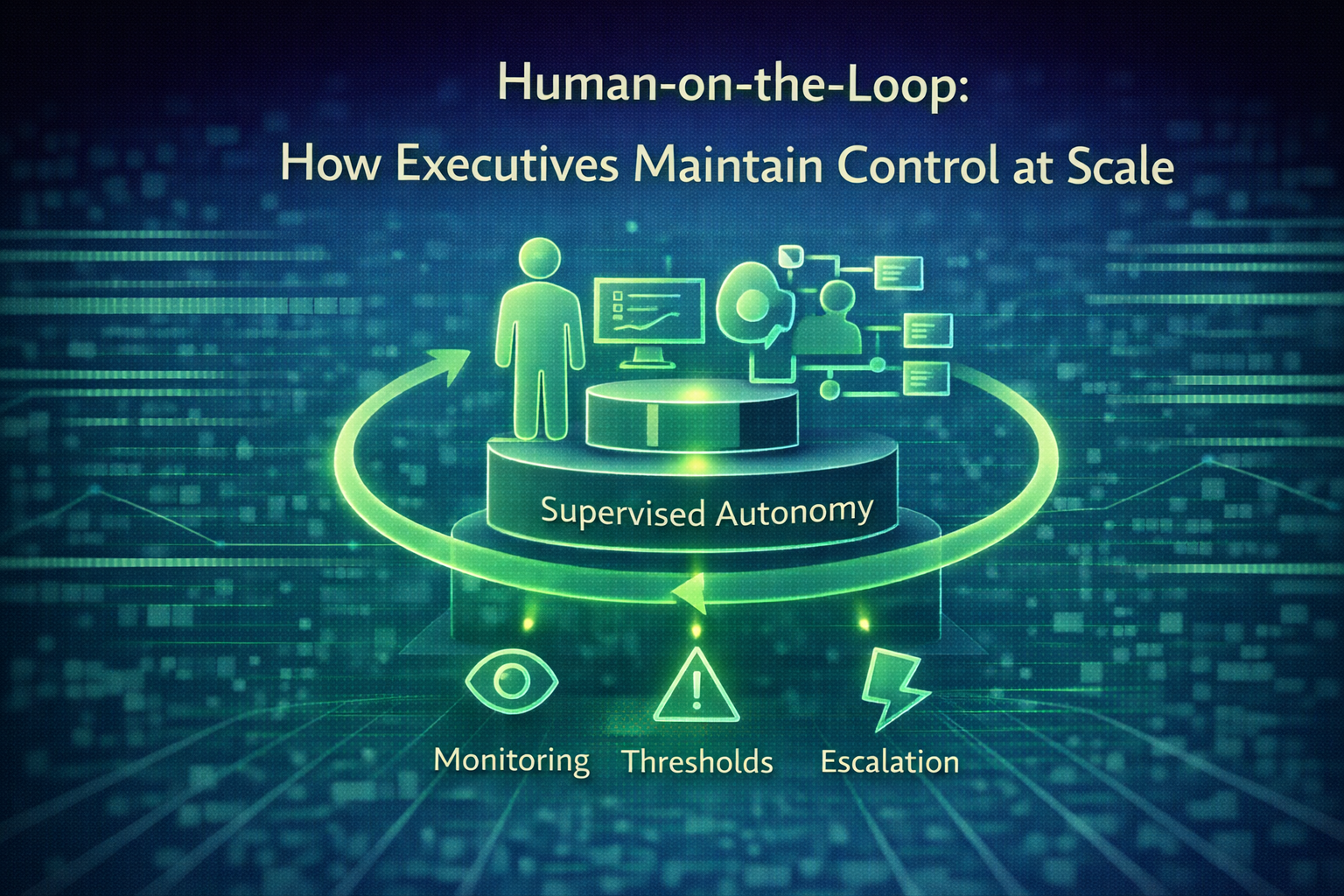
The answer is a governance model that sits between manual approval and full autonomy: Human-on-the-loop. Human-on-the-loop is the operating model of supervised autonomy. AI systems operate within defined boundaries, while humans supervise performance, monitor thresholds, review exceptions, and intervene when risk increases. This will become one of the most important governance patterns for scaling agentic systems responsibly.
The Problem: Manual Oversight Does Not Scale
Many enterprises begin AI adoption with a sensible approach. Humans approve key actions, validate outputs, and correct errors. This creates safety and trust. Then adoption expands. As AI systems are embedded across workflows, the volume of actions increases. In agentic AI, those actions can chain together across tools and systems. If humans are required to approve each step, the enterprise creates friction and bottlenecks. The organization becomes trapped between two undesirable outcomes:
slow down AI usage and lose value
allow autonomy without sufficient control and increase risk
Human-on-the-loop is the practical middle path. It allows AI to operate at speed, while ensuring the enterprise remains accountable and governable.
What Human-on-the-Loop Means in Practice
Human-on-the-loop means AI systems can act autonomously within defined limits, while humans supervise through continuous monitoring and intervene through escalation triggers. The model depends on four conditions.
Clear boundaries. AI is permitted to operate only within defined workflows and authority levels.
Continuous observability The enterprise can see what the AI is doing, what data it is using, and how outcomes are trending.
Defined thresholds and triggers. The system escalates to humans when confidence drops, risk increases, or anomalies appear.
Accountable ownership. Humans remain accountable for outcomes and for managing the system’s behavior over time.
This model is not passive. It requires real operating discipline. It is supervision by design.
The Executive Value: Control Without Bottlenecks
Human-on-the-loop creates value in three ways.
1. It preserves speed
AI can operate without constant human interruption, enabling productivity and cycle-time gains.
2. It preserves control
Humans remain responsible and can intervene before errors become disruptive.
3. It creates measurable governance
The enterprise can track exceptions, drift, and behavior trends, strengthening auditability and risk management.
This model delivers the core outcome executives need: Scalable AI with accountability.
When Human-on-the-Loop Is the Right Choice
Executives should apply human-on-the-loop to workflows that are meaningful but not catastrophic if an error occurs, and where errors can be detected quickly and corrected easily. Common examples include:
triaging and routing service tickets
summarizing operational reports
drafting internal communications
recommending remediation steps for incidents
monitoring system behavior and suggesting actions
detecting anomalies in logs and telemetry
generating compliance evidence and mapping artifacts
preparing financial or operational analysis for human review
coordinating internal workflows where final action remains controlled
The model is especially effective when AI actions are frequent but low to medium risk, and where human attention is best applied to exceptions rather than routine steps.
When Human-on-the-Loop Is Not Enough
Executives should also be clear about when human-on-the-loop is insufficient. High-risk workflows require human-in-the-loop approval. Examples include:
modifying production configurations
changing access controls and permissions
executing financial transactions
publishing customer-facing outputs without review
initiating high-impact operational processes
interacting with regulated decision workflows
executing actions with large blast radius potential
Human-on-the-loop is a scaling model. It is not a substitute for control where the cost of error is high.
The System Requirements That Make Human-on-the-Loop Work
Human-on-the-loop is only as strong as the enterprise’s ability to observe and intervene. Executives should insist on six system requirements.
1. Telemetry and traceability
The system must log:
decisions and actions
data sources and retrieval context
tool calls and sequence of actions
confidence signals and thresholds
exceptions and escalation events
Without traceability, the enterprise cannot supervise reliably.
2. Confidence scoring and uncertainty detection
AI systems should provide measurable indicators of confidence and risk. Low confidence should trigger escalation.
3. Drift detection
Outputs degrade over time as data and conditions change. Drift must be monitored continuously and remediated quickly.
4. Guardrails and policy enforcement
AI systems must operate within enforced boundaries, including access controls, action constraints, and prohibited operations.
5. Intervention mechanisms
Executives should require operational controls such as:
pause and rollback capability
kill-switches for agent workflows
staged rollout and throttling
escalation channels tied to ownership
6. Ownership and on-call readiness
Supervision requires humans who are responsible for intervention. If no one is accountable, the model fails. These requirements are why engineering intelligence matters. Engineering intelligence provides the observability and governance layer that makes human-on-the-loop feasible.
The Executive Governance Model: Three Tiers
A useful executive model is to define oversight as three tiers, applied consistently across the portfolio of AI use cases.
Human-in-the-loop. High-risk actions require approval.
Human-on-the-loop. Medium-risk actions operate autonomously with supervision and escalation.
Human-out-of-the-loop. Low-risk actions operate autonomously with minimal oversight, appropriate only where errors are easily reversible and contained.
Executives should require every AI-enabled workflow to be assigned to one of these tiers. This ensures consistency across the enterprise and prevents ungoverned autonomy from emerging informally.
A Practical Implementation Path
Executives can implement human-on-the-loop supervision through a structured sequence.
Identify candidate workflows. Choose high-frequency workflows where automation delivers value and risk is manageable.
Define boundaries and authority. Clarify what the system can do autonomously and what requires escalation.
Build monitoring and thresholds. Define the telemetry, confidence triggers, and drift indicators that drive intervention.
Establish accountable ownership. Assign operational responsibility and define response expectations.
Scale through measured expansion. Increase autonomy only when reliability and governance effectiveness are proven.
This approach ensures supervision is deliberate rather than reactive.
Take Aways
Enterprise AI will not scale through manual approvals alone. It also cannot scale through autonomy without control.
Human-on-the-loop is the operating model that resolves this tension. It enables supervised autonomy, preserving speed while maintaining accountability and governance.
The enterprises that succeed will not be those that automate the most. They will be those that maintain control while scaling intelligence.
Human-on-the-loop is how leaders do that.