
CEO Corner: Governance and Trust: Building the Guardrails for Enterprise AI (part 9 of 10 in the series) by Mark Hewitt
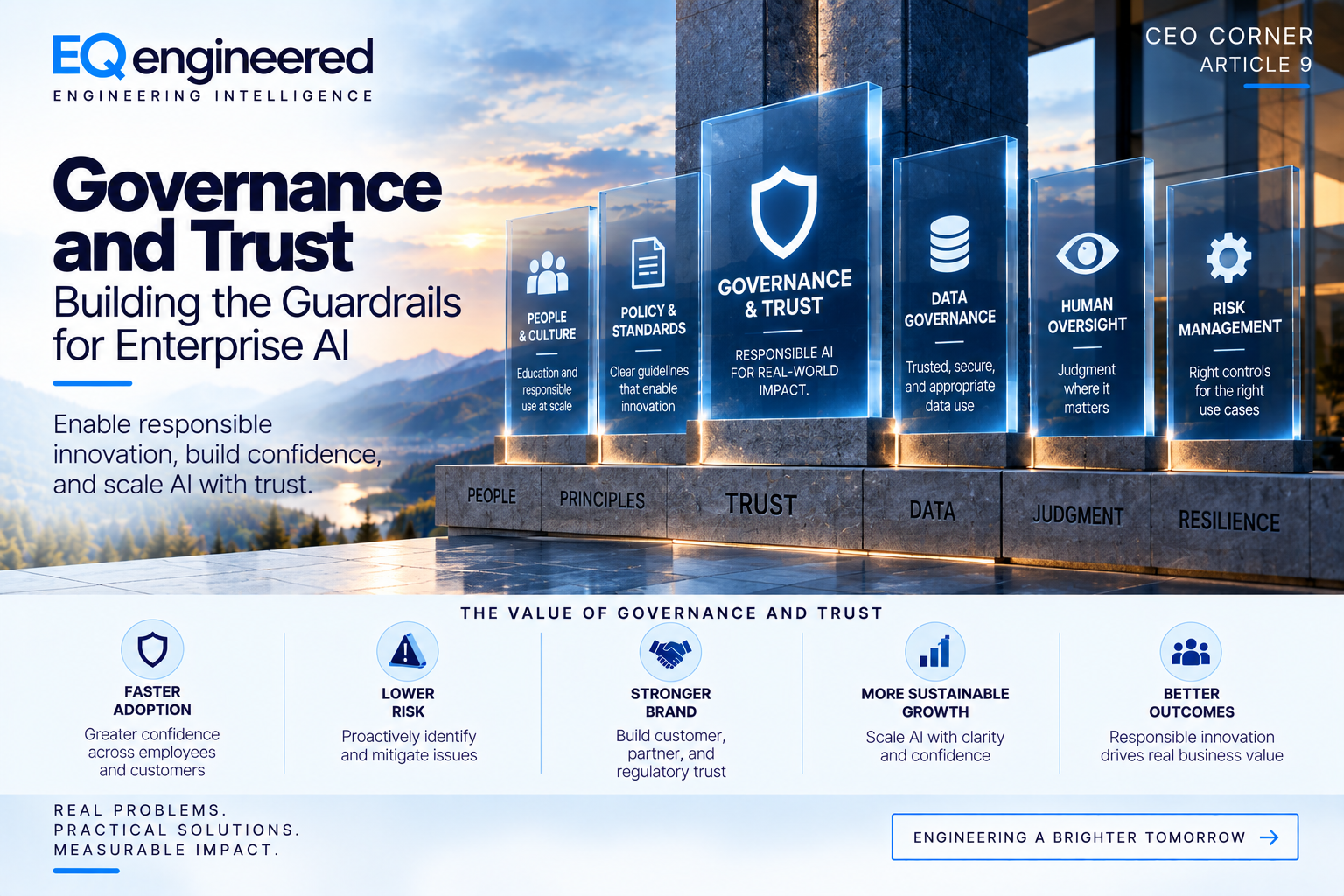
As artificial intelligence becomes more deeply embedded in enterprise operations, the conversation around governance is becoming increasingly important. Organizations are moving beyond experimentation and beginning to deploy AI into workflows that affect customers, employees, business decisions, and critical systems. With that evolution comes a greater responsibility to understand not only what AI can do, but how it should be used, who is accountable for its outcomes, and what safeguards need to be in place.
I believe one of the most important distinctions organizations need to make is that governance should not be viewed as something that slows innovation. Done well, governance creates the confidence required to innovate responsibly and at scale. At EQengineered, we have made Governance and Trust a foundational capability within our Enterprise AI Operating System, not a separate activity performed after a solution has been designed or deployed. Our thinking is straightforward: if an organization intends to make AI part of how its business operates, trust must be engineered into the system from the beginning.
Governance Should Enable Innovation
For many organizations, governance has traditionally been associated with policies, approvals, compliance reviews, and restrictions. Those activities have an important place, particularly in regulated industries, but they represent only part of what effective governance should accomplish. The larger objective is to establish an environment where people understand how to use AI responsibly, which technologies and data they can work with, what decisions require human involvement, and how risks are evaluated and managed. When those expectations are clear, teams can move forward with greater confidence rather than navigating uncertainty with every new initiative.
Without a coherent governance framework, organizations often experience one of two outcomes:
Innovation slows because teams are unsure what is permitted, or
Experimentation moves ahead independently without consistent standards, visibility, or accountability.
Neither approach creates the foundation for sustainable enterprise adoption Effective governance provides a third path. It establishes practical guardrails that allow innovation to proceed while protecting the interests of the business, its customers, its employees, and other stakeholders.
Trust Must Be Designed Into the Operating Model
One of the reasons we developed the Enterprise AI Operating System was to connect capabilities that are too often treated independently. Strategy, workforce readiness, engineering execution, operations, institutional knowledge, and measurable business outcomes all influence one another. Governance needs to operate across those same dimensions.
Within Engineering Intelligence Strategy, governance begins by helping leaders determine which opportunities are appropriate, what risks they introduce, and what organizational principles should guide investment decisions. During Engineering Intelligence Catalyst, employees and leaders develop the understanding necessary to use AI responsibly and recognize its limitations. Through Engineering Intelligence Compass, governance becomes part of architecture, requirements, development, testing, deployment, and continuous improvement.
Once an AI capability enters production, governance continues through monitoring, operational controls, incident management, and human oversight. Lessons from those experiences should then strengthen the Engineering Intelligence Knowledge System, allowing effective practices to become reusable organizational assets. This is an important shift in perspective. Governance is not a checkpoint that an AI initiative passes before moving forward. It is an ongoing capability that evolves alongside the technology, the organization, and the business environment.
Not Every AI Application Carries the Same Risk
As enterprise AI adoption expands, organizations will need to become more sophisticated in how they evaluate and manage risk. Applying the same level of oversight to every AI application is neither practical nor necessary. An AI capability that helps an employee summarize internal meeting notes presents a very different risk profile from a system that influences financial decisions, handles sensitive customer information, or autonomously takes actions across enterprise applications. The appropriate governance model should reflect those differences.
Risk considerations may include the sensitivity of the information involved, the consequences of an incorrect output, the degree of autonomy granted to the system, the potential impact on customers or employees, and the ability to detect and reverse an undesirable action. For lower-risk applications, governance may involve approved tools, basic usage policies, access controls, and employee training. For more consequential systems, organizations may need formal validation, stronger security controls, documented decision authority, auditability, continuous monitoring, and explicit human approval requirements. The objective is not to create unnecessary complexity. It is to apply the right level of discipline to the right business problem.
Governance Is More Than a Policy Document
One of the challenges organizations face is the assumption that AI governance can be addressed primarily through the creation of policies and standards. Those documents are necessary, but their existence does not guarantee that responsible practices are being followed. Governance becomes meaningful when it is reflected in how work actually gets done. That means incorporating security and privacy considerations into architecture, defining appropriate access to enterprise data, establishing testing and validation practices, documenting decision responsibilities, and creating mechanisms for identifying and responding to unexpected behavior. It also means preparing employees to recognize situations where AI output should be questioned, verified, or escalated. As AI becomes part of everyday workflows, responsible use cannot depend exclusively on a centralized governance team. It must become part of the organization's operating culture. This is where technology, process, and people come together. A governance framework is only as effective as the organizational behaviors and engineering practices that support it.
Data Governance and AI Governance Are Inseparable
The quality and trustworthiness of enterprise AI depend heavily on the information those systems use. Organizations have spent years developing practices around data quality, access, classification, privacy, security, and stewardship. AI does not eliminate the need for those disciplines. In many cases, it makes them more important. An AI application may generate a convincing response while relying on incomplete, outdated, or improperly accessed information. A retrieval system may surface documents that a particular user should not be permitted to see. An agent may combine information from multiple systems in ways that introduce new security or privacy considerations. These challenges reinforce the importance of understanding where data originates, who owns it, how it is accessed, and whether it is appropriate for the intended use. For executives, this also means recognizing that AI readiness is closely connected to the maturity of the organization's existing data practices. Investments in data architecture, governance, and quality are not separate from an AI strategy. They are often prerequisites for making that strategy successful.
Human Oversight Needs to Be Intentional
Human oversight is frequently described as a fundamental principle of responsible AI. I agree with that principle, but I also believe organizations need to be more deliberate about what it means in practice. Simply placing a human somewhere in a workflow does not necessarily create meaningful oversight. The organization needs to determine which decisions require human judgment, what information the individual needs to make an informed assessment, when intervention should occur, and who is accountable for the outcome.
In some situations, human review may be required before an AI-generated recommendation is acted upon. In others, automated processes may operate within established boundaries, with human intervention triggered when exceptions, uncertainty, or elevated risks arise. The appropriate approach depends on the nature of the workflow and the consequences of getting it wrong. The goal should be to combine the speed and scalability of AI with the judgment, accountability, and contextual understanding that people provide. Done thoughtfully, this creates a stronger operating model than either unrestricted automation or unnecessary manual intervention.
Agentic AI Raises the Stakes
The emergence of agentic AI makes governance even more consequential. There is an important difference between an AI system that generates information and one that can independently interact with applications, invoke tools, retrieve data, execute transactions, or initiate actions within a business process. As organizations introduce greater autonomy, they also introduce new questions around identity, permissions, accountability, auditability, and operational control.
What is an agent authorized to do?
Which systems and information can it access?
What happens when it encounters a situation outside its intended scope?
How are its actions recorded?
When must it request human approval?
How can the organization stop or reverse an action if something goes wrong?
These are not simply technology questions. They are questions about enterprise authority, responsibility, and risk. Organizations will need to establish clear boundaries for autonomous systems and ensure those boundaries are enforced through architecture, engineering practices, operational monitoring, and governance controls. As AI becomes more capable, the importance of designing trust into the operating model will only increase.
Governance Must Continue After Deployment
A recurring theme throughout this series is that deploying an AI capability is not the end of the journey. It is the beginning of operating that capability in the real world. The same principle applies to governance. Models change, data evolves, employees discover new ways to use systems, and business requirements shift. Risks that were not apparent during development may become visible only after an application has been operating for some time.
Organizations therefore need mechanisms to reassess risks, evaluate incidents, monitor system behavior, update controls, and incorporate lessons learned. This is one of the reasons AI Operations and Governance and Trust are closely connected within our Enterprise AI Operating System. Operational evidence should inform governance decisions, and governance requirements should shape how AI systems are operated. Over time, this relationship creates a more mature and responsive approach to managing enterprise AI.
Make Governance Part of Institutional Knowledge
At EQengineered, we believe every engagement should contribute to the organization's ability to execute the next one more effectively. That principle applies to governance as much as it does to engineering. When teams develop effective security patterns, responsible AI practices, review processes, testing methods, monitoring approaches, or governance controls, those lessons should become part of the Engineering Intelligence Knowledge System. Rather than repeatedly solving the same governance challenges, organizations can build upon proven approaches. Teams gain access to reusable reference architectures, policies, checklists, runbooks, and implementation patterns that help them work more consistently and efficiently.
This is another way enterprise AI capability compounds. As organizational experience grows, governance can become more effective without necessarily becoming more burdensome. The organization develops greater clarity about which risks matter, which controls work, and how to support innovation responsibly.
Trust Is a Business Requirement
Ultimately, governance and trust are not simply matters of regulatory compliance or technical risk management. They are business requirements. Customers need confidence that their information is protected and that AI-enabled interactions are reliable. Employees need confidence that the systems they use are appropriate, understandable, and supported by clear expectations. Executives need confidence that AI investments are creating value without introducing unacceptable risk. Without that confidence, adoption becomes difficult, investment decisions become harder, and the organization's ability to scale AI is constrained. With it, organizations can move forward more decisively.
I believe the enterprises that succeed with AI will be those that recognize governance as an integral part of innovation, not a competing priority. They will develop operating models that connect strategy, people, engineering, operations, and institutional knowledge with clear accountability and practical safeguards. They will also understand that trust is not something an organization establishes once and then assumes will endure. It must be earned, demonstrated, monitored, and continually reinforced.
The objective is not to eliminate every possible risk or create a perfect governance framework before moving forward. It is to build the organizational capability to innovate responsibly, learn continuously, and scale with confidence. The purpose of governance is not to prevent innovation, but rather to make responsible innovation possible at enterprise scale.